
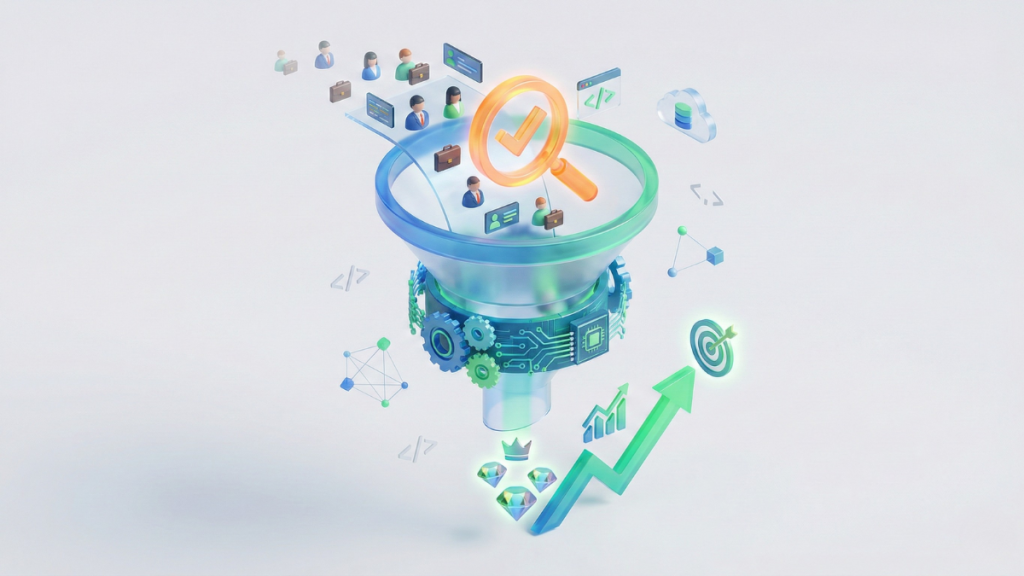
Scaling B2B lead generation often breaks what works. Volume increases, but quality collapses. Sustainable growth requires scaling systems, not channels, inside a [scalable B2B lead generation system] designed to protect intent at every stage.
Why scaling usually destroys lead quality
Most teams scale by:
- Adding channels without redefining qualification
- Increasing budgets without tightening controls
- Automating processes that were never stable
This creates funnel inflation and erodes trust, especially when B2B lead quality measurement is missing.
What scalable B2B growth actually looks like
True scalability means:
- Qualification rules stay stable
- Conversion rates remain predictable
- Sales effort scales linearly, not exponentially
This only happens when growth is constrained by B2B funnel alignment, not traffic volume.
Systems that must scale first
Before increasing acquisition, these layers must be solid:
- Lead definition and scoring logic
- SEO pages designed to qualify
- Lead magnets mapped to intent
- Recycling rules for mis-timed leads
Together, they form the backbone of a B2B lead generation funnel that scales without noise.
How to increase volume safely
Once the system is stable:
- Expand keyword coverage, not intent scope
- Replicate high performing pages, not experiments
- Scale budgets only on segments that convert
This approach preserves performance inside a scalable B2B lead generation system.
The role of constraints in scalable growth
Constraints are not blockers they are safeguards.
Clear limits on:
- Who can enter the funnel
- How leads progress
- When sales engages
These constraints ensure that scaling strengthens not weakens qualified B2B lead definition.
B2B lead generation scales when structure comes before speed.
If quality drops during growth, the problem is not scale it’s the system underneath.