What are the best SEO audit tools?
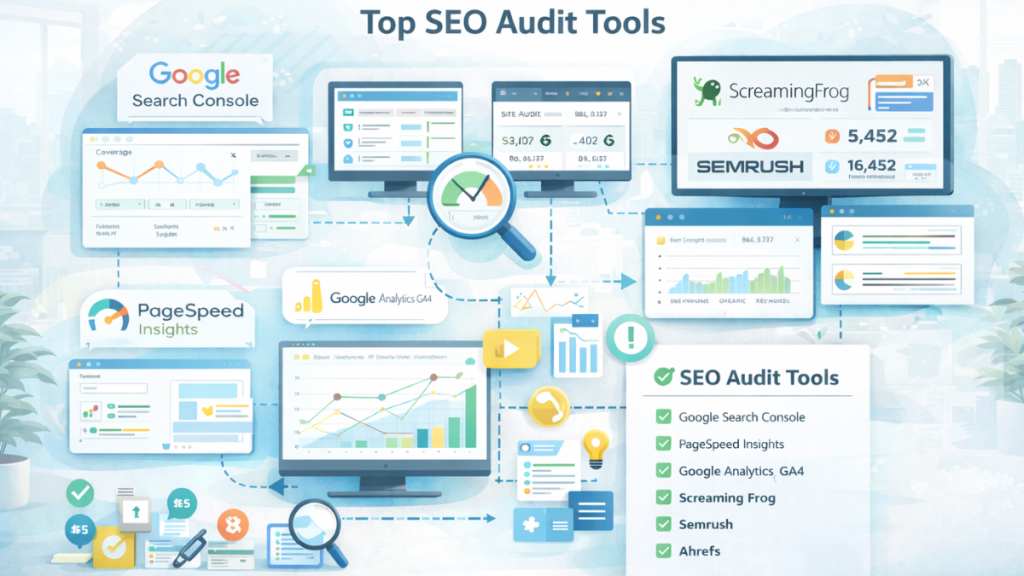
The best SEO audit tools are those that help you evaluate technical performance, content quality, indexing issues, and backlink risks with precision. They simplify large-scale analysis and provide actionable insights that guide strategic decisions. These tools support the broader approach outlined in our SEO audit and competitive analysis hub, ensuring your audits remain comprehensive and data-driven.
Why are SEO audit tools essential?
SEO audit tools are essential because manual audits are slow, incomplete, and often inaccurate. Tools reveal patterns you would otherwise miss—crawl issues, toxic links, content decay, Core Web Vitals, and competitive gaps. Experience shows that businesses using a consistent toolset scale faster, fix issues sooner, and maintain stronger performance during algorithmic changes.
Free SEO audit tools (high value options)
How to use google search console for SEO audits?
Google Search Console (GSC) is the foundational tool for understanding how Google views your site.
Key features for audits:
- Coverage report (indexing errors, excluded pages)
- Page Experience & Core Web Vitals
- Performance reports (queries, pages, CTR, impressions)
- Sitemaps validation
- Manual actions & security issues
Why it matters:
GSC provides direct insights from Google, making it essential for diagnosing crawlability, indexing, and performance issues.
How can pagespeed insights help audit performance?
PageSpeed Insights (PSI) measures Core Web Vitals using field data (CrUX) and lab data (Lighthouse).
Audit focus:
- LCP (Largest Contentful Paint)
- CLS (Cumulative Layout Shift)
- INP (Interaction to Next Paint)
- Opportunities to reduce JavaScript
- Image optimization suggestions
Experience shows that improving CWV correlates strongly with better mobile rankings and user engagement.
How does google analytics support content audits?
Google Analytics (GA4) helps identify behavioral issues that affect SEO.
Use GA4 for:
- Engagement metrics
- Bounce & exit pages
- Pages generating conversions
- Declining performance trends
- Internal search insights
GA4 does not measure rankings, but it reveals how users interact with your content—critical for aligning with search intent.
Paid SEO audit tools (professional grade options)
How to use screaming frog for technical audits?
Screaming Frog is one of the most powerful crawling tools on the market.
What it detects:
- Broken links (4xx / 5xx)
- Redirect chains
- Missing meta tags
- Duplicate content
- Orphan pages
- Canonical inconsistencies
- JavaScript rendering issues
Why experts rely on it:
It replicates how a search engine crawls your site, making it essential for assessing technical architecture.
It integrates naturally with insights covered in the Technical SEO Audit satellite.
How to use semrush for comprehensive SEO analysis?
Semrush is a full-suite SEO platform offering detailed audits, keyword research, competitive insights, and link intelligence.
Audit features:
- Site Audit (crawl issues, HTTPS, CWV, hreflang)
- Keyword opportunities & cannibalization
- Backlink analytics
- Toxic link detection
- Organic & paid competitive insights
Strengths:
Semrush is trusted for its accuracy, depth of reporting, and user-friendly dashboards—ideal for businesses needing fast, reliable decision-making.
How to use ahrefs for backlink and keyword audits?
Ahrefs is the industry leader in backlink intelligence.
Ahrefs excels at:
- Backlink quality evaluation
- Anchor text auditing
- Lost & broken link recovery
- Link gap vs competitors
- Content gap opportunities
- SERP history tracking
Experience shows that Ahrefs’ backlink database often detects risks earlier than other tools, making it essential for off-page audits and strengthening findings from the Backlink Audit satellite.
How do sitebulb and deepcrawl support enterprise audits?
Sitebulb and DeepCrawl are advanced crawling solutions for larger websites.
Key advantages:
- Visual crawl maps
- Automated prioritization
- Advanced rendering analysis
- Multi-domain reporting
- Team collaboration features
These tools are ideal for agencies, SaaS platforms, and large B2B companies with complex architectures.
How to build the ideal SEO audit tool stack?
A strong audit stack typically combines:
1. One crawler
Screaming Frog or Sitebulb
technical structure, status codes, site architecture
2. One backlink intelligence tool
Ahrefs or Semrush
authority, toxic links, opportunities
3. One performance tool
PageSpeed Insights or Lighthouse
Core Web Vitals, performance optimization
4. One behavior analytics tool
GA4
engagement, conversions, behavior signals
5. One first-party source
Google Search Console
crawling, indexing, impressions, CTR, errors
This toolkit covers 100% of the audit requirements described in the broader cluster.
How to use audit tools without over relying on them?
Tools guide your decisions—but should not replace human judgment.
Avoid:
- Blindly trusting toxicity or priority scores
- Making decisions based only on crawl data
- Misinterpreting correlation as causation
- Ignoring business context
- Assuming all issues have equal impact
Experience shows that the most successful companies combine tool data with expert evaluation, business insights, and competitor intelligence.
The right SEO audit tools empower you to uncover issues quickly and make smarter optimization decisions. When used strategically, they reinforce all pillars of your SEO audits—technical, content, backlinks, and competitive landscape.