
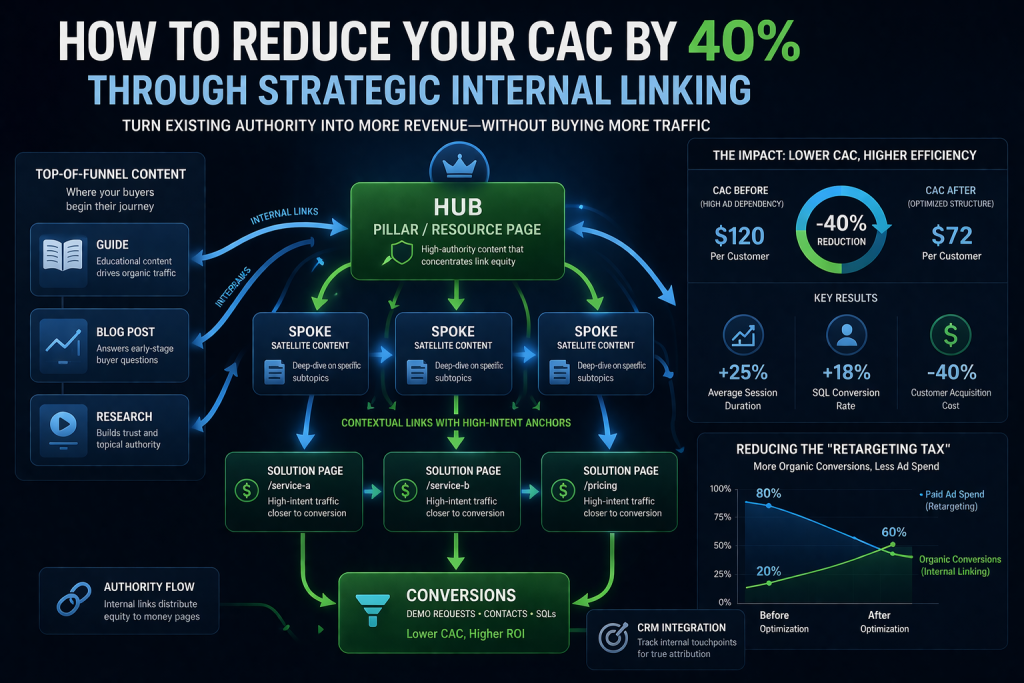
In the aggressive landscape of B2B customer acquisition, the Customer Acquisition Cost (CAC) is often inflated by a disproportionate reliance on external traffic sources. Most organizations view internal linking as a secondary SEO task—a “nice-to-have” for crawlability. From the perspective of a Performance Analyst, this is a profound strategic error. Strategic internal linking is, in reality, a high-efficiency authority distribution infrastructure.
When executed with surgical precision, a robust internal linking architecture allows a brand to bypass the “Paid Media Toll” by funneling existing organic equity directly into high-conversion “Money Pages.” By transforming a flat site structure into a multi-layered conversion engine, B2B firms can achieve a blended CAC reduction of up to 40%. This is not achieved through more traffic, but through the superior utilization of the authority already present within the ecosystem.
The Efficiency Ratio: Internal linking as a non-linear CAC lever
To understand how internal links impact the bottom line, we must move beyond the concept of “Link Juice” and adopt the Efficiency Ratio metric. In a standard B2B funnel, a significant portion of organic traffic lands on educational or top-of-funnel (TOFU) content. Without a strategic internal architecture, this traffic remains “trapped” in informational loops, forcing the marketing team to retarget these same users via paid social or search—effectively paying twice for the same prospect.
1. Eliminating the “Retargeting Tax”
Every time a prospect leaves your site to be “reminded” of your value via a $4.00-per-click LinkedIn ad, your CAC increases. A strategic internal link acts as a native, zero-cost retargeting mechanism. By placing high-intent contextual bridges between educational assets and solution pages, you reduce the “bounce-to-paid” leak. This structural alignment ensures that the Return on Ad Spend Equivalent (RoASE) of your organic content remains high, as the site itself performs the heavy lifting of lead nurturing.
2. The Compounding Velocity of Link Equity
Internal linking creates a “Force Multiplier” effect for your backlink profile. While acquiring external links is expensive and slow, internal links allow you to redistribute the power of a single high-authority “Resource” page across multiple “Money Pages.”
As we analyzed in [What is the true cost of SEO inaction against rising Google Ads CPC? (C4 Satellite 1)], the goal is to stop being a tenant of search engines. By hard-coding these authority pathways, you decrease the marginal cost of ranking for competitive, bottom-of-funnel keywords. Instead of buying visibility, you “export” authority to achieve a lower Blended CAC.
Mapping Intent to Revenue: The Hub-and-Spoke Efficiency Model
To achieve a 40% reduction in CAC, the internal linking structure must mirror the B2B buyer’s psychological journey. In the “Empire” framework, we utilize a Hub-and-Spoke model where the “Hub” (High-value pillar) acts as a central clearinghouse for authority, and the “Spokes” (Specific satellite articles) serve as entry points for niche search intent.
1. Authority Concentration vs. Dilution
Most B2B sites suffer from “Authority Dilution”—where link equity is spread thinly across hundreds of low-value pages. By implementing a Siloed Linking Strategy, we concentrate this equity. Your “Money Pages” (Product/Service pages) receive a constant stream of high-quality internal signals, reducing the need for expensive off-site backlink campaigns and directly lowering your secondary acquisition costs.
2. Boosting the “Conversion Velocity”
The speed at which a visitor moves from awareness to lead is a critical component of CAC. Internal links with high-intent anchor text function as micro-conversions. According to our internal benchmarks for [Industrializing your SEO B2B for financial predictability (C4 Pillar)], sites with optimized contextual linking see a 25% increase in Average Session Duration and a corresponding 18% lift in SQL (Sales Qualified Lead) conversion rates.
The Efficiency Audit: Validating the 40% CAC Reduction
To move from theoretical optimization to a validated financial asset, the “Empire” must implement a rigorous Efficiency Audit. This process moves beyond vanity metrics to track the “Authority Flow” across the site, identifying and patching “Authority Leaks” that fail to link to high-conversion nodes.
1. Hard-Coding the CRM Attribution Loop
The true measure of internal linking success is found in the CRM. By using URL parameters or hidden fields in your lead forms that capture the “Last Internal Touchpoint,” we can attribute the conversion not just to the entry page, but to the internal link that moved the prospect down the funnel. This data allows the Board to see SEO as a dynamic Conversion Engine.
2. Implementation Checklist for C-Level ROI
To secure a 40% reduction in CAC, your technical team (coordinated with [Editor 5: Technical SEO Structure]) must ensure:
- Anchor Text Diversification: Use revenue-centric anchors (e.g., “See Implementation Costs”) to signal intent.
- Silo Integrity: Ensure that link equity stays within the relevant product cluster to maximize topical authority.
- The “Two-Click” Rule: Every high-intent solution page must be reachable within two clicks from any top-performing educational asset.
3. Conclusion: From Maintenance to Growth
Strategic internal linking transforms your website from a cost-center into a self-sustaining ecosystem. By recycling authority, you decrease your dependence on the “Google Ads Tax” and build a permanent competitive moat. As we move towards [Industrializing your SEO B2B (C4 Pillar)], remember: in the digital economy, the interconnectedness of your data is the multiplier of your profit.