
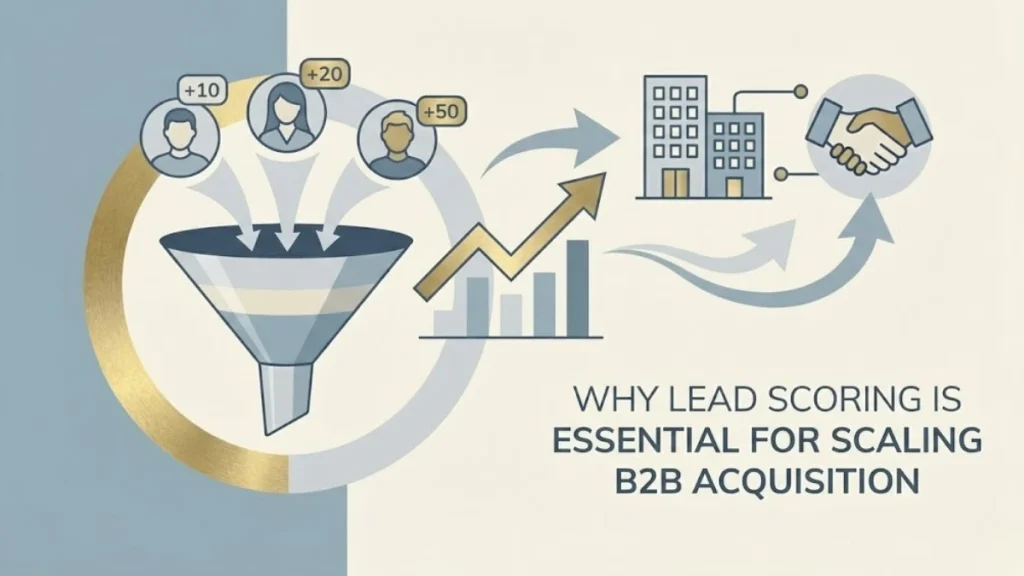
Lead scoring is essential for scaling B2B acquisition because it gives teams a data driven system to identify high intent prospects, prioritize follow up, and allocate resources efficiently. Without scoring, companies treat all leads equally, which leads to wasted time, low conversion rates, and unpredictable pipeline quality.
What makes lead scoring a core component of scalable B2B growth?
Modern B2B buying journeys are non linear. Prospects consume content, compare vendors, and validate solutions across multiple touchpoints before engaging. Lead scoring brings order to this complexity by quantifying buyer readiness.
Direct answer:
Lead scoring helps you scale acquisition because it ranks leads by intent and qualification, allowing sales and marketing to focus on those most likely to convert.
A strong scoring model improves:
• alignment between marketing and sales
• forecasting accuracy
• MQL → SQL progression
• win rates
• CAC efficiency
This system becomes even more powerful when integrated into structured acquisition frameworks like the one described in the B2B lead generation strategies framework, where scoring plays a central role in funnel predictability.
How does lead scoring improve lead quality and conversion?
Lead scoring translates buyer behavior into signals. It assigns points to actions, engagements, and characteristics that indicate intent.
Direct answer:
Lead scoring improves conversion because it identifies the leads with the highest likelihood of becoming revenue.
Strong scoring systems evaluate both:
- Fit score (firmographics, industry, role, size)
- Behavior score (content engagement, visits, downloads, sessions, demo intent)
Companies that use both dimensions see significantly stronger pipeline performance because they capture who the prospect is and how they behave.
This dual-scoring method mirrors persona-driven qualification principles similar to those explained in the guide on building a buyer persona for B2B success.
What are the key signals to use in a lead scoring model?
Lead scoring works only when built around signals that actually predict revenue. Many companies rely on vanity interactions that do not reflect true intent.
Direct answer:
The strongest scoring signals reflect behaviors that correlate with commercial intent and pipeline acceleration.
High-impact B2B scoring signals include:
Fit signals
• job title / seniority
• industry relevance
• company size
• use case match
• geographic alignment
Behavior signals
• visits to pricing pages
• repeated engagement with BOFU content
• webinar attendance
• downloading strategic assets
• returning multiple times within a short window
• interacting with ROI or comparison content
Negative signals
• irrelevant industries
• low-budget segments
• student emails
• competitors
When companies track both positive and negative signals, qualification becomes more accurate and forecasting becomes more reliable.
Why many B2B lead scoring systems fail
Most scoring systems underperform because they rely on guesses rather than data, or they treat all actions with the same weight.
Direct answer:
Lead scoring fails when it is based on assumptions, unprioritized actions, or outdated buyer behavior.
Common failure points include:
• giving equal points for high and low intent actions
• not updating scoring rules
• unclear thresholds for MQL → SQL
• lack of feedback from sales
• overvaluing content consumption without context
A scoring system must evolve as buyer behavior changes especially with the rise of independent research and longer digital journeys.
How to build a lead scoring model that predicts revenue
A predictive scoring system is built through iteration, not intuition. The most effective models are created through structured processes.
Direct answer:
Build a predictive scoring model by analyzing past deals, identifying intent patterns, and assigning weighted scores to proven signals.
A strong build process includes:
- Analyze closed won deals
Identify behaviors and characteristics shared by leads who converted. - Map signal clusters
Group behaviors by intent stage (TOFU → MOFU → BOFU). - Assign weighted scores
Give higher points to high intent signals like pricing page visits. - Create qualification thresholds
Define MQL and SQL levels based on real patterns. - Sync scoring with CRM and automation workflows
- Iterate quarterly based on performance and real pipeline data
Many teams use funnel models similar to those outlined in optimizing conversion funnels for B2B growth to map behaviors and intent more accurately.
How to align lead scoring with sales and marketing
Lead scoring only works when both teams agree on definitions. Misalignment is the biggest cause of low MQL → SQL conversion.
Direct answer:
Align scoring with sales by defining shared qualification criteria, reviewing scoring logic together, and syncing lead readiness thresholds.
For alignment to work, both teams must agree on:
• ICP criteria
• high intent behaviors
• qualification thresholds
• MQL handoff rules
• follow up expectations
• disqualification rules
This alignment tightens the entire acquisition engine, improving pipeline velocity and forecasting accuracy.
How to use lead scoring to automate acquisition at scale
Lead scoring becomes the foundation for automation. It enables systems that route, prioritize, and nurture leads without manual work.
Direct answer:
Use lead scoring to automate routing, prioritization, and nurturing based on readiness and intent.
Automation examples include:
• Routing SQL ready leads directly to sales
• Adding mid intent leads to MOFU nurture sequences
• Triggering BOFU offers based on scoring thresholds
• Sending high fit accounts into ABM workflows
• Automatically disqualifying low value segments
This automation reduces acquisition costs and increases the consistency of pipeline creation.
The next step in building a predictable lead engine
Once your scoring system is in place, the next priority is to measure performance accurately. Continue with our guide on how to measure B2B lead generation ROI, which explains the metrics and attribution models needed to understand the true impact of your acquisition system.