
image by MERIEM AB & IMAGE FX ET CANVA
Is your content strategy misdiagnosing the buyer’s pain?
In the B2B conversion ecosystem, the format is not an artistic choice; it is a psychological trigger. Most marketing teams treat eBooks and White Papers as interchangeable commodities. This is a revenue-leaking mistake.
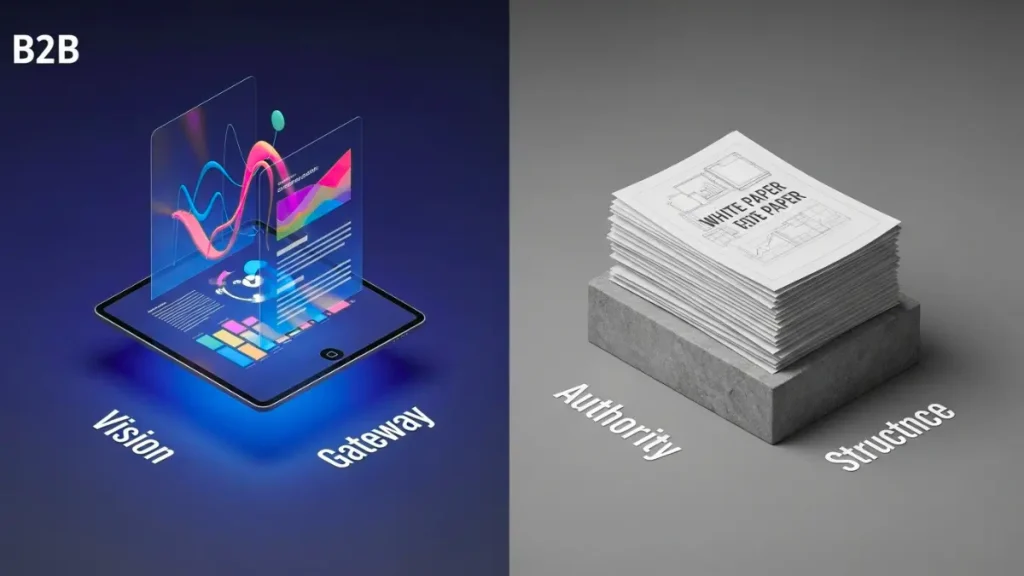
An eBook is a “Gateway Drug”—it sells the idea of a solution to a problem-aware persona. A White Paper is the “Evidence Locker”—it sells the validity of your methodology to a solution-aware technical committee. Confusing the two leads to high bounce rates at the top of the funnel and stalled deals at the bottom.
This analysis deconstructs the functional mechanics of both assets. We will not discuss design or copywriting. We will engineer the choice based on one metric: Buyer Intent Velocity.
The asset-intent mismatch: Why your downloads don’t convert
Before drafting a single line, you must audit the maturity of your target audience. A mismatch here destroys the ROI of your content production.
The eBook: The “vision” asset (Top-of-Funnel)
The eBook is designed for the Explorer. This persona knows something is wrong but hasn’t defined the technical scope of the solution.
- Primary Function: Education and Problem Framing.
- Cognitive Load: Low. Scannable, visual, concept-heavy.
- Trigger Event: “I need to understand the landscape.”
- Success Metric: Volume of MQLs (Marketing Qualified Leads).
According to the principles of building a high-converting B2B Lead generation funnel, the eBook operates at the Awareness stage. It requires low friction. If you gate an eBook with a 12-field form, you kill the velocity. If you fill it with dense academic regression analysis, you lose the reader’s attention span.
The white paper: The “Authority” asset (middle/bottom-of-funnel)
The White Paper is designed for the Evaluator and the Skeptic. This persona creates the shortlist. They don’t need “education”; they need “proof.”
- Primary Function: Validation and Risk Mitigation.
- Cognitive Load: High. Dense, data-rich, linear argumentation.
- Trigger Event: “I need to justify this purchase to the CFO.”
- Success Metric: Conversion to SQL (Sales Qualified Lead) or Deal Acceleration.
This distinction is critical when you align your content with how to build an accurate B2B buyer persona.
You are not writing for the same person, or at least, not for the same moment in their neural decision path. The White Paper is the heavy artillery you deploy when the prospect asks: “Prove it works.”
In the next section, we will break down the structural engineering of each format to ensure your production line builds the right vehicle for the right terrain.
Structural engineering: The blueprint of authority vs accessibility
Once the intent is diagnosed, the execution must follow a rigid architectural framework. You cannot simply “dress up” a blog post as a White Paper, nor can you “dumb down” a technical thesis into an eBook without losing credibility.
The eBook architecture: Horizontal & Modular
The eBook is built for speed of consumption. Its structure mimics a slide deck rather than a textbook.
- The Hook: A promise of transformation (e.g., “From Chaos to Clarity”).
- The Layout: 60% text, 40% visual assets (graphs, pull quotes, icons).
- The Navigation: Modular chapters. The reader should be able to jump to Chapter 3 without reading Chapter 1 and still extract value.
- The Tone: Conversational, second-person (“You”), aspirational.
This modularity makes the eBook the ideal candidate for repurposing into a the “Zero-Fluff” white paper checklist or a series of social posts. It is an “atomizable” asset.
The white paper architecture: vertical & linear
The White Paper is built for depth of scrutiny. Its structure mimics an academic dissertation or a legal brief.
- The Hypothesis: A clear statement of a problem or a new methodology (e.g., “The Impact of API Latency on Revenue”).
- The Layout: 90% text, 10% data visualization. Single-column text often signals higher authority than magazine-style layouts.
- The Navigation: Linear. The argument builds sequentially. You cannot understand the Conclusion if you skip the Methodology.
- The Tone: Objective, third-person (” The data suggests”), authoritative.
As detailed in the the B2B white paper protocol: Turning original research into a Lead generation engine, the White Paper does not “sell” your product. It sells your philosophy. The product is merely the logical conclusion of the philosophy.
The decision matrix: which one builds the pipeline?
To eliminate guesswork, use this decision matrix before commissioning your next asset. This system forces alignment between the content format and the business objective.
| Variable | eBook Strategy | White Paper Strategy |
|---|---|---|
| Primary Goal | Lead Generation (Volume) | Lead Qualification (Quality) |
| Sales Cycle Stage | Awareness / Interest | Consideration / Decision |
| Target Audience | Users / Managers | C-Level / VPs / Technical Leads |
| Data Requirement | Industry Trends / Best Practices | Original Research / Proprietary Data |
| Format Length | 2,000 – 3,000 words | 3,000 – 6,000+ words |
| Shelf Life | 12 – 18 Months (Trends fade) | 3 – 5 Years (Methodologies endure) |
| Gate Strategy | Low Friction (Email only) | High Friction (Full qualification form) |
This matrix proves that the choice is binary based on your immediate revenue goal. If you need to feed the SDR team with raw contacts, deploy the eBook. If you need to arm your Account Executives with closing material, deploy the White Paper.
In the final section, we will analyze the distribution mechanics and how to measure the specific ROI of each format beyond simple “downloads.”
Measuring the Invisible: ROI beyond the download
The “Vanity Metric Trap” is the most common failure point in premium content strategy. Marketing teams celebrate 500 downloads, but the C-Suite demands revenue. To prove value, you must track the asset’s performance differently based on its type.
eBook metrics: velocity & virality
For an eBook, the volume of consumption is a leading indicator of market interest.
- Key Metric: Click-Through Rate (CTR) to Consumption. Do they actually open the PDF?
- Secondary Metric: Social Shares. eBooks are shareable assets. High share velocity indicates high resonance with the “pain point.”
- Revenue Link: Track the % of eBook downloaders who transition to an MQL status within 30 days. This measures the asset’s ability to “warm up” cold traffic.
White paper metrics: influence & attribution
For a White Paper, volume is irrelevant. You want the right 50 people to read it, not the wrong 5,000.
- Key Metric: Time on Page / Scroll Depth. If the PDF is hosted as a web view, are they reading the methodology section?
- Secondary Metric: Sales Enablement Usage. How often do your sales reps attach this document to closing emails?
- Revenue Link: Use Multi-Touch Attribution to see if the White Paper appears in the path-to-purchase of closed-won deals. Often, it is the “tipping point” asset.
As emphasized in data-driven performance: Linking organic traffic to revenue, if you cannot attribute a closed deal to the consumption of your authority content, your content engine is flying blind.
The hybrid ecosystem
The debate “White Paper vs. eBook” is ultimately a false dichotomy. A mature B2B growth engine requires both, operating in sequence.
The eBook captures the market’s attention. The White Paper earns the market’s trust.
Your Action Plan:
- Audit your current library. Do you have a surplus of “fluffy” eBooks and zero deep-dive White Papers? You have an Authority Gap.
- Map your assets to the funnel. Ensure every eBook has a “Next Step” Call-to-Action that leads to a deeper White Paper for those ready to advance.
- Don’t reinvent the wheel. If you have a successful White Paper, atomize it into three distinct eBooks to widen the top of your funnel.
The format is the vessel. The intent is the fuel. Choose the vessel that carries your prospect to the revenue line with the least resistance.