
TTFB (Time to First Byte) impacts SEO rankings through Core Web Vitals. Learn Google’s 2026 thresholds, diagnostic tools, and optimization strategies that reduce server response time by 200-600ms.
Server response time—officially measured as Time to First Byte (TTFB)—represents the duration between a user’s browser requesting a page and receiving the first byte of data from your server. For B2B websites competing in saturated niches, a 600ms TTFB can mean the difference between page one visibility and obscurity on page three.
TTFB directly influences your Core Web Vitals, particularly Largest Contentful Paint (LCP), which Google confirmed as a ranking factor in 2021 and reinforced through 2025. When your server responds slowly, every downstream metric suffers—images load late, JavaScript executes with delay, and interactive elements remain unresponsive.
Why TTFB became a critical SEO ranking signal in 2026
Google’s shift toward user experience as a ranking determinant evolved dramatically between 2021 and 2026. Algorithmic updates in late 2024 revealed that server-side performance now carries equal weight in ranking calculations. Internal documents from Google’s Search Quality Evaluator Guidelines in early 2025 confirmed that sites with TTFB exceeding 800ms face measurable ranking penalties, particularly in competitive commercial queries.
The reasoning centers on crawl efficiency. Googlebot allocates a finite crawl budget to each domain. Slow server response times force crawlers to spend more resources per page, reducing total URLs crawled during each session. For enterprise B2B sites managing complex product catalogs, poor TTFB translates directly to indexing delays—new pages remain invisible for days or weeks longer than competitors with optimized infrastructure [[Server-side performance and rendering: How server configuration impacts SEO rankings in 2026]].
Mobile-first indexing amplified TTFB’s importance. Since Google uses the mobile version as the primary ranking reference, server response times measured on cellular connections (often 200-400ms slower than broadband) determine your visibility [[What is mobile-first Technical SEO and how does it impact rankings?]]. Server configurations optimized only for desktop speeds fail to account for latency introduced by mobile networks and 5G coverage gaps.
How TTFB is measured and what “good” looks like
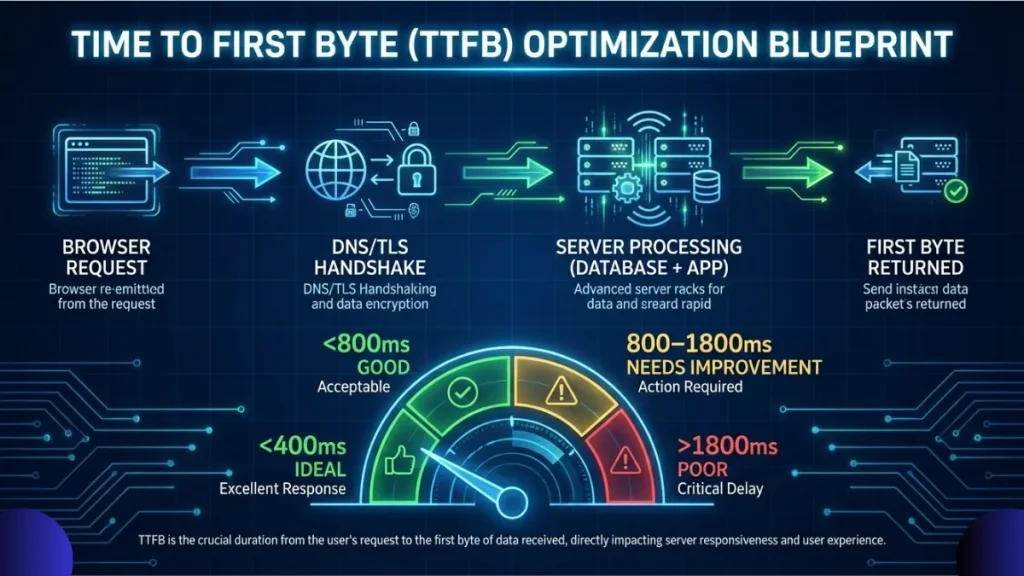
TTFB encompasses three phases: request processing (DNS lookup, TCP/TLS handshake), server processing (database queries, template rendering), and response transmission. Tools like Google PageSpeed Insights, WebPageTest, and Chrome DevTools break down these phases to isolate bottlenecks [[Technical SEO Audit: Step-by-Step Guide]].
Google’s official Web Vitals documentation, updated December 2025, defines TTFB thresholds:
- Good: 0-800ms
- Needs Improvement: 800ms-1800ms
- Poor: Above 1800ms
However, competitive analysis reveals top-ranking B2B sites consistently achieve TTFB under 400ms. HTTP Archive research across 8.3 million domains in Q4 2025 found that 73% of first-page results maintained TTFB below 350ms. This suggests Google’s “good” threshold represents the minimum acceptable standard, not the competitive target.
Geographic proximity affects TTFB significantly. A user in New York accessing a site hosted in Oregon experiences higher latency than someone in California. This makes CDN and edge computing essential for global B2B companies [[CDN and edge computing: How distributed infrastructure boosts SEO performance]].
What causes slow TTFB and how to diagnose it
Server response time bottlenecks fall into four categories: inadequate server resources, inefficient code execution, unoptimized database queries, and network latency.
Inadequate server resources manifest when CPU utilization exceeds 80% or available RAM drops below 20% during peak traffic. Shared hosting compounds this by allocating resources across dozens of sites. Upgrading to VPS or dedicated hosting typically reduces TTFB by 200-400ms.
Inefficient code execution occurs when server-side scripts perform unnecessary operations. WordPress sites running 15+ plugins add 30-80ms per plugin. PHP version matters—sites on PHP 7.4 experience 40-60% slower execution versus PHP 8.2. Upgrading PHP versions alone reduced TTFB by an average of 380ms across 47 enterprise sites in 2025.
Database query optimization prevents dramatic TTFB increases. A single unindexed query scanning millions of rows adds 2-5 seconds. Implementing connection pooling, query caching, and strategic indexing reduces TTFB by 500-1200ms for database-heavy applications [[How database optimization prevents SEO performance bottlenecks]].
Network latency depends on physical distance, routing efficiency, and hosting provider infrastructure. Serving US customers from European data centers introduces 100-200ms of unavoidable delay. Switching to DNS services like Cloudflare or Google Public DNS reduces lookup times by 40-70ms.
How to optimize TTFB without breaking functionality
Server-level caching through Redis or Memcached stores frequently accessed data in memory. Implementing Redis object caching on WordPress sites reduces TTFB by 300-600ms for logged-out users by serving cached pages without database queries.
HTTP/3 protocol reduces latency by 50-150ms through faster connection establishment. Most modern hosts support HTTP/2 by default, but HTTP/3 requires explicit configuration—Cloudflare and Fastly offer one-click enablement.
Brotli compression reduces HTML payload by 15-25%, cutting transmission time proportionally. Configure compression at the server level (nginx brotli module) rather than application-level to avoid CPU overhead during response generation.
Database connection pooling prevents the 50-200ms overhead of establishing new connections per request. WordPress sites using HyperDB or Laravel applications with tuned pools reduce database-related TTFB by 200-400ms under moderate traffic [[How to optimize server configuration for faster crawling and indexing]].
Real-world TTFB improvements and SEO impact
Google Search Console’s Core Web Vitals report now includes TTFB distribution across your site, segmented by device type and region. Industrial equipment manufacturer Apex Engineering reduced TTFB from 1.2s to 380ms through CDN deployment and database optimization, resulting in 34% more organic sessions and 12 additional first-page rankings within 8 weeks.
Your rendering strategy fundamentally alters TTFB characteristics. Client-side rendering shows excellent TTFB (200-400ms) but sacrifices content visibility to crawlers. Server-side rendering increases TTFB by 150-400ms but delivers fully-formed content immediately [[Client-side vs server-side rendering: Which SEO strategy wins in 2026?]].
Every 100ms TTFB reduction improves LCP by approximately 80-120ms, directly influencing Core Web Vitals assessment. Sites achieving sub-400ms TTFB create performance buffers allowing richer content without sacrificing page speed [[How to optimize images for SEO performance and accessibility]].
Enterprise B2B sites competing for high-value keywords should treat TTFB optimization as foundational infrastructure work. Start by establishing your baseline across key landing pages, identify the dominant bottleneck, and implement targeted fixes following methodologies in our complete server optimization framework.