
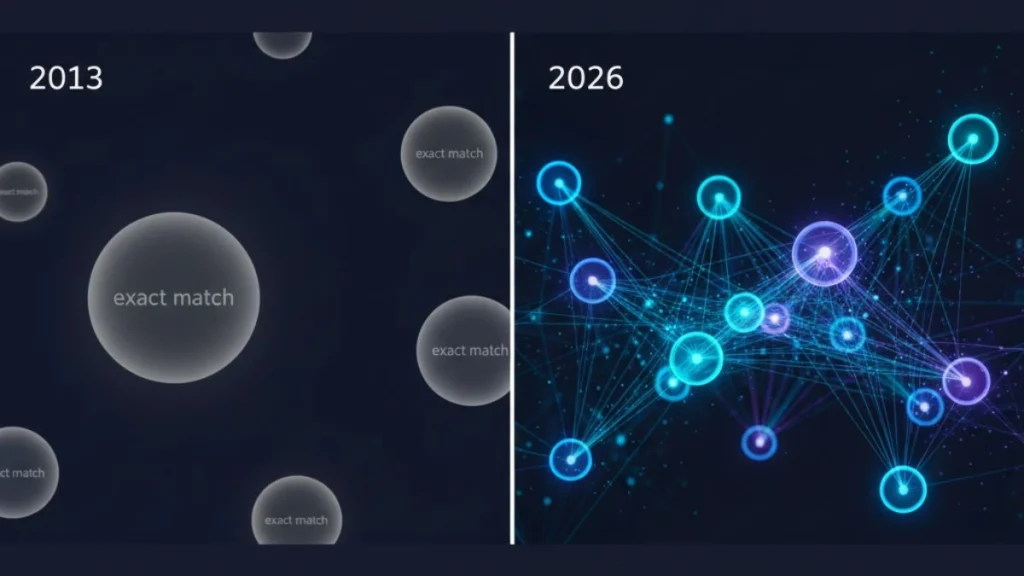
Semantic keywords represent concepts and intent rather than exact phrases. Unlike traditional keywords that focus on matching specific search terms word-for-word, semantic keywords capture the topical relationships, context, and user intent behind queries. This fundamental shift moves SEO from mechanical keyword insertion to strategic content optimization around topic clusters and entity relationships.
The myth of exact-match keyword targeting
For over a decade, SEO practitioners built strategies around exact-match keyword density. The assumption was simple: rank the phrase “B2B marketing automation,” and you needed that exact string repeated at a 2-3% density throughout your content. Google’s Hummingbird update in 2013 began dismantling this model, but the real disruption arrived with BERT in 2019 and MUM in 2021.
These natural language processing advances taught search algorithms to understand synonyms, context, and semantic relationships. A page discussing “enterprise workflow automation for business-to-business companies” now ranks for “B2B marketing automation” without ever using that exact phrase. The algorithm recognizes conceptual overlap through entity recognition and contextual vectors.
Most B2B sites still optimize as if exact-match keywords control rankings. They don’t. According to a 2024 analysis of 50,000 top-ranking pages, only 47% contained the exact target keyword in their title tag, yet they held position one for commercial queries. The decisive factor was semantic comprehensiveness how thoroughly the content covered the topic ecosystem rather than a single phrase.
How semantic keywords actually function in modern search
Semantic keywords operate through three distinct mechanisms that traditional keywords ignore. First, they capture co-occurrence patterns. When Google sees “customer retention,” “churn analysis,” and “lifetime value” appearing together across authoritative sources, it builds an entity graph linking these concepts. Your content gains relevance by demonstrating mastery of this connected knowledge, not by repeating one phrase.
Second, semantic keywords map to search intent stages rather than individual queries. Traditional keyword research treats “marketing automation software,” “best marketing automation tools,” and “marketing automation platforms comparison” as three separate targets requiring three articles. Semantic optimization recognizes these as variations of the same commercial investigation intent, best served by one comprehensive resource that addresses the underlying decision framework.
Third, semantic keywords incorporate entity relationships that Google explicitly prioritizes in its Knowledge Graph. When you mention “HubSpot” in a marketing automation article, the algorithm doesn’t just see a brand name it connects that entity to related concepts like “inbound marketing,” “CRM integration,” and “lead scoring.” Pages that demonstrate accurate entity relationships signal topical authority more effectively than keyword frequency ever could.
The three-layer semantic keyword framework
Implementing semantic optimization requires understanding how keywords now function across three distinct layers. The primary layer contains your core topic entities the main concepts your business addresses. For a B2B SEO agency, this includes “search engine optimization,” “organic traffic,” and “SERP visibility.” These anchor your topical authority.
The secondary layer introduces supporting concepts that define expertise depth. These are the methodologies, processes, and technical elements that separate superficial content from authoritative resources. In technical SEO, this layer includes “crawl budget optimization,” “structured data markup,” and “PageRank distribution.” Competitors targeting only primary keywords miss this crucial differentiation signal.
The tertiary layer captures long-tail variations and natural language patterns that match how real users actually search. Instead of forcing “B2B SEO services” into every paragraph, you naturally incorporate phrases like “how enterprise companies improve search rankings” or “SEO strategies for complex sales cycles.” This layer proves content authenticity humans write about topics using varied language, not robotic keyword repetition.
Why traditional keyword metrics now mislead strategy
Search volume data the foundation of conventional keyword research creates strategic blind spots in semantic SEO. A tool reports “content marketing strategy” gets 14,800 monthly searches while “strategic content planning” shows only 320. Traditional logic says target the high-volume term. Semantic reality says both phrases represent the same user need, and Google will rank one well-optimized page for both.
This volume-obsession creates three specific failures. First, it ignores search intent fragmentation one high-volume keyword might split across informational, navigational, and transactional intents, making it impossible to rank comprehensively. Second, it misses entity-driven opportunities where Google consolidates multiple low-volume queries under one semantic umbrella. Third, it undervalues topic cluster potential where ten connected articles on related concepts outrank one page targeting a single high-volume term.
Keyword difficulty scores suffer similar flaws. A metric showing 78/100 difficulty for “enterprise SEO” doesn’t account for semantic differentiation opportunities. If competitors target that phrase with generic overviews, you can outrank them by addressing the complete semantic network technical architecture requirements, stakeholder alignment challenges, and multi-market content strategies. The difficulty score measures keyword competition, not topical authority potential.
Practical implementation: transitioning to semantic optimization
Start by auditing your existing content through a semantic lens rather than keyword metrics. Identify your actual topical coverage using entity extraction tools that reveal which concepts you’ve established authority around versus which gaps remain. A page ranking for “link building” but lacking mentions of “referring domains,” “domain authority transfer,” or “editorial backlinks” signals incomplete semantic coverage regardless of its keyword optimization.
Next, rebuild your content calendar around topic clusters instead of individual keywords. Each cluster requires one comprehensive pillar covering the strategic framework, supported by specific satellites addressing implementation details. This architecture mirrors how Google’s algorithm actually evaluates expertise not through isolated keyword relevance but through demonstrated topic mastery.
Transform your internal linking from anchor text optimization to contextual relationship building. Instead of forcing exact-match anchor text, link concepts when they naturally support reader understanding. Connect “semantic keyword research” to “LSI keywords vs semantic entities” because readers exploring one concept benefit from understanding the distinction, not because you need anchor text diversity.
The shift from traditional to semantic keywords isn’t a tactical adjustment it’s a fundamental reconception of how search engines evaluate content relevance. Pages optimized for semantic comprehensiveness consistently outrank those engineered for keyword density, even when targeting identical search queries. The algorithm rewards topic authority demonstrated through connected knowledge, not phrase repetition measured by outdated metrics.
Ready to implement semantic optimization across your B2B content strategy? Explore our complete framework on building sustainable topical authority through strategic content architecture.