
PART 1: THE FINANCIAL METAMORPHOSIS : FROM MARKETING EXPENSE TO STRATEGIC ASSET
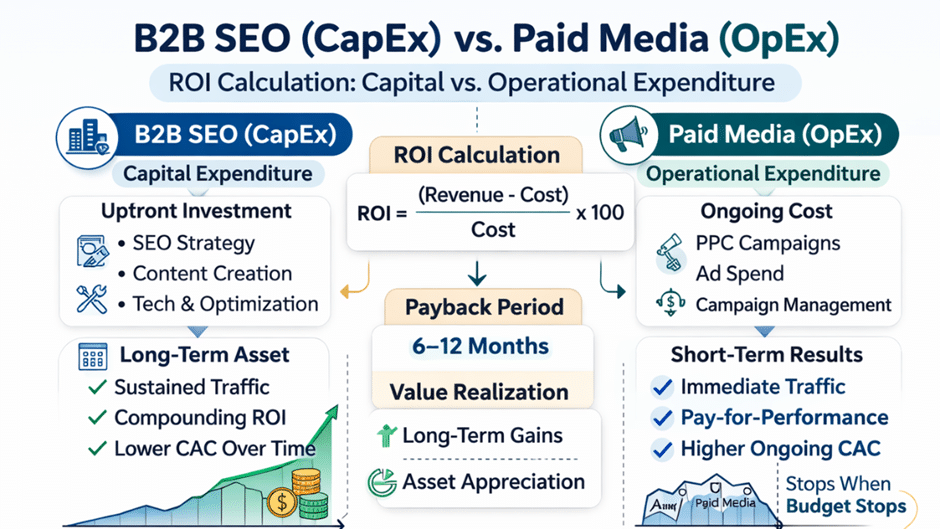
The OpEx Trap: Why B2B Organizations are Bleeding Capital
In the traditional accounting view, marketing is treated as a line item under Operating Expenditures (OpEx). For a CFO, this means every dollar spent on customer acquisition is “consumed” within the fiscal period. This is particularly true for Paid Media (SEA). When a B2B firm spends $100,000 on Google Ads, that capital is gone the moment the click occurs. If the lead does not convert immediately, the investment has zero residual value. This creates a dangerous dependency: the business is essentially “renting” its market share.
In 2026, this model is no longer sustainable. With the inflation of Cost Per Click (CPC) driven by AI-powered bidding wars and increased competition, the “Paid Media Tax” is eroding EBITDA margins across the B2B sector. To survive, the organization must undergo a financial metamorphosis, shifting its acquisition strategy from a consumable expense to a Capital Expenditure (CapEx) model.
SEO as a Capital Asset: The Architecture of Equity
When we build an “Empire” through the Decaseo system, we are not “doing SEO”; we are constructing an intangible asset that appears on the strategic balance sheet. Unlike a temporary ad campaign, a high-authority semantic cluster is a structural improvement to the business’s infrastructure.
Just as a manufacturer invests in a new factory to lower production costs over ten years, a B2B firm invests in an Organic Empire to lower its Customer Acquisition Cost (CAC) over a multi-year horizon. This investment is amortizable. The initial costs technical auditing , semantic mapping , and high-authority content production are front-loaded, but the benefits accrue over time with a marginal cost that trends toward zero. This is the definition of a high-yield asset.
The Mathematics of Valuation: Ranking #1 vs. Google Ads
To prove the depth of this asset, we must look at the concrete valuation of a #1 position for a high-value B2B keyword. Let us take a strategic keyword with a monthly search volume of 1,000 and a CPC of $25.
1. The Rented Model (Paid Search)
To maintain a top position via Google Ads for 24 months, assuming a 10% Click-Through Rate (CTR) and a conservative 5% annual inflation in CPC:
- Year 1 Cost: $30,000
- Year 2 Cost: $31,500
- Total 24-Month Outlay: $61,500 (Total Asset Value at the end: $0)
2. The Owned Model (The Empire Asset)
An organic #1 spot typically captures a 30% CTR three times the efficiency of a paid ad.
- Monthly Traffic Value: 1,000 searches * 30% CTR * $25 CPC equivalent = $7,500/month.
- Annual Yield: $90,000/year.
- Total 24-Month RoASE: $180,000.
If the initial investment to secure this position was $15,000, the ROI is transformative. At month 25, the Ads user must pay another $2,600 to stay visible. The Empire owner pays $0.
PART 2: THE OPERATIONAL BRIDGE – INTEGRATING CRM, HIDDEN FIELDS, AND LEAD SCORING
Breaking the Data Silo: The Architect’s Mandate
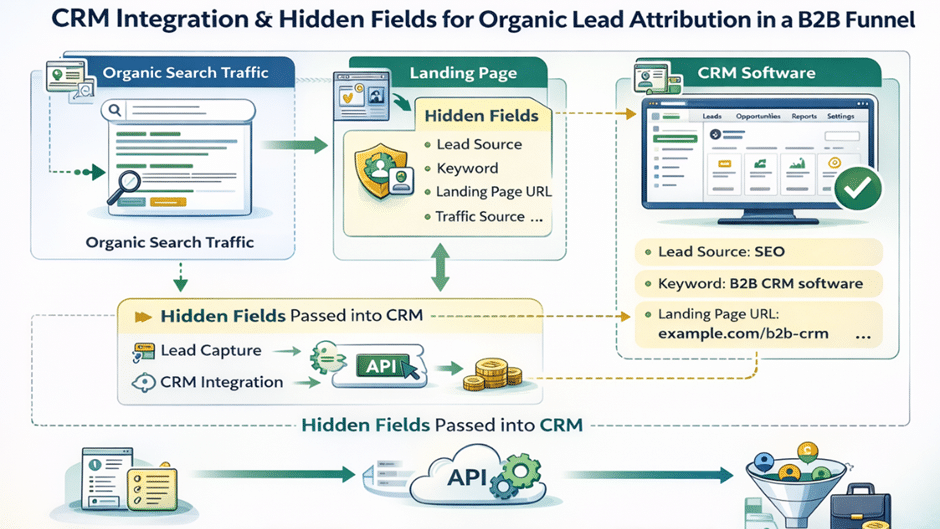
A strategic asset is only as valuable as the data it produces. In the B2B sector, the greatest failure of traditional SEO is the “Last-Mile Gap”the space between a user landing on a page and their conversion into a Sales Qualified Lead (SQL). The Analyst of the Empire demands visibility into the Revenue Lifecycle. This requires a deep integration between the CMS and the CRM (HubSpot, Salesforce).
The Engineering of Traceability: Hidden Fields
The primary tool for this operational bridge is the implementation of Dynamic Hidden Fields. While the user sees a simple contact form, the “Empire” is capturing critical metadata:
- Original Entry Source: Identifying the specific “Satellite” article of entry.
- Semantic Intent: Mapping keyword intent directly to the lead record.
- Content Pathing: Tracking Pillar pages consumed before conversion.
When a salesperson knows a prospect has spent 15 minutes reading about “B2B CAC Reduction,” the opening call is no longer “cold” it is a continuation of an expert conversation.
Lead Scoring 2.0: The Semantic Qualifier
The Editor 9 protocol introduces Semantic Lead Scoring:
- Informational entry: +10 points.
- Strategic Pillar download: +50 points.
- ROI Calculator/Pricing visit: +100 points.
This ensures SDRs focus on leads “pre-sold” by the Empire’s authority, reducing friction and shortening the time-to-close.
PART 3: THE BOARDROOM REPORT – The Language of the Board: Capital Efficiency, LTV, AND THE COMPETITIVE MOAT
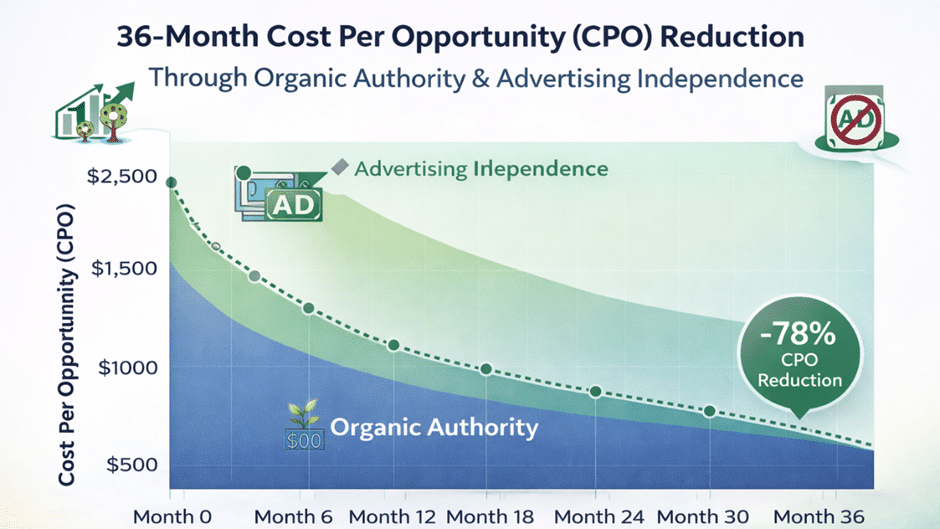
When reporting to the Board, the conversation shifts to Cost Per Opportunity (CPO) and Lifetime Value (LTV). Data shows that leads from deep semantic authority have a 25% higher close rate than paid leads. The Empire performs the “Trust Transfer” before the first human interaction.
The LTV Multiplier
Organic customers exhibit:
- Lower Churn Rates: Better alignment with the value proposition.
- Higher Expansion Potential: Trust in the brand’s authority.
- Referral Velocity: Authority breeds advocacy.
The Competitive Moat: Defending Against Generative AI
In 2026, the rise of “Zero-Click Search” is a filter, not a threat. AI models (LLMs) rely on high-authority, original, and deeply structured data. By building a massive semantic architecture, you become the Primary Source for the AI. When an AI agent provides a B2B recommendation, it cites the Empire. This “Inference Authority” is the ultimate moat.
Strategic Sovereignty
Achieving Advertising Independence is the moment a company moves from being a market participant to a market leader. It is the transition from “buying clicks” to “owning the conversation.” By calculating the true ROI of SEO through asset valuation and CRM integration, we prove the Empire is the backbone of your firm’s future valuation.