
What is an SEO audit report?
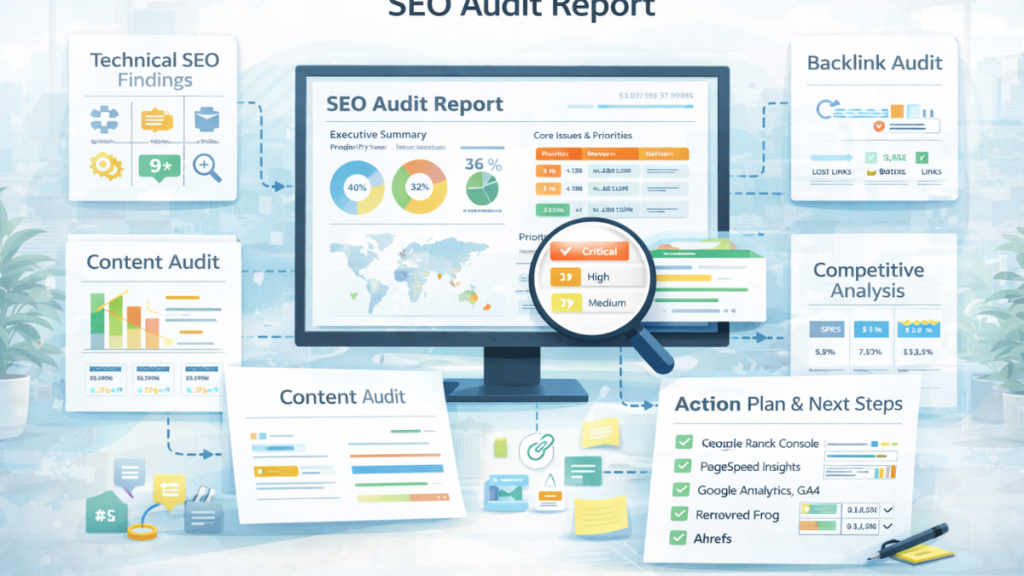
An SEO audit report is a structured document that summarizes your technical, content, backlink, and competitive findings in a clear, actionable way. Its goal is to transform data into decisions stakeholders can understand. This reporting structure fits into the broader methodology explained in our SEO audit and competitive analysis hub, ensuring each audit leads to strategic improvements rather than isolated fixes.
Why does a clear SEO audit report matter?
A clear SEO audit report matters because stakeholders—executives, marketing teams, developers—need actionable insights, not technical noise. A well-structured report creates alignment, accelerates implementation, and prevents miscommunication. Experience shows that businesses with strong reporting frameworks execute faster and maintain better long-term visibility.
How to structure an SEO audit report?
A strong SEO audit report follows a hierarchy that moves from high-level insights to detailed, technical findings.
Recommended structure:
- Executive summary
- Core issues & priorities
- Technical SEO findings
- Content audit findings
- Backlink profile analysis
- Competitive landscape summary
- Action plan & next steps
This ensures stakeholders understand the most important insights before diving into technical details.
How to write an executive summary for an SEO audit?
The executive summary should provide a non-technical overview of the audit’s most important insights.
Include:
- Current visibility status
- Biggest obstacles to ranking
- Opportunities with the highest ROI
- Three to five priority recommendations
Executives rarely read the entire audit. The summary must be simple, strategic, and aligned with business goals.
How to prioritize SEO issues in the report?
Prioritization is essential for clarity and resource allocation.
Use a priority framework such as:
| Priority | Action Type | Reason |
| Critical | Fix immediately | Blocks crawling, indexing, or conversions |
| High | Address soon | Strong impact on rankings or UX |
| Medium | Improve progressively | Enhances performance but not urgent |
| Low | Optional | Minor impact or long-term optimization |
This structure allows teams to focus on actions that move the needle first.
How to present technical SEO findings clearly?
Technical SEO findings can overwhelm non-technical audiences. Present them visually and concisely.
Best practices:
- Group issues by category (indexing, site architecture, CWV, mobile)
- Include screenshots or short examples
- Highlight impact: “This issue affects X pages”
- Link each issue to a business implication
For example:
“Slow LCP on key landing pages can increase bounce rate and reduce conversion potential, especially for mobile users.”
How to report content audit results?
Translate content performance into insights:
Key elements to include:
- Pages with declining traffic
- Thin or outdated content
- Cannibalization issues
- Content gaps vs competitors
- High-opportunity keywords
This section must demonstrate how improving content relates directly to visibility, authority, and conversions.
How to present backlink audit insights?
Backlink insights should highlight authority risks and opportunities.
Include:
- Total referring domains
- Toxic or risky backlinks
- Lost or broken backlinks
- Link gap vs competitors
- High-authority sites linking to top competitors
Tie each point to impact:
“Toxic links increase risk during algorithm updates; cleaning them protects stability.”
How to summarize competitive insights?
Competitive insights show where you stand relative to others in your market.
Highlight:
- Keyword gaps
- Backlink gaps
- Content depth comparison
- SERP feature ownership (snippets, FAQs)
- Strengths competitors rely on
- Weaknesses you can exploit
This section directly supports the insights explored in the Competitive SEO Analysis satellite.
How to turn audit findings into an actionable roadmap?
Turning insights into actions is the core value of the report.
We recommend structuring your roadmap by:
- Priority (Critical → Low)
- Department (Content, Development, Product, SEO)
- Estimated impact
- Required resources
- Timeline
This helps internal teams understand responsibilities and deadlines.
How to present KPIs and success metrics?
Your report should end with clear KPIs that track post-audit progress.
Common metrics include:
- Indexation rate
- Pages meeting Core Web Vitals
- Organic traffic growth
- Keyword rankings
- Number of recovered or earned backlinks
- Conversion improvements from organic channels
This aligns naturally with the ROI insights seen in the Conversion & Growth pôle.
How to tailor the audit report for stakeholders?
Different audiences need different levels of detail.
Customize your report for:
- Executives: high-level, ROI-focused insights
- Marketing teams: content recommendations & ranking opportunities
- Developers: technical issues with clear instructions
- Sales teams: improvements tied to lead generation
A flexible reporting structure increases implementation speed and ensures cross-functional alignment.
A well-executed SEO audit report transforms complex data into clear priorities and strategic decisions. When combined with strong technical, content, backlink, and competitive audits, it becomes a roadmap for sustainable organic growth.