
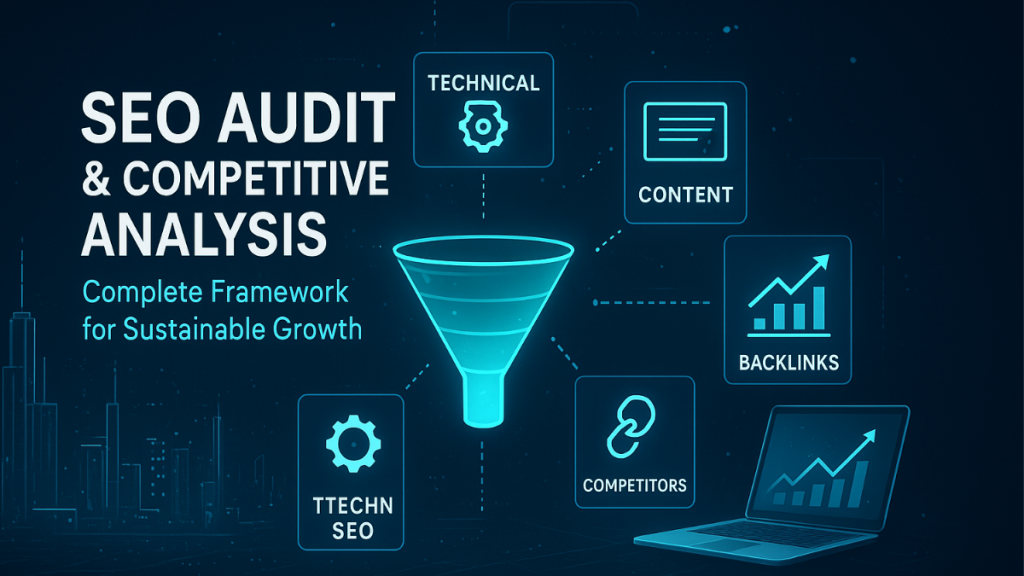
A complete SEO audit and competitive analysis gives you a full picture of how your website performs, why it ranks where it does, and what must be improved to achieve long-term organic growth. It goes beyond isolated checks and instead evaluates four core pillars: technical health, content relevance, backlink authority, and competitive landscape. Each pillar depends on the others, and together they create the foundation for scalable SEO performance.
This guide serves as the central hub page of the entire framework. Here you will find a structured method that connects all essential audit components technical, content, backlinks, tools, and competitive insights along with clear recommendations and strategic actions. For deeper explanations, the corresponding satellite pages provide comprehensive breakdowns, such as the Technical SEO Audit, the Content SEO Audit, the Backlink Audit, and the Competitive SEO Analysis.
This hub consolidates everything into a single, practical resource designed for B2B and B2C teams seeking clarity, prioritization, and a roadmap grounded in proven SEO methodology.
SECTION 1: What is an SEO audit and competitive analysis?
What is an SEO audit?
An SEO audit is a complete evaluation of your website’s technical performance, content quality, indexing status, backlink profile, and on-page optimization. Its goal is to identify issues that block visibility and highlight opportunities to improve organic performance. A proper audit goes far beyond surface-level checks it focuses on diagnosing root causes, evaluating performance signals, and prioritizing actions based on business impact.
An SEO audit typically analyzes:
- Technical performance: crawlability, Core Web Vitals, site architecture
- Content relevance: intent alignment, content depth, outdated or thin pages
- Authority signals: backlink profile, toxic links, gaps vs competitors
- User behavior signals: bounce rate, engagement, conversion pathways
- Search performance: rankings, impressions, CTR, keyword opportunities
This forms the base layer of the entire SEO strategy.
What is a competitive SEO analysis?
A competitive SEO analysis evaluates the performance, strengths, and weaknesses of the websites ranking for your target keywords. Unlike business competitors, SEO competitors are the sites that own the search landscape sometimes entirely different players.
A competitive SEO analysis typically examines:
- Keywords competitors dominate
- Content depth and structure
- Backlink authority and link acquisition patterns
- Technical strengths (speed, architecture, UX)
- SERP ownership (featured snippets, People Also Ask, video results)
- Topic coverage and content gaps
This analysis reveals growth opportunities your competitors overlook and helps you build strategies based on evidence, not assumptions.
How do SEO audits and competitive analysis work together?
The synergy between both analyses creates a complete strategic picture:
SEO Audit = Internal diagnosis
Where your weaknesses, gaps, and opportunities lie.
Competitive Analysis = External benchmark
How your competitors perform and what they leverage to outrank you.
When combined, they allow you to:
- Prioritize actions that create the highest impact
- Understand what is required to win in your niche
- Identify underutilized opportunities
- Build realistic, ROI-driven SEO roadmaps
- Strengthen your topical authority
This combined approach is essential for building resilient growth in today’s AI-driven search environment.
Why are SEO audits critical in the SGE (Search Generative Experience) Era?
Search engines now rely heavily on AI-driven answers, contextual understanding, and user intent modeling.
A modern audit must therefore evaluate not only technical and content factors but also:
- Page clarity and scannability
- Semantic coverage of topics
- E-E-A-T signals (expertise, experience, authority, trust)
- Alignment with conversational or question-based queries
- Eligibility for AI-generated overviews and summaries
Experience shows that the websites best prepared for SGE are those with structured clusters, clear hierarchy, and deeply optimized pages exactly what the broader audit framework supports.
How does a complete SEO audit support long term growth?
A full audit provides structure, clarity, and prioritization. It helps businesses:
- Fix critical issues blocking growth
- Improve content relevance and authority
- Capture competitor gaps
- Strengthen internal linking and site architecture
- Improve UX and engagement signals
- Build a future-proof SEO strategy
This ensures your organization does not just react to search changes, but builds a foundation strong enough to withstand algorithm shifts and rising competition.
Internal link toward relevant satellite
For a deep breakdown of how to evaluate each component, explore the satellite:
Technical SEO Audit: Boost Your Site Performance
SECTION 2: How to conduct a technical SEO audit
What is a technical SEO audit?
A technical SEO audit is the process of evaluating all the technical elements that affect how search engines crawl, render, and index your website. Its purpose is to ensure your site is accessible, fast, mobile-friendly, and structured in a way that supports both search engines and users.
A solid technical foundation is mandatory before optimizing content, backlinks, or competitive strategy.
For a deep and fully detailed breakdown, refer to the dedicated satellite: Technical SEO Audit: Boost Your Site Performance.
Why is technical SEO the foundation of your search performance?
Technical SEO determines whether Google can properly access your pages, understand their structure, interpret their context, and deliver them to users.
Even strong content and backlinks cannot rank if the site has issues such as blocked resources, slow loading times, or broken links.
A strong technical foundation ensures:
- Crawlers can discover all important pages
- Pages load fast and meet Core Web Vitals
- Search engines understand your content hierarchy
- Users experience smooth navigation
- Indexation is efficient, without wasting crawl budget
Experience shows that businesses fixing technical issues first see faster ranking gains and smoother content performance.
How to audit crawlability and indexing?
Crawlability determines whether search engines can access your pages. Indexing determines whether they can store and serve them.
Steps to audit crawlability:
- Review your robots.txt for disallowed paths
- Check for blocked resources (JS, CSS, images)
- Analyze crawl errors (404, 500, redirect loops)
- Identify orphan pages
- Validate sitemap structure and freshness
Steps to audit indexation:
- Analyze Search Console’s Index Coverage
- Look for pages “Crawled – Not Indexed”
- Identify duplicate or thin pages
- Confirm canonical tags
- Remove junk URLs or parameter-based pages
A clean crawl and index landscape is the baseline for stronger rankings.
How to evaluate site speed and core web vitals?
Core Web Vitals (CWV) measure user-perceived performance. Poor scores lead to lower satisfaction and reduced visibility.
Key metrics:
- LCP (Largest Contentful Paint) loading performance
- CLS (Cumulative Layout Shift) layout stability
- INP (Interaction to Next Paint) user interaction speed
Audit recommendations:
- Compress & resize images
- Reduce JavaScript execution time
- Implement lazy loading
- Improve server response times
- Use responsive, modern image formats WebP, AVIF
Performance improvements often correlate with better engagement and conversion rates.
How to check mobile friendliness and UX?
Mobile-first indexing means Google uses the mobile version of your site as the primary source for ranking.
Audit focus:
- Responsive design behavior
- Tap target accessibility
- Viewport configuration
- Mobile layout stability
- Page usability issues
- Popup or interstitial intrusiveness
A mobile audit ensures your site aligns with modern user behavior and search expectations.
How to audit site architecture and URL structure?
Clear structure helps both users and search engines understand how content connects.
Audit actions:
- Review depth of key pages ideally 2, 3 clicks max
- Validate breadcrumb structure
- Ensure clean, readable URLs
- Detect parameter-based duplicates
- Confirm logical category and subcategory hierarchy
- Evaluate internal linking (topical cluster alignment)
Strong architecture supports the cluster strategy, making it easier for Google to interpret your topical relevance—especially important as SGE relies increasingly on semantic relationships.
How to identify and fix duplicate content?
Duplicate content causes cannibalization, wasted crawl budget, and ranking confusion.
Common sources:
- URL parameters
- HTTP vs HTTPS
- Trailing slashes inconsistencies
- Printer-friendly versions
- Pagination mishandling
- Repeated content blocks across templates
Solutions include:
- Proper canonical tags
- Consolidating similar pages
- Avoiding indexation of utility URLs
- Implementing consistent URL rules
Addressing duplication ensures each page has a clear ranking focus.
How to audit redirects and broken links?
Broken links degrade user experience and waste crawl resources.
Check for:
- 404 pages
- 410 deleted pages
- Redirect chains (301 → 302 → 301)
- Redirect loops
- Incorrect redirect types
- Internal links pointing to old URLs
Fix recommendations:
- Repair internal broken links
- Use clean 301 redirects
- Avoid unnecessary 302 or meta refresh redirects
- Update internal linking after URL migrations
A clean redirect structure increases efficiency and supports long-term stability.
How to evaluate structured data and schema markup?
Structured data helps search engines interpret your content clearly.
Audit focus:
- Validate schema types: FAQ, Article, Breadcrumb, Product, HowTo
- Check for syntax errors
- Ensure alignment between schema and on-page content
- Identify missing structured data opportunities
- Validate rich results eligibility
Implementing structured data correctly increases visibility in SERP features and improves SGE understanding.
How to integrate technical findings into your SEO roadmap?
Technical findings must translate into prioritized actions:
Priority examples:
- Fix indexing barriers Critical
- Improve CWV on key landing pages High
- Remove outdated duplicate content Medium
- Consolidate inconsistent URL patterns Medium
- Expand structured data coverage Low, Medium
This aligns with the structured methodology applied across the entire cluster and ensures all future optimizations perform better.
Internal link toward relevant satellite
For a full breakdown of the process and in-depth checklists, explore:
Technical SEO Audit: Boost Your Site Performance
SECTION 3: How to conduct a content SEO audit
What is a content SEO audit?
A Content SEO Audit is the process of evaluating how well your pages align with search intent, topical authority, and user expectations. It identifies outdated or thin content, intent mismatches, missed opportunities, and structural weaknesses that limit rankings.
This section provides the high-level framework; the complete breakdown is available in the satellite: Content SEO Audit: Improve Relevance and Rankings.
Why does content quality matter more than ever?
Modern search especially under SGE prioritizes clarity, relevance, and depth. Search engines analyze not just keywords, but context, structure, and how comprehensively a page covers a topic.
Strong content performance requires:
- Meeting the dominant search intent
- Covering subtopics users expect
- Maintaining freshness and accuracy
- Demonstrating clear expertise
- Offering actionable value
- Structuring content for AI driven summaries
Experience shows that even technically strong sites underperform when content is outdated, shallow, or poorly aligned with user intent.
How to audit content performance and engagement?
Start by analyzing behavioral and performance data to identify pages that need improvement.
Key metrics include:
- Organic clicks & impressions
- Rankings over 3, 6 months
- Time on page
- Bounce and exit rates
- CTR by query
- Conversion contribution
- Declining traffic trends
Audit goals:
- Locate pages losing authority
- Identify content cannibalization
- Understand user drop off behavior
- Validate intent alignment
A performance-first approach ensures improvements are based on data, not assumptions.
How to assess search intent alignment?
Search intent is the foundation of relevance.
If your content doesn’t match intent, ranking is nearly impossible.
Audit steps:
- Analyze SERP features (People Also Ask, snippets, videos)
- Review competitor content depth & format
- Examine query modifiers (best, how to, vs, template, pricing)
- Check user behavior metrics (dwell time, bounce rate)
Intent types to validate:
- Informational: guides, explanations, definitions
- Commercial: comparisons, alternatives, buyer queries
- Transactional: product pages, pricing, demos
- Navigational: branded queries
Matching format and depth to dominant SERP intent is essential in SGE environments.
How to detect thin, outdated, or duplicate content?
Thin or outdated pages weaken your topical authority.
Common issues:
- Articles under 400, 500 words
- Old posts with no updates
- Repeated subtopics across several pages
- Shallow coverage vs competitors
- Duplicate intent or keyword cannibalization
Solutions include:
- Merging overlapping pages
- Expanding thin content
- Removing irrelevant or zero value pages
- Refreshing old content with current data
A clean, consolidated content library improves ranking stability.
How to perform a gap analysis to find new opportunities?
A gap analysis identifies topics competitors cover but you don’t.
Tools and methods:
- Semrush Keyword Gap
- Ahrefs Content Gap
- People Also Ask scraping
- SERP analysis for missing subtopics
- Reviewing competitor content clusters
Look for:
- Missing long tail queries
- Emerging industry topics
- Comparison keywords vs, alternatives
- How to questions not covered yet
- High intent pages competitors rely on
Identifying these gaps strengthens your topic cluster and improves SGE eligibility.
How to audit content structure and readability?
Content readability directly impacts user engagement and SEO outcomes.
Audit recommendations:
- Use short paragraphs
- Add descriptive headers preferably questions
- Include lists, tables, and summaries
- Improve transitions and flow
- Use consistent tone and clarity
- Add rich media when appropriate
A structured page is easier for search engines to interpret and easier for users to absorb.
How to audit on page SEO elements?
On-page factors influence how search engines understand your content.
Audit key elements:
- Title tag relevance & structure
- H1 clarity and keyword targeting
- Meta descriptions aligned with intent
- Image alt text & compression
- Internal link placement
- Schema markup opportunities
Improving these elements increases visibility in SERP features, including SGE responses.
How to establish a content refresh strategy?
Refreshing content maintains competitiveness and prevents decay.
Best practices:
- Quarterly intent re-check
- Annual full refresh for key articles
- Update stats and examples regularly
- Add new internal links after publishing new content
- Expand depth when competitors increase theirs
A refresh roadmap ensures your content remains aligned with evolving SERP expectations.
Integrating content audit findings into a roadmap
Transform insights into clear actions with a prioritization matrix:
High-value actions include:
- Updating high traffic declining pages
- Merging thin or overlapping content
- Fixing intent mismatches
- Expanding pages covering high opportunity keywords
- Building new content for uncovered subtopics
- Strengthening internal linking
This ensures your content evolves with user expectations and remains competitive in AI driven search.
Internal link toward relevant satellite
For a full breakdown with examples and detailed scoring methods, explore:
Content SEO Audit: Improve Relevance and Rankings
SECTION 4: How to conduct a backlink audit
What is a backlink audit?
A backlink audit is the process of evaluating the quality, relevance, and trustworthiness of all external websites linking to your domain. Its goal is to identify toxic links, measure authority signals, and find opportunities to strengthen your backlink profile.
This section provides the high level framework; the detailed version is available in the satellite: Backlink Audit: Identify Risks and Growth Opportunities.
Why are backlinks still one of the strongest ranking signals?
Despite algorithm evolution and AI driven SERPs, backlinks remain a core trust signal. Search engines use them to measure authority, verify credibility, and identify which websites deserve visibility.
Strong backlinks contribute to:
- Higher ranking stability
- Faster indexation
- Stronger topical authority
- Better eligibility for SGE results
- Increased referral and branded traffic
Experience shows that websites with diverse, high-authority link profiles experience less volatility during major algorithm updates.
How to extract and consolidate your backlink data?
Start by collecting data from multiple sources to avoid blind spots.
Recommended sources:
- Google Search Console
- Ahrefs
- Semrush
- Majestic
- Site crawlers that detect backlinks inside content
Extract key data points:
- Referring domains
- Authority scores DR/DA/TF/CF
- Anchor texts
- Follow vs nofollow ratios
- Link velocity growth pace
- Lost or broken backlinks
- Toxicity or spam scores
Consolidating everything into a single spreadsheet ensures accuracy for deeper evaluation.
How to identify toxic or high risk backlinks?
Toxic links originate from spammy, irrelevant, or manipulative sources.
They pose real risks: decreased trust, ranking drops, or algorithmic suppression.
Indicators of harmful backlinks:
- Links from low quality or irrelevant domains
- Deindexed or penalized websites
- Excessive exact match anchors
- Automated blog networks (PBNs)
- Link farms or mass directories
- Sitewide footer or sidebar links
- Sudden spikes in link acquisition
Tools can flag suspicious patterns, but manual review is necessary before disavowing anything.
How to evaluate backlink relevance and authority?
Two factors matter most: relevance and authority.
Evaluate relevance by asking:
- Is the linking site related to your industry or topic?
- Is the linking page contextually aligned with your content?
- Does the anchor text accurately describe the target page?
Evaluate authority using:
- DR/DA Ahrefs/Moz
- Organic traffic of the linking domain
- Page level authority metrics
- Editorial quality and trust indicators
A few relevant, high-authority backlinks often outperform hundreds of weak or unrelated links.
How to analyze anchor text distribution?
Anchor text provides context about your pages to search engines.
A natural anchor profile protects you from penalties and improves clarity.
Healthy anchor distribution includes:
- Branded anchors : majority
- Partial match anchors
- Generic anchors: e.g., “learn more”
- Exact match anchors in moderation
Over optimized anchor profiles are common in penalized or risk-prone backlink profiles.
How to audit lost and broken backlinks?
Lost backlinks represent missed opportunities and reduced authority.
Audit steps:
- Identify broken pages that used to have backlinks
- Review changes on the linking sites
- Validate whether content updates caused link removal
- Prioritize recovery for high-authority lost links
Fix recommendations:
- Implement 301 redirects for old pages
- Recreate high value content removed in the past
- Reach out to webmasters when links were lost unintentionally
Recovering lost backlinks often delivers faster authority gains than acquiring new ones.
How to identify backlink gaps vs competitors?
A backlink gap analysis uncovers domains linking to competitors but not to you.
Use tools like:
- Ahrefs Link Intersect
- Semrush Backlink Gap
- Majestic Clique Hunter
Look for:
- High authority domains linking to multiple competitors
- Industry relevant publications
- Niche resource pages
- Local or sector specific directories
- Thought leadership platforms
These insights fuel a data backed link acquisition strategy aligned with your competitive landscape.
How to create a safe and strategic disavow file?
Disavowing links should remove clear risks but must be done carefully.
Best practices:
- Only disavow links with confirmed harmful patterns
- Document why each domain is included
- Upload via Google Search Console
- Reassess your disavow file every 3-6 months
Over-disavowing can cause unnecessary authority losses.
How to turn backlink audit insights into growth strategies?
Your audit findings should feed into a long-term link acquisition strategy.
Opportunities include:
- Refreshing high-value content to attract natural links
- Creating original research, tools, or templates
- Guest posting on relevant publications
- Earning links from partners and vendors
- Strengthening internal linking to boost your most linkable pages
A backlink strategy rooted in audit insights produces sustainable, high authority growth.
Internal link toward relevant satellite
For complete methodologies, detailed scoring criteria, and risk-assessment frameworks, explore:
Backlink Audit: Identify Risks and Growth Opportunities
SECTION 5: How to perform a competitive SEO analysis
What is a competitive SEO analysis?
A competitive SEO analysis examines how other websites rank for the keywords, topics, and markets you target. It compares their strengths, weaknesses, and strategies with yours revealing opportunities you can leverage to outperform them.
This section offers a high-level view; the full methodology is detailed in the satellite: Competitive SEO Analysis: Find Growth Opportunities.
Why does competitive SEO matter for growth?
SEO is not an isolated discipline your performance depends on the quality of your competitors.
Even if your website is technically excellent, strong competitors can occupy SERP territory you need.
Competitive SEO matters because it helps you:
- Understand what Google rewards in your niche
- Identify strategic opportunities competitors ignore
- Detect weaknesses you can exploit
- Prioritize content that drives measurable growth
- Benchmark your performance against industry standards
Experience shows that businesses integrating competitor insights into their SEO roadmap grow faster and more reliably.
How to identify your true SEO competitors?
Your true SEO competitors are the websites ranking for your target queries not necessarily companies selling the same product.
Steps to identify them:
- Analyze keyword overlap using Ahrefs, Semrush, or Moz
- Review “SERP competitors” for your core keywords
- Identify websites dominating your category pages
- Exclude irrelevant giants: Wikipedia, Pinterest . unless they hold key positions
- List 5–10 realistic direct SEO competitors
This ensures your analysis focuses on SERP realities, not assumptions.
How to analyze competitor keyword strategy?
Keyword strategy reveals the topics competitors prioritize and the queries generating their traffic.
Audit focus:
- Keywords with the highest organic traffic
- Long tail keywords driving stable positions
- SERP ownership: snippets, FAQs, videos, top stories
- Keyword gaps where competitors rank and you do not
- Rapidly growing competitor pages
- Cannibalization patterns
These insights guide you toward the most profitable and attainable keyword opportunities.
How to examine competitor content quality and structure?
Content drives rankings structure determines usability.
Compare competitors on:
- Content depth coverage of subtopics
- Use of question based headers SGE alignment
- Freshness and update frequency
- Visual assets : charts, videos, illustrations
- Page layout and readability
- FAQ sections and People Also Ask coverage
- Schema markup: FAQ, Article, HowTo
Experience shows that well structured, frequently updated content consistently outranks older or shallow pages.
How to evaluate competitor backlink profiles?
Backlinks signal trust and authority. Analyzing competitor link profiles shows how they strengthen their SEO presence.
Audit items include:
- Referring domains count
- Authority of linking sites
- Anchor text distribution
- Editorial vs. artificial links
- Lost or broken competitor backlinks
- Link gap: domains linking to competitors but not you
These insights help you replicate high-impact backlink strategies and avoid risky patterns.
How to audit competitor technical strengths?
Competitor technical evaluation reveals structural advantages or weaknesses.
Analyze:
- Page speed and Core Web Vitals
- Mobile friendliness
- Site structure depth
- Internal linking logic
- Clean vs. complex URL structures
- JavaScript rendering patterns
- Crawl efficiency
When competitors outperform you technically, their weaker content can still outrank yours. Identifying technical gaps lets you reverse that dynamic.
How to identify content and topic gaps?
Topic gaps show what competitors cover and what you don’t.
Look for:
- Missing subtopics within your cluster
- Comparison keywords best, vs, alternatives
- High intent buyer queries
- Templates, checklists, reports competitors publish
- Trending industry themes they cover faster than you
This is one of the most efficient ways to expand your cluster and strengthen your authority.
How to build an opportunity focused growth strategy?
Competitive findings should be transformed into strategic decisions.
Prioritize actions such as:
- Creating content on high value keywords competitors dominate
- Refreshing pages competing directly with top performers
- Strengthening internal linking to boost low performing pages
- Acquiring backlinks from domains linking to multiple competitors
- Producing unique assets competitors lack research, data, tools
This ensures that every improvement you make targets meaningful gaps resulting in measurable gains.
How to avoid copying competitors blindly?
Effective analysis does not mean replicating competitor strategies.
Avoid mistakes like:
- Mimicking structure without intent analysis
- Targeting keywords beyond your authority level
- Overusing exact match anchors because competitors do
- Replicating flawed backlink tactics
- Chasing topics outside your topical clusters
Your competitive strategy should be informed never imitative.
Internal link toward relevant satellite
For the full methodology, templates, and scoring models, explore:
Competitive SEO Analysis: Find Growth
SECTION 6 : What are the best tools for an SEO audit?
What are SEO audit tools and why do they matter?
SEO audit tools are platforms that analyze technical issues, content performance, backlink profiles, and competitive patterns at scale. They allow teams to detect problems instantly, validate assumptions with data, and build a reliable roadmap based on objective insights.
This section provides a strategic overview; the fully detailed comparison is available in the satellite: Best SEO Audit Tools: Free and Paid Options.
How do SEO audit tools improve efficiency and accuracy?
Manual audits are slow, incomplete, and error-prone.
SEO tools automate data collection and highlight issues you would likely miss—such as crawl anomalies, JavaScript rendering problems, toxic backlinks, or emerging ranking opportunities.
SEO tools help you:
- Measure performance accurately
- Prioritize fixes based on impact
- Benchmark competitors
- Detect issues affecting SGE visibility
- Build stronger, data backed strategies
Companies that use a consistent tool suite achieve faster diagnostics, quicker implementation, and more stable results.
Free tools for SEO audits
How to use google search console GSC for audits?
Google Search Console is essential because it shows how Google perceives your site.
GSC helps you audit:
- Indexation issues
- Crawl anomalies
- Mobile usability
- Performance trends CTR, impressions, rankings
- Sitemaps and structured data
- Security and manual actions
GSC is the most accurate source for understanding how Google interprets your site.
How does pagespeed insights support performance audits?
PageSpeed Insights PSI measures real world and lab performance Core Web Vitals.
Evaluate:
- LCP, CLS, INP
- JavaScript execution
- Render blocking resources
- Server response times
- Image optimization
Improving Core Web Vitals significantly boosts UX and ranking potential.
How does google analytics help audit content and behavior?
GA4 identifies behavioral patterns that influence SEO outcomes.
Use GA4 to audit:
- Engagement rate
- Bounce and exit pages
- User journeys
- Pages leading to conversions
- Internal search data
- Drop off patterns
These insights reveal content weaknesses and UX issues that harm rankings.
Paid tools for professional grade audits
How to use screaming frog for technical SEO audits?
Screaming Frog is one of the most powerful website crawlers.
It detects:
- Broken links 4xx/5xx
- Redirect chains
- Missing meta tags
- Duplicate pages
- Canonical inconsistencies
- Rendering issues
- Orphan pages
It replicates a search engine crawl, making it essential for technical diagnostics.
How does semrush support full SEO audits?
Semrush provides a comprehensive suite covering technical, content, keywords, and backlinks.
Key capabilities:
- Site Audit : CWV, crawl issues, hreflang, HTTPS
- Keyword opportunity and cannibalization reports
- Backlink audits
- Competitive analysis
- Visibility trends
Its all in one structure makes it ideal for strategic SEO decisions.
What makes ahrefs a leader for backlink and keyword analysis?
Ahrefs is known for the strongest backlink database and accurate keyword tracking.
It excels at:
- Evaluating backlink quality
- Identifying toxic and risky links
- Tracking link gains & losses
- Discovering content gaps
- Benchmarking competitor profiles
For off page audits, Ahrefs often detects issues earlier than other platforms.
How do sitebulb and deepcrawl support enterprise SEO?
These tools specialize in enterprise-level crawling and diagnostics.
They provide:
- Visual crawl maps
- Advanced rendering analysis
- Automated prioritization rules
- Multi-domain comparisons
- Team collaboration features
They are ideal for large sites with complex architectures.
How to build the perfect SEO audit tool stack?
The ideal stack depends on your team’s needs, but most professionals rely on a balanced mix of:
1. One crawler
Screaming Frog, Sitebulb, or Deepcrawl
For: architecture, duplicate content, redirects, CWV integration
2. One backlink tool
Ahrefs or Semrush
For: authority signals, toxic links, competitive link gaps
3. One performance tool
PageSpeed Insights
For: CWV and performance optimization
4. One behavioral tool
Google Analytics
For: engagement and conversion signals
5. One first-party source
Google Search Console
For: crawling, indexing, CTR, impressions
This toolset covers 100% of audit needs across technical, content, authority, and competitive dimensions.
How to avoid over relying on tools?
Tools support decisions they do not replace expertise.
Avoid mistakes like:
- Blindly trusting automated priority scores
- Fixing issues that have no business impact
- Ignoring intent or UX signals
- Taking toxicity scores at face value
- Assuming more data always equals better SEO
Tools reveal symptoms; experts diagnose root causes.
Internal link toward relevant satellite
For the full tool breakdown, feature-by-feature comparisons, and actionable recommendations, explore:
Best SEO Audit Tools: Free and Paid Options