
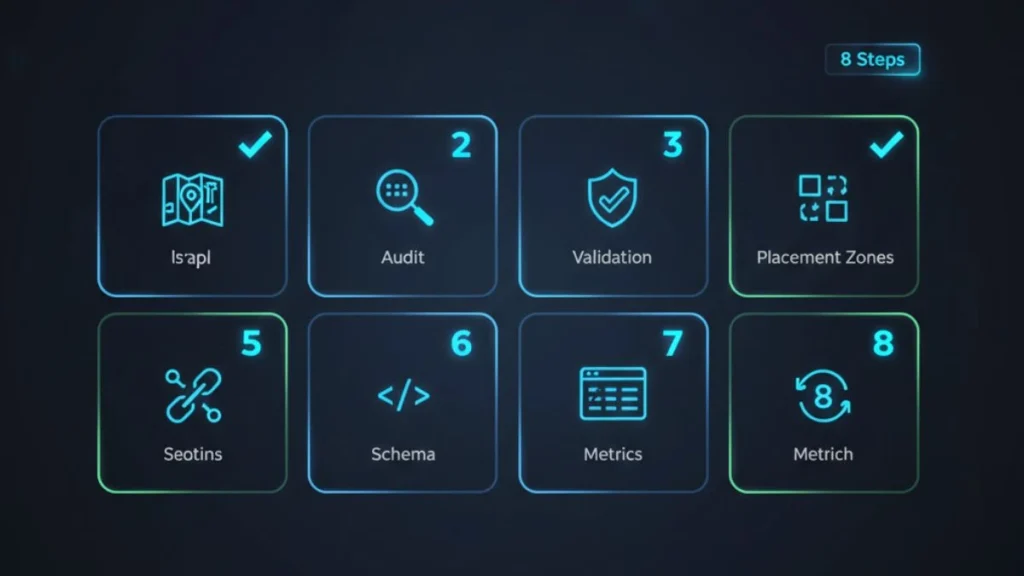
Optimizing content for semantic relevance requires a systematic approach that goes beyond traditional keyword placement. This eight-step checklist transforms generic articles into topical authority signals by addressing entity relationships, content depth, and contextual connections that modern search algorithms prioritize. Each step builds on the previous one to create comprehensive semantic coverage that captures rankings across multiple related queries.
Step 1: Map your primary topic entity and related concepts
Begin by identifying the core entity your content addresses not the keyword, but the actual concept or subject matter. For “B2B lead generation,” the primary entity is the business process of acquiring qualified prospects, not the phrase itself. Use entity extraction tools to reveal how Google categorizes this topic within its Knowledge Graph.
Next, identify the mandatory co-occurring entities that define topic completeness. For lead generation content, Google expects to see related concepts like “marketing qualified leads,” “sales funnel stages,” “conversion rate optimization,” and “lead scoring systems.” Pages missing these connected entities appear superficial regardless of word count or keyword density.
Document the semantic relationship map between your primary entity and supporting concepts. This isn’t a keyword list it’s a knowledge structure showing how ideas connect logically. A complete semantic map for “content marketing ROI” must link measurement methodologies, attribution models, performance metrics, and business impact frameworks that together demonstrate comprehensive topic understanding.
Step 2: Audit existing content for semantic gaps
Run your current article through natural language processing tools that identify entity coverage versus topical expectations [best-semantic-seo-tools]. Compare your entity mentions against top-ranking competitors addressing the same subject. A gap analysis revealing you’ve covered 12 related entities while position-one pages average 23 signals immediate optimization opportunities.
Focus on entity relationship accuracy, not just entity mentions. If your content claims “marketing automation improves lead quality” without explaining the operational connection between nurture campaigns and qualification criteria, you’re listing entities without demonstrating knowledge. Google validates whether your entity relationships reflect actual domain expertise or superficial term matching.
Identify which critical entities remain completely absent from your content. If a piece on “B2B SEO strategy” never mentions “buyer journey stages,” “technical decision-maker targeting,” or “long sales cycle optimization,” you’ve signaled incomplete topic treatment. These gaps prevent comprehensive semantic coverage regardless of how well you’ve optimized present entities.
Step 3: Validate entity relationships against Google’s Knowledge Graph
Cross-reference your entity connections against how Google actually maps these concepts. When you claim “content syndication builds domain authority,” verify this relationship aligns with technical reality syndication typically uses canonical tags that don’t transfer authority. Inaccurate entity relationships damage E-E-A-T signals faster than missing entities reduce rankings.
Use Google’s “People Also Ask” and “Related Searches” to identify which entity relationships the algorithm considers mandatory for your topic [what-are-semantic-keywords]. If every top-ranking page connects “lead scoring” with “CRM integration” and “sales alignment,” your content must demonstrate this same relationship pattern to compete semantically.
Test entity disambiguation accuracy by ensuring context clearly defines which specific entity you’re addressing. The term “conversion” could reference website conversion rates, sales conversion metrics, or currency conversion in international contexts. Ambiguous entity usage confuses semantic parsing and reduces topical relevance signals.
Step 4: Optimize entity placement in high-priority content zones
Strategic entity placement amplifies semantic signals beyond what natural distribution achieves. Position your primary entity and top three supporting entities within the first 100 words to establish immediate topical focus. This early placement helps algorithms quickly categorize your content’s semantic territory.
Include related entities in H2 and H3 subheadings to reinforce topic structure. Instead of generic headers like “Key Benefits” or “Best Practices,” use entity-rich alternatives: “How Lead Scoring Criteria Improve MQL Quality” or “Attribution Model Selection for Multi-Touch Campaigns.” These semantic headers strengthen topical coherence while improving scannability.
Distribute secondary entities naturally throughout body content rather than clustering them in single paragraphs. Entity co-occurrence patterns matter, but forced proximity looks manipulative. Mention “customer acquisition cost” when discussing budget frameworks, “lifetime value” when addressing retention strategies, and “churn analysis” when covering performance metrics contextually appropriate placement signals expertise rather than optimization.
Step 5: Build internal links that reinforce entity relationships
Transform internal linking from anchor text optimization to semantic relationship mapping. Link “semantic keyword research” to “entity mapping frameworks” because these concepts connect logically, not because you need keyword-rich anchors. This contextual linking demonstrates how entities relate within your broader topic ecosystem.
Connect to pillar content that establishes comprehensive topic authority . When discussing specific entity applications in satellite content, link to pillar pages that cover the strategic framework. This architecture mirrors how Google evaluates expertise through demonstrated knowledge networks rather than isolated page relevance.
Ensure every piece of semantic content links to at least two other topic areas beyond its immediate cluster. An article on “LSI keywords vs semantic entities” [lsi-keywords-vs-semantic-entities-which-drives-better-rankings] should connect to both technical implementation guides and strategic planning frameworks, breaking silos that limit topical authority signals.
Step 6: Implement structured data markup for entity clarity
Add Schema.org markup that explicitly declares which entities your content addresses. Article schema, HowTo schema, and FAQ schema help Google parse entity relationships with technical precision that complements natural language signals. This structured validation reinforces the semantic comprehensiveness your content demonstrates.
Use entity-specific schema types when available. For product comparisons, implement Product schema with defined attributes. For process documentation, use HowTo schema with explicit step entities. This technical layer removes ambiguity about which entities you’re covering and how they relate within your content structure.
Step 7: Measure semantic coverage against topical benchmarks
Establish entity coverage thresholds based on competitive analysis. If comprehensive topic treatment in your niche requires addressing 18-22 related entities across 2,500 words, use these benchmarks to assess whether content reaches semantic completeness. Superficial coverage with 8-10 entities won’t compete regardless of keyword optimization quality.
Track entity relationship accuracy as a quality metric beyond entity mention frequency. One article accurately connecting 15 entities through demonstrated knowledge outranks content that lists 25 entities without explaining relationships. Depth of entity understanding matters more than breadth of entity inclusion.
Monitor how your semantic optimization affects rankings across query variations, not just target keywords. Proper semantic coverage should improve visibility for 10-15 related searches simultaneously as Google recognizes your comprehensive topic treatment. If rankings improve for only your exact target term, you’re still optimizing mechanically rather than semantically.
Step 8: Update content based on entity evolution and algorithm signals
Revisit semantic optimization quarterly as Google’s Knowledge Graph expands and entity relationships evolve. New entity connections emerge as industries change “AI-powered lead scoring” became a critical entity in marketing automation content only after 2023. Regular entity audits ensure your topical coverage remains current.
Analyze which entity gaps persist across your content ecosystem despite individual page optimization. If ten articles about B2B marketing never adequately cover “multi-stakeholder decision processes,” this systematic entity absence limits your overall topical authority. Address these gaps strategically rather than through isolated page updates.
From checklist to continuous semantic practice
These eight steps transform semantic optimization from one-time implementation to ongoing strategic practice. Initial execution establishes baseline semantic coverage, but sustained topical authority requires continuous entity relationship refinement as your knowledge demonstrates deepens .
The checklist provides immediate tactical wins entity gap filling, relationship validation, structured markup while building toward strategic advantages that compound over time. Each semantically optimized article strengthens related content’s authority signals, creating network effects traditional page-level optimization cannot achieve.
Semantic SEO fundamentally shifts content quality assessment from keyword metrics to knowledge demonstration. This checklist operationalizes that philosophical change into concrete actions that measurably improve how search algorithms evaluate your topical expertise and comprehensive coverage.
Ready to audit your content ecosystem for semantic optimization opportunities? Apply this framework systematically to build sustainable topical authority that withstands algorithm evolution.