
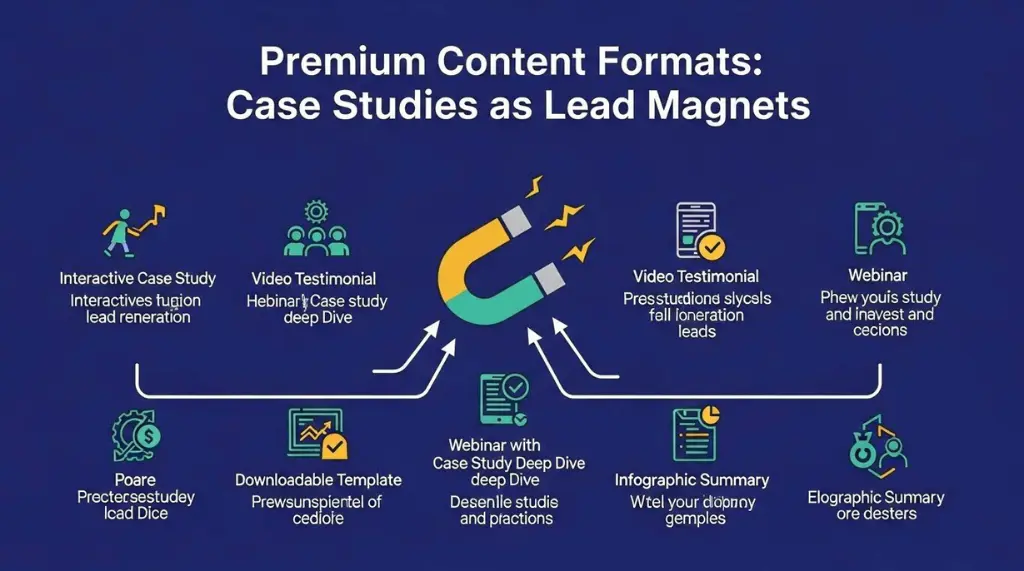
Image by [MERIEM AB] & [IMAGE FX & CANVA].
A written case study on your blog is only the first life of the story. When you repurpose it into premium formats like gated PDFs, playbooks, webinars, or interactive demos, it becomes a lead magnet you can use in campaigns, nurturing flows, and sales conversations. Choosing the right premium format depends on your audience, sales cycle, and the system you design in your [content marketing case study system guide] to keep everything coherent.
Why do premium content formats matter for case studies?
Most teams publish case studies as blog posts and stop there. They miss the opportunity to extract exponentially more value from the same client story by adapting it into formats that serve different channels, buyer stages, and engagement preferences. A blog post reaches organic search traffic. A gated PDF captures email addresses from high-intent prospects. A webinar builds personal connection and allows real-time objection handling. A video testimonial shortens sales cycles by building trust faster than text alone.
Premium formats transform case studies from passive content into active lead generation and conversion assets. When you gate a case study as a downloadable resource, you identify prospects who are actively researching solutions and willing to exchange contact information for proof. When you present a case study in a webinar, you create urgency and community around your expertise. When you package multiple case studies into an industry-specific playbook, you position yourself as the definitive authority in that vertical.
We recommend planning premium format repurposing during the initial case study creation phase rather than treating it as an afterthought. When you know a story will become a video, PDF, and slide deck, you collect richer visual assets, structure interviews for quotable soundbites, and design data presentations that work across multiple formats.
What mindset shift is required to maximize case study ROI?
From “publishing content” to “building assets”
The traditional content marketing mindset treats each piece as a discrete publication: write it, publish it, move on. The premium format mindset treats each case study as raw material for an asset suite that compounds in value over time.
A single well-documented case study can become a 2,000-word blog post, a 15-page gated PDF with additional data visualizations, a 45-minute webinar featuring the client as a guest speaker, a 3-minute video testimonial for your homepage, a slide deck for sales enablement, six social media quote graphics, and a chapter in an annual industry report. Each format serves a different audience segment and stage of the buyer journey, multiplying the return on your initial case study investment.
This shift requires thinking about case studies as modular content systems rather than finished articles. During planning and production, you capture more data than you will use in any single format, collect multiple media types including photos and screen recordings, and structure narratives so they can be condensed or expanded depending on the format requirements.
How do you choose the right premium format for your Case study?
Match format to buyer journey stage and channel
Not every case study needs every format. The strategic question is: where do your ideal prospects spend time, and what format best serves their needs at each stage of consideration?
Early-stage prospects discovering your brand through social media or paid ads respond well to short-form video testimonials and infographics that communicate transformation quickly. Mid-stage prospects actively comparing solutions benefit from gated PDF case studies with detailed methodology sections and ROI calculators they can share internally. Late-stage prospects close to a decision gain confidence from live webinars where they can ask questions directly to your team and the featured client.
For B2B audiences with long sales cycles and committee-based decisions, prioritize formats that are easy to share internally: PDF downloads, slide decks, and one-pagers that decision-makers can forward to stakeholders. For B2C audiences with shorter consideration windows, prioritize formats that build emotional connection quickly: video testimonials, before-and-after photo stories, and interactive calculators that personalize the value proposition.
The [content marketing case study system guide] provides a decision matrix that maps case study formats to specific buyer personas, industries, and deal sizes, helping you allocate production resources to the formats with the highest conversion potential for your business model.
Consider Production Complexity and Resource Availability
Premium formats vary dramatically in production cost and timeline. A gated PDF might require 4-6 hours of design work. A professionally produced video testimonial might require travel, filming, editing, and client coordination spanning several weeks. A webinar requires platform setup, promotion, live facilitation, and post-event follow-up.
Start by inventorying your internal capabilities and budget. If you have strong design resources but limited video production experience, prioritize PDF playbooks and slide decks initially. If you have an engaged audience and live presentation skills, webinars offer high ROI with moderate production complexity. If you have budget for external vendors, video testimonials create differentiation that is difficult for competitors to replicate.
The key is consistency over perfection. It is better to systematically repurpose every case study into two or three premium formats you execute well than to attempt ambitious multi-format strategies that stall in production and never reach your audience.
What are the most effective premium content formats for case studies?
Gated PDF case studies: the Lead generation Workhorse
A gated PDF transforms your blog case study into a lead capture asset. The format works because it offers prospects a portable, shareable version they can read offline, annotate, and circulate to decision-making committees without requiring them to return to your website.
High-performing gated PDFs include elements beyond the blog version: executive summaries that busy stakeholders can scan in 60 seconds, expanded data sections with charts and comparison tables, implementation timelines that show month-by-month progression, and resource lists linking to related methodologies. The added value justifies the email exchange and positions the PDF as a strategic resource rather than a reformatted blog post.
Structure your gated PDF with internal navigation. Include a clickable table of contents, page numbers, and clear section breaks so readers can jump directly to the information most relevant to their evaluation criteria. When prospects can quickly find the ROI calculation or the implementation challenges section, they stay engaged longer and perceive higher value.
For distribution strategy, promote gated case study PDFs through targeted paid campaigns, email nurture sequences, and as downloadable resources on high-intent landing pages. Track which lead sources generate the highest-quality conversions so you can allocate budget to channels where case study content performs best.
Video testimonials: building trust at scale
Video case studies compress emotional connection and credibility into formats that prospects consume in minutes rather than reading for 10-15 minutes. A three-minute client testimonial featuring the decision-maker explaining their challenge, your solution, and their results builds trust faster than any written narrative because prospects see real people, hear authentic voices, and assess body language that signals genuine satisfaction.
The most effective video testimonials follow a simple three-act structure: the client describes their situation before working with you, they walk through the key moments of the transformation, and they share specific results with visible enthusiasm. Keep production values professional but not overly polished—authenticity matters more than cinematic quality for B2B audiences evaluating vendor credibility.
Repurpose video testimonials across multiple channels. Embed the full version on product pages and case study landing pages. Extract 30-second clips for social media ads highlighting specific results. Create audio-only versions for podcast sponsorships or nurture email sequences. Provide sales teams with the video file so they can share it directly during proposal presentations or follow-up conversations.
For B2C audiences, video case studies work particularly well on product pages where prospects are close to purchase but need final reassurance. Featuring customers who match your target demographic discussing their transformation creates identification and reduces perceived risk.
Interactive case study tools: personalization at scale
Interactive formats allow prospects to input their own parameters and see customized results based on your proven case study data. An ROI calculator built around a case study lets prospects enter their current metrics and project potential outcomes using your methodology. A diagnostic tool asks prospects questions about their situation and recommends specific case studies that match their profile.
These interactive tools serve two purposes. First, they increase engagement time and emotional investment—prospects who spend 5-10 minutes exploring an interactive tool develop stronger intent than those who passively read. Second, they generate behavioral data that sales teams use for prioritization and personalization. When a prospect uses your ROI calculator and projects significant value, that signal justifies immediate outreach.
Build interactive case study tools using simple platforms that integrate with your CRM and marketing automation systems. The goal is not technical sophistication but strategic insight. Every interaction should teach you something about prospect priorities, constraints, or urgency that helps sales teams customize their approach.
The measuring case study ROI guide explores exactly how to design ROI calculators and measurement frameworks that connect case study narratives to quantifiable business outcomes prospects can defend internally.
How do you maintain quality across multiple formats?
Establish format-specific checklists
Each premium format has unique quality standards. A gated PDF needs professional layout, accessible fonts, and consistent branding. A video testimonial requires clear audio, good lighting, and tight editing. A webinar needs rehearsed transitions, backup technology plans, and prepared Q&A responses.
Create checklists for each format that your team follows before publishing. The PDF checklist includes items like “Does the executive summary fit on one page?” and “Are all internal links functional?” The video checklist includes “Is audio clear in the first 10 seconds?” and “Does the client name appear as a lower-third graphic?” These checklists prevent quality inconsistencies that undermine credibility when prospects evaluate your professionalism through your content.
Use templates to scale production
Premium format production becomes exponentially more efficient when you build reusable templates. Design one master PDF template with placeholder sections for client story, metrics, implementation, and resources. Create one video testimonial script outline that works across industries with minor customization. Develop one webinar presentation deck structure that you populate with case-specific content.
Templates ensure brand consistency, reduce production time, and allow you to delegate format creation to junior team members without sacrificing quality. The initial investment in template design pays dividends across dozens of case studies as your library scales.
How do you distribute premium case study formats for maximum impact?
Match distribution channels to format strengths
Each premium format performs best in specific channels. Gated PDF case studies convert highest when promoted through targeted LinkedIn ads to decision-makers actively researching solutions, through dedicated landing pages optimized for high-intent keywords, and through email campaigns to engaged leads who have already consumed related content.
Video testimonials generate strongest engagement when embedded on product pages where purchase intent peaks, shared in sales follow-up emails to reinforce verbal pitches, and promoted through YouTube and social platforms where algorithm-driven discovery introduces your brand to new audiences. Webinar case studies work best when promoted to existing email lists with established trust and through partner co-marketing where you leverage another organization’s audience credibility.
Strategic distribution means aligning format characteristics with channel expectations and audience behavior. Do not simply publish every format everywhere—test systematically, measure performance by channel and format combination, and double down on the pairings that generate qualified pipeline rather than vanity metrics like downloads or views.
Create Multi-touch campaigns around premium case studies
A single exposure to a case study rarely drives conversion. Build campaigns that expose prospects to the same client story through multiple formats across 3-5 touchpoints. Start with a social media teaser highlighting one compelling metric. Follow with a gated PDF download offer in a retargeting ad. Send an email featuring video testimonial clips to leads who downloaded the PDF. Invite high-engagement prospects to a live webinar where they can ask questions directly.
This multi-format sequencing reinforces your message, accommodates different learning preferences, and signals that you have comprehensive proof rather than isolated success stories. Prospects who engage with case studies across multiple formats demonstrate higher purchase intent and close at rates 2-3 times higher than single-touch leads.
Coordinate campaigns with your sales team so they can reference specific case study formats during conversations. When a sales rep knows a prospect downloaded the manufacturing case study PDF, they can reference specific sections during discovery calls and offer the webinar replay as a value-add that keeps momentum between meetings.
How do you measure the performance of premium case study formats?
Track format-specific conversion metrics
Each premium format requires tailored measurement. For gated PDFs, track download conversion rate, lead quality score based on demographic and firmographic data, and progression rate from download to sales-qualified lead. For video testimonials, measure view completion rate, engagement time, and correlation with shortened sales cycles. For webinars, track attendance rate, question engagement during Q&A, and post-event demo request conversion.
Connect these format metrics to revenue outcomes. Use multi-touch attribution to understand which case study formats appear most frequently in closed-won deal paths. Interview recent customers about which content influenced their decision. Ask sales teams which formats shorten objection handling and accelerate deal velocity. These qualitative and quantitative signals reveal which premium formats justify continued investment.
The methodology for building comprehensive case study measurement systems is detailed in the measuring case study ROI guide, which provides frameworks for connecting content engagement to pipeline and revenue rather than stopping at top-of-funnel vanity metrics.
Run A/B tests on format variations
Optimize premium format performance through systematic testing. Test different gated PDF page lengths to find the optimal balance between comprehensive value and reader commitment. Test video testimonial lengths to identify whether 2-minute or 5-minute versions generate higher engagement and conversion. Test webinar topics, guest speakers, and call-to-action timing to improve registration and attendance rates.
Document winning variations in your format templates so improvements compound across future case studies. When you discover that executive summary pages in PDFs increase download-to-lead conversion by 18%, make that element standard in every subsequent gated case study. This continuous optimization transforms premium format production from creative experimentation into data-driven systems that predictably generate qualified pipeline.
How premium formats amplify your entire case study system
Premium content formats are not standalone tactics—they are distribution multipliers that amplify the strategic value of your case study library. When you systematically repurpose every client story into 3-4 premium formats, you create an asset suite that works across every channel, campaign, and sales conversation in your go-to-market strategy.
This format diversity also future-proofs your content investment. As new platforms emerge and audience preferences shift, you have modular assets ready to deploy rather than needing to recreate proof points from scratch. A case study with video, PDF, slide deck, and interactive tool versions can quickly adapt to TikTok, LinkedIn newsletters, partner webinars, or whatever distribution channels dominate in the next 12-24 months.
The integration of premium formats into your broader content ecosystem is central to the content marketing case study system guide, which shows how to build production workflows, distribution calendars, and measurement dashboards that treat case studies as living assets that compound in value rather than one-time publications that decay after launch.
When you combine strategic format selection, systematic repurposing, coordinated distribution, and rigorous measurement, premium content formats transform case studies from blog posts into revenue-generating assets that justify their production cost many times over.