
On-page SEO determines whether your B2B website captures qualified traffic or remains invisible in competitive search results. While technical SEO handles infrastructure and off-page SEO builds authority through backlinks, on-page optimization controls the elements you directly manage: content quality, keyword targeting, structure, and user signals. These factors represent 40-50% of your ranking potential and directly influence whether prospects trust your expertise enough to engage.
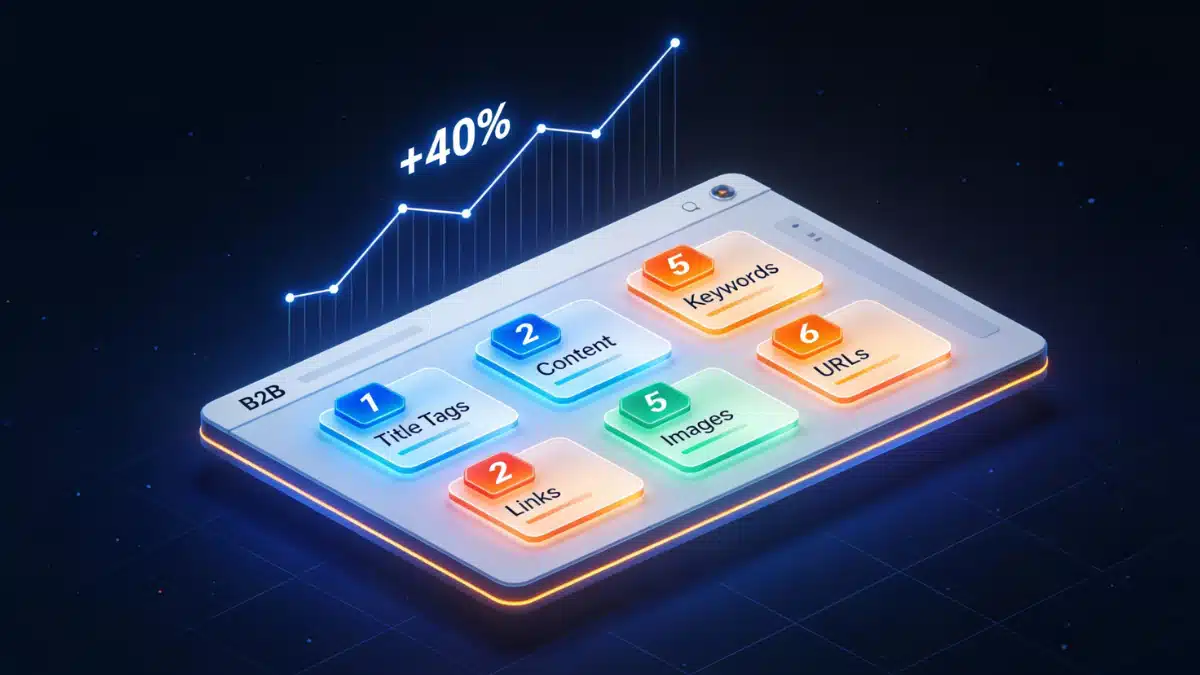
The challenge for B2B companies isn’t awareness that on-page SEO matters it’s knowing which elements deliver ROI and which waste resources on marginal improvements. A manufacturing company migrating from offline sales to digital channels doesn’t need perfect optimization across 200 ranking factors. They need strategic focus on the six elements that control 80% of their visibility : title tags, content structure, keyword placement, internal linking, image optimization, and URL architecture.
We recommend viewing on-page SEO as a system rather than a checklist. Each element amplifies the others strategic keyword placement works better when supported by clear content structure, which performs better with optimized internal links distributing authority to priority pages. This interconnected approach separates websites that rank consistently from those that struggle despite publishing regularly.
Search engines have evolved beyond simple keyword matching to evaluate comprehensive quality signals. Google’s algorithms now assess content depth, E-E-A-T (Experience, Expertise, Authoritativeness, Trustworthiness), user engagement metrics, and semantic relevance. Your on-page optimization must satisfy both algorithmic requirements and human expectations technical perfection without user value fails, as does valuable content that search engines can’t properly interpret.
This guide provides the complete on-page optimization framework that B2B companies use to transition from low-visibility to dominant market positions. Each section addresses one core optimization element, explaining not just what to do but why it matters and how it integrates with other components for compound impact.
How to optimize title tags and meta descriptions for click-through rate?
Title tags and meta descriptions control your first impression in search results, directly determining whether qualified prospects click your listing or competitors. These elements serve dual purposes: they signal relevance to search algorithms while functioning as persuasive copy that differentiates your result from nine others on the same page.
Why title tags matter for rankings and clicks
Title tags represent one of the strongest on-page ranking factors. Google uses them to understand page content and match queries to relevant results. But their real power lies in click-through rate influence a compelling title can increase organic traffic by 20-30% without improving your ranking position.
For B2B audiences, title tags must balance keyword targeting with specific value propositions. Generic titles like “SEO services” compete with thousands of identical options. Specific titles like “enterprise SEO platform: manage 10,000+ pages without technical resources” immediately communicate unique value while incorporating target keywords.
We recommend the proven formula: primary keyword + quantified benefit + qualifier, limited to 50-60 characters. This structure maximizes both algorithmic relevance and human appeal. “B2B content strategy: 47-point audit that identified $2M in missed opportunities” tells prospects exactly what they’ll get while targeting their search query.
What makes meta descriptions effective
Meta descriptions don’t directly influence rankings but dramatically affect whether users click your result. Google rewrites 60-70% of meta descriptions that don’t align with search intent, making strategic crafting essential for maintaining message control.
Effective meta descriptions follow a template: target audience/role + problem or goal + specific deliverable + light call-to-action, within 140-160 characters. “Manufacturing executives struggling with digital visibility use this on-page optimization framework to identify and fix the ranking gaps keeping qualified prospects from finding their solutions.
Numbers, specificity, and active voice create stronger engagement than generic descriptions. “Discover the title tag formula that increased our clients’ CTR by 47%” outperforms “learn about title tag optimization” by creating concrete expectations and implying proven methodology.
[How to optimize title tags and meta descriptions for higher click-through rate provides the complete methodology for crafting titles and descriptions that maximize both rankings and clicks, including A/B testing frameworks and CTR benchmark data by industry and search intent].
How to structure your content for better SEO and user experience?
Content structure determines whether users stay engaged or bounce within seconds of landing on your page. Search engines evaluate structural organization to understand topical depth and content quality, while users scan headers and formatting to quickly assess relevance before committing time to read.
Why header hierarchy controls rankings
Proper header hierarchy (H1, H2, H3) creates a content outline that search engines use to understand your page’s topical coverage. Every page needs exactly one H1 that defines the main topic, with H2 tags dividing content into major sections and H3 tags providing granular detail under each H2.
Skipping heading levels jumping from H2 directly to H4 breaks semantic structure and confuses both crawlers and screen readers serving vision-impaired users. This accessibility failure increasingly impacts rankings as Google prioritizes sites demonstrating inclusive design.
For B2B content targeting decision-makers who scan before reading, descriptive headers function as mini-value propositions. “Introduction” wastes an H2 opportunity, while “Why manufacturing companies lose 60% of qualified traffic to poor content structure” communicates specific value and incorporates relevant keywords naturally.
What makes content scannable and engaging
Paragraph length directly impacts engagement and bounce rate. Keep paragraphs between 2-4 sentences (40-70 words) to maintain readability on mobile devices where long blocks become intimidating walls of text. Research shows that 54% of Americans read below sixth-grade level, making concise paragraphs essential for broad accessibility.
Strategic use of bullet points and numbered lists optimizes for featured snippets while improving user experience. Google frequently extracts structured content for position zero because lists make information extraction straightforward. We recommend formatting at least one section per page as a list targeting snippet opportunities.
Whitespace distribution reduces cognitive load by 20%. Dense content without breathing room overwhelms readers and triggers immediate exits. B2B audiences particularly benefit from generous spacing because they often multitask while researching adequate whitespace allows them to easily resume reading after interruptions without losing their place.
[How to structure your content for better SEO and user experience delivers the complete framework for organizing content with proper header hierarchies, optimal paragraph lengths, and strategic formatting that doubles engagement metrics while satisfying algorithmic quality requirements].
Where should you place keywords for maximum SEO impact?
Keyword placement has evolved beyond simple density calculations into strategic positioning that signals topical authority without triggering over-optimization penalties. Modern search algorithms evaluate where keywords appear, how they’re used contextually, and whether surrounding content supports comprehensive topic coverage.
What are the eight priority keyword zones?
Your H1 tag should contain your primary keyword, ideally front-loaded near the beginning. This represents the strongest on-page relevance signal after the title tag. “Keyword research tools for B2B SEO” outperforms “the complete guide to tools you can use for B2B SEO keyword research” by placing the target phrase prominently.
The first 100-150 words carry disproportionate weight for relevance calculations. Search engines assume early content establishes topic focus, while users scanning your introduction need immediate confirmation they’ve found the right resource. Including your primary keyword naturally in the opening paragraph satisfies both requirements.
We recommend incorporating primary keywords or close variations in 2-3 subheadings throughout your content. This reinforces topical relevance while creating multiple entry points for users scanning your page structure. H2 tags like “How to develop link building strategies for B2B” naturally include keyword variations while maintaining clarity.
Your URL should contain the primary keyword in shortened, readable format. “example.com/keyword-research-tools” provides a relevance signal while improving click-through rates compared to cryptic alternatives like “example.com/p?id=12345.”
How do you avoid keyword stuffing penalties?
Maintain 1-2% keyword density for primary keywords 10-20 mentions per 1,000 words. This range signals relevance without triggering spam filters. Focus on semantic keyword usage rather than exact-match repetition: if your primary keyword is “email marketing automation,” related terms like “automated email campaigns” and “marketing automation tools” provide topical support without redundancy.
Keyword variations prevent the unnatural patterns that modern algorithms easily detect. Using synonyms, plurals, and different word orders creates natural language flow while helping you rank for multiple related queries. “Content marketing strategy,” “content strategy framework,” and “marketing content planning” all support the same topical focus.
Context matters more than frequency. A keyword appearing once in a strategic location (H1, first paragraph, URL) carries more weight than appearing ten times randomly throughout body content. Prioritize high-impact zones, then allow natural writing to achieve optimal density through contextual usage.
[Where should you place keywords for maximum SEO impact reveals the eight high-priority placement zones, optimal density calculations, and LSI keyword integration strategies that maximize relevance signals while maintaining the conversational tone required for modern content that converts].
How to build authority with strategic internal links?
Internal linking represents the most underutilized on-page SEO lever available to B2B companies. While external backlinks capture attention, strategic internal links distribute authority across your site, establish topical relationships, and guide both users and search crawlers through your content ecosystem. Sites with strong internal linking architectures rank for 40% more keywords than those with weak structures.
Why internal linking matters for topical authority
Internal links serve three critical functions: they distribute page rank from high-authority pages to strategic targets, they establish topical relationships between related content, and they improve crawl efficiency by helping search engines discover and index pages faster. Google’s algorithms evaluate internal linking patterns to understand site architecture and determine which pages represent your most important content.
Pages with 5-10 quality internal links pointing to them signal higher value and typically rank better than orphaned pages with few or no internal links. This authority distribution allows new content to benefit immediately from established pages’ accumulated ranking power rather than waiting months to build independent authority.
For users, internal links provide navigation and context that reduces bounce rate while moving prospects through the buyer journey. A visitor reading about keyword research who encounters a contextual link to “how to analyze search intent” can deepen their knowledge without leaving your site metrics that correlate directly with improved rankings.
What is topic cluster architecture?
Topic clusters organize content into pillar pages (hubs) covering broad topics comprehensively, supported by cluster pages (spokes) diving deep into specific subtopics. Each cluster page links back to the pillar, and the pillar links to all its clusters, creating tight topical networks that signal comprehensive expertise to search engines.
This architecture accomplishes multiple objectives simultaneously: it demonstrates subject matter authority, distributes page rank efficiently from pillars to supporting content, and creates clear navigation paths for users exploring related topics. A B2B SaaS company might have a “marketing automation” pillar with clusters covering “email workflows, “lead scoring,” “CRM integration,” and “ROI measurement.”
We recommend using descriptive anchor text that includes target page keywords rather than generic “click here” phrases. Our keyword research guide provides step-by-step instructions for identifying high-intent keywords” signals relevance while providing context about destination content. Include 2-5 contextual internal links per 1,000 words for optimal balance between user value and authority distribution.
[How to build authority with strategic internal links provides the complete methodology for implementing topic cluster architecture, optimizing anchor text, and distributing page rank from high-authority pages to strategic targets that need ranking boosts].
How to optimize images for SEO performance and accessibility?
Images account for 50-60% of total page weight on most B2B websites, yet they remain one of the most neglected optimization opportunities. Unoptimized images slow page speed, hurt core web vitals scores, and miss valuable traffic from Google image search which represents approximately 22% of all Google searches and billions of monthly opportunities to capture qualified traffic.
Why image optimization impacts rankings
Properly optimized images improve page load speed, a confirmed ranking factor and critical component of core web vitals. Pages loading in under 2.5 seconds rank significantly higher than slower alternatives, and image optimization often represents the fastest path to meaningful speed improvements. A single uncompressed 5MB image can delay page load by 3-4 seconds on average mobile connections, devastating both user experience and rankings.
Beyond technical performance, images provide accessibility for visually impaired users relying on screen readers. Alt text the HTML attribute describing image content serves dual purposes: it enables screen readers to vocalize image descriptions for vision-impaired users, and it gives search engines context about image content since algorithms can’t “see” images the way humans do.
Content with relevant images receives 94% more views than text-only alternatives, and users retain 65% more information when visual elements support written content. These engagement improvements lower bounce rates and longer time on page signal quality to search engines and correlate directly with ranking improvements.
What are the core image optimization priorities?
Alt text should be descriptive and specific, under 125 characters when possible. Instead of “graph,” write “line graph showing 47% increase in organic traffic from January to December 2024.” Include target keywords naturally when your image genuinely illustrates them, but never force keywords that don’t accurately describe image content.
File names provide search engines another data point for understanding image content. Rename files before uploading: “content-marketing-workflow-diagram.jpg” communicates context, while “IMG_20241115.jpg” provides no SEO value. Use hyphens to separate words (search engines treat hyphens as word separators but read underscores as single words).
We recommend WebP format for most use cases it offers 30-50% smaller file sizes than JPEG with equivalent quality. Target 100-200KB maximum for hero images and 50-100KB for body images. Implement lazy loading for below-the-fold images using the native loading="lazy" HTML attribute to defer loading until images approach the viewport, reducing initial page weight and improving load speed.
[How to optimize images for SEO performance and accessibility delivers the complete framework covering alt text best practices, file compression techniques, modern format selection, lazy loading implementation, and structured data that captures image search traffic while improving core web vitals scores].
How to create SEO-friendly URLs that rank and convert?
URL structure communicates relevance before users even click your result. Clean, descriptive URLs build trust and improve click-through rates by 20-30% compared to messy alternatives filled with parameters or cryptic characters. This permanent optimization decision impacts every future page you publish changing URLs later requires redirects that risk losing accumulated authority.
Why URLs matter for rankings and trust
Search engines use URLs as a relevance signal, though less powerful than title tags or content. Keywords appearing in URLs contribute to topical understanding, particularly for competitive queries where multiple relevance signals determine rankings. Google has confirmed that URLs provide a ranking boost when they clearly describe page content.
URL structure impacts site architecture and crawl efficiency. Logical hierarchies help search engines understand content relationships and prioritize crawling. A URL like “example.com/services/seo/technical-seo” clearly shows content hierarchy services > SEO > technical SEO helping both users and crawlers navigate your site efficiently.
For B2B audiences, professional URL structure signals attention to detail that extends to your products and services. A well-structured URL like “example.com/b2b-seo-strategy” communicates credibility, while “example.com/p?id=12345&cat=seo&ref=abc” creates uncertainty that reduces click-through rates before prospects even reach your content.
What makes URLs SEO-friendly?
Keep URLs under 60-80 characters total, with slugs limited to 3-5 words. Shorter URLs display fully in search results, are easier to remember and share, and correlate with higher rankings. “b2b-keyword-research-guide” communicates the same information as “ultimate-comprehensive-complete-guide-to-b2b-keyword-research-strategies” while avoiding truncation.
Use hyphens to separate words, never underscores. Search engines treat hyphens as word separators but interpret underscores as word connectors. “keyword-research” is read as two words; “keyword_research” is interpreted as one nonsensical word. This distinction affects keyword matching and relevance signals.
We recommend incorporating your primary keyword in the URL slug when it fits naturally. If targeting “B2B lead generation strategies,” a URL like “example.com/b2b-lead-generation-strategies” clearly signals relevance. Remove stop words (a, the, of, for) that add length without SEO value: “example.com/guide-seo” is cleaner than “example.com/the-guide-to-seo.”
Use HTTPS protocol exclusively it’s a confirmed ranking factor. Google prioritizes secure sites, and Chrome displays warning messages for HTTP sites collecting user data. Maintain lowercase letters consistently to avoid duplicate content issues, as some servers treat “Example.com/SEO” and “example.com/seo” as different URLs.
[How to create SEO-friendly URLs that rank and convert teaches the best practices for URL length, keyword incorporation, hierarchy implementation, and common mistakes that hurt B2B websites, ensuring your URL structure supports both user trust and search performance].
On-page SEO represents the foundation of sustainable organic visibility for B2B companies. While algorithms evolve and ranking factors shift, the core principles remain constant: clear communication of topical relevance, exceptional user experience, and comprehensive demonstration of expertise through content depth and structural organization.
The six elements covered in this framework title tags, content structure, keyword placement, internal linking, image optimization, and URL architecture interact synergistically rather than functioning independently. Strategic keyword placement works better when supported by clear header hierarchies, which perform better with optimized internal links distributing authority to priority pages, all accelerated by fast-loading images and trust-building URLs.
We recommend implementing on-page optimization systematically rather than attempting perfect execution across all elements simultaneously. Start with title tags and meta descriptions on your top 10 organic landing pages these deliver immediate CTR improvements without requiring content rewrites. Then address content structure and keyword placement before moving to internal linking architecture and technical elements like image compression.
The businesses dominating competitive B2B niches aren’t executing 200 optimization tactics they’re mastering these six foundational elements and executing them consistently across all content. A manufacturing company ranking page 1 for “industrial automation solutions” didn’t get there through advanced schema markup or perfect technical SEO. They got there through strategic keyword targeting in optimized title tags, comprehensive content structured for both users and algorithms, internal linking that establishes topical authority, and attention to details like image alt text and clean URLs that compound over time.
Track performance metrics that matter: organic traffic to priority pages, rankings for target keywords, conversion rates from organic visitors, and engagement signals like time on page and bounce rate. These metrics reveal whether your on-page optimization generates business value or merely satisfies algorithmic requirements without driving revenue.
[How to optimize title tags and meta descriptions for higher click-through rate provides the most immediate value implementing compelling titles and descriptions on existing high-traffic pages can increase organic visitors by 20-30% within weeks without requiring content rewrites or technical changes, making it the optimal starting point for B2B companies beginning their on-page optimization journey].
Your on-page SEO foundation determines whether prospects find your expertise when researching solutions or whether they discover competitors first. The difference between page 1 visibility and page 3 obscurity often comes down to consistent execution of these six elements across your priority content not perfect optimization, but strategic focus on the factors that control 80% of your ranking potential.