
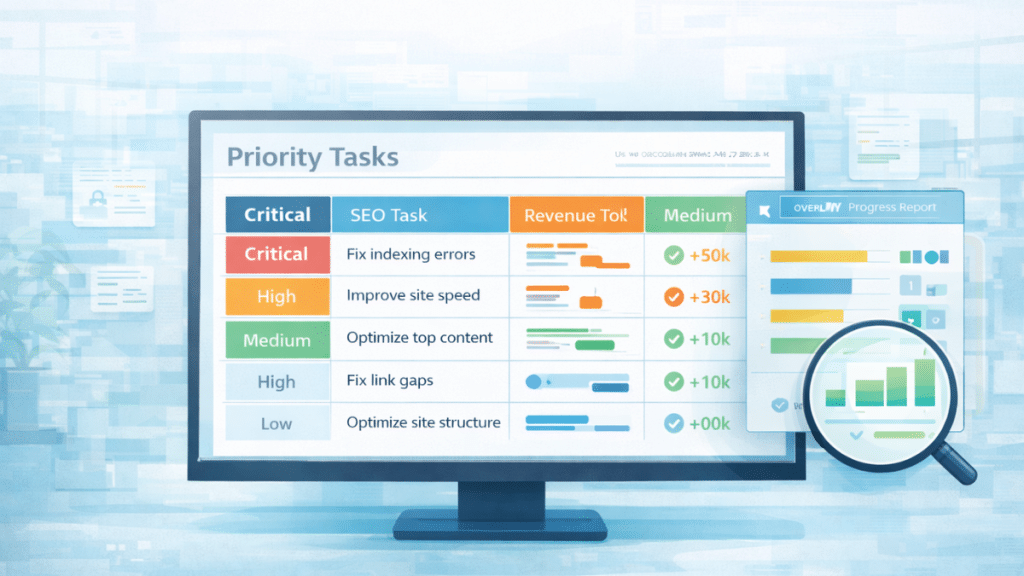
Most SEO audits don’t fail because the analysis is wrong.
They fail because nothing clearly indicates what to do first.
After weeks of crawling, benchmarking, and reporting, teams often end up with a long list of issues each labeled “important.” Without prioritization, execution stalls or resources are wasted on low-impact fixes. An audit without a decision layer is not a roadmap; it’s documentation.
To be actionable, audit findings must be translated into a priority matrix that balances business impact, effort, and urgency. This decision framework sits at the core of the audit-to-revenue methodology explained in [How to Prioritize SEO Fixes That Actually Drive Revenue].
Why traditional severity scores don’t work
Most SEO tools rank issues by technical severity. The problem is that severity is technical, not strategic.
A critical error on a low-intent page may have no revenue impact, while a moderate issue on a high-converting page can silently suppress growth. When severity is evaluated without context, teams fix what looks urgent instead of what drives results.
Effective prioritization must account for:
- page intent,
- role in the funnel,
- and competitive pressure.
This logic builds directly on the principles used to isolate true revenue blockers in [How to Identify Technical SEO Issues That Actually Block Revenue].
The three dimensions of an effective SEO priority matrix
A priority matrix should help teams decide not just visualize data. Each audit finding must be evaluated across three dimensions.
1. Business impact
Start by estimating how strongly the issue limits demand capture:
- Does it affect revenue-generating or high-intent pages?
- Does it block indexing, rankings, or conversions?
- Is the impact direct or indirect?
Only issues with a clear business connection should score high. This mirrors the decision-focused reporting logic outlined in [SEO Audit Report: Create Actionable Insights].
2. Effort and dependency
Next, assess implementation cost:
- development complexity,
- cross-team dependencies,
- deployment risk.
High-impact fixes with low effort should always be prioritized. Low-impact issues requiring heavy engineering investment should be deferred or ignored.
3. Competitive urgency
Finally, validate urgency through competitive context:
- Are competitors unaffected by the same issue?
- Are they gaining visibility where you are blocked?
- Is the performance gap widening over time?
If competitors outperform you due to a solvable SEO limitation, the issue represents active opportunity loss. This validation step aligns with [Competitive SEO Analysis: Find Growth Opportunities].
From matrix to execution
Once issues are scored, they naturally fall into four actionable quadrants:
- Fix now → high impact, low effort
- Plan next → high impact, high effort
- Opportunistic → low impact, low effort
- Ignore → low impact, high effort
This structure converts audit outputs into a clear execution roadmap instead of an overwhelming task list.
Using the matrix to align teams and leadership
A priority matrix only creates value if it drives alignment.
When issues are positioned transparently, discussions shift from opinions to trade-offs. Teams no longer debate what matters, but when and why. For executives, the matrix answers three essential questions:
- What are we fixing now?
- What revenue or risk does this unlock?
- What can safely wait?
This clarity transforms SEO from a technical activity into a business discipline.
Why visibility matters more than precision
The goal of a priority matrix is not perfect scoring it is shared understanding. Approximate impact estimates outperform vague severity labels when the reasoning is visible.
When stakeholders understand why an issue is prioritized, execution friction drops, scope creep decreases, and SEO decisions become proactive instead of reactive.
How this satellite fits into the broader audit system
This article focuses on prioritization mechanics. It assumes that true revenue blockers have already been identified.
That identification process is covered in [How to Identify Technical SEO Issues That Actually Block Revenue], while strategic arbitration across audit dimensions is formalized in [How to Prioritize SEO Fixes That Actually Drive Revenue].
Executive takeaway
SEO success is not about fixing everything.
It is about fixing the right issues at the right time, with a rationale everyone understands.
A clear priority matrix is what turns audit insights into measurable business outcomes.