
Content structure is the invisible architecture that determines whether your page ranks and converts. Search engines evaluate how logically your content flows, while users decide within seconds if your page deserves their attention. Poorly structured content confuses both audiences, leading to high bounce rates and lost rankings. A strategic approach to content organization can double your engagement metrics while satisfying Google’s E-E-A-T criteria.This complete on-page SEO system reveals the exact structure principles that transform underperforming content into conversion assets.
Why does content structure matter for SEO performance?
Content structure directly influences how search engines interpret and rank your pages. Google’s algorithms parse header hierarchies to understand topical relationships and content depth. Pages with clear structural organization rank higher because they provide unambiguous signals about what the content covers and how comprehensively it addresses the topic.
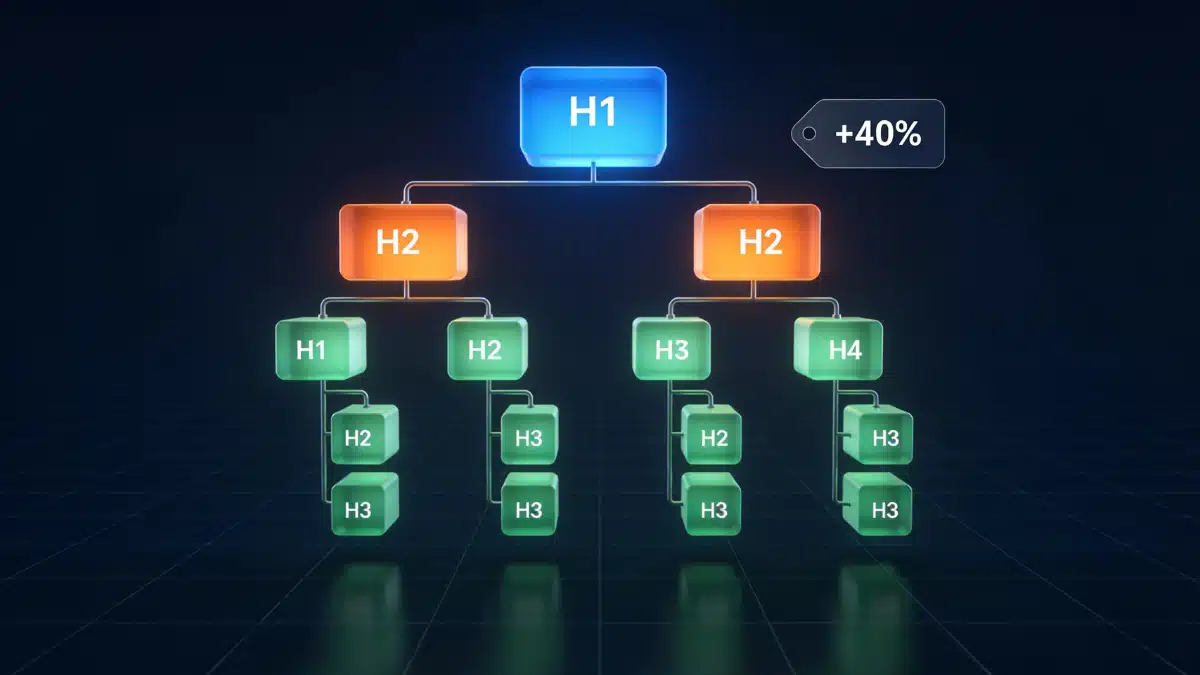
User experience metrics tie directly to structure quality. Research shows that 38% of users stop engaging with websites if the layout is unattractive or difficult to navigate. Well-structured content reduces bounce rate by 40% compared to unstructured alternatives because users can quickly evaluate whether the page answers their question.
For B2B audiences conducting thorough research before purchasing decisions, structure communicates professionalism and expertise. A logistics company comparing enterprise software solutions won’t trust content that lacks clear organization it signals carelessness that extends to the product itself. Experience shows that B2B decision-makers correlate content quality with product quality.
How should you implement header hierarchy correctly?
What is the proper H1 through H6 structure?
Every page should contain exactly one H1 tag representing the main topic. This primary heading tells search engines and users what the entire page addresses. Multiple H1 tags dilute focus and create confusion about page purpose a common mistake that undermines topical authority.
H2 tags divide your content into major sections that support your H1. These represent the key subtopics or questions your content answers. For a page about “B2B content marketing strategy,” H2 tags might include “How to build a content calendar,” “What content formats generate leads,” and “How to measure content ROI.”
H3 tags break down H2 sections into granular details. Each H3 should logically relate to its parent H2. If your H2 asks “How to build a content calendar,” H3 tags underneath might address “What frequency works for B2B audiences” and “How to align content with buyer journey stages.”
We recommend limiting header depth to H3 in most cases. H4, H5, and H6 tags suggest unnecessary complexity that harms readability. If you need headers beyond H3, your content likely requires restructuring into multiple pages or a clearer organizational framework.
Why does heading order matter?
Skipping heading levels damages both accessibility and SEO. Jumping from H2 directly to H4 breaks the logical hierarchy that screen readers and search engine crawlers expect. This violation of semantic HTML standards confuses assistive technologies and reduces the structural clarity that algorithms reward.
Heading order creates a content outline that search engines use to generate featured snippets and understand context. When Google extracts answers for position zero, it relies heavily on heading structure to identify relevant sections. Disordered headings reduce your chances of capturing these high-visibility placements.
B2B readers scanning your content depend on logical heading progression to evaluate depth before committing time. A manufacturing executive researching supply chain software scans headings first inconsistent hierarchy suggests the content wasn’t professionally developed, reducing trust before they read a single paragraph.
How do you optimize paragraph structure for engagement?
What is the ideal paragraph length?
Keep paragraphs between 2-4 sentences or 40-70 words. This length maintains readability on mobile devices where long paragraphs create intimidating walls of text. Research shows that 54% of Americans read below sixth-grade level, making concise paragraphs essential for broad accessibility.
Single-sentence paragraphs work strategically to emphasize critical points. “This changes everything.” used as a standalone paragraph creates visual impact and signals importance. Overusing this technique dilutes its effectiveness reserve it for genuinely pivotal statements.
We recommend using transition words between paragraphs to maintain flow. “However,” “Additionally,” and “Consequently” guide readers through your argument logically. Abrupt topic shifts without transitions increase cognitive load and raise bounce rates by forcing readers to work harder to follow your reasoning.
How should you structure individual sentences?
Front-load important information in each sentence. “Strategic content structure improves both rankings and conversions” outperforms “Improvements in rankings and conversions result from strategic content structure.” Active voice creates momentum and positions key concepts prominently where skimming readers notice them first.
Vary sentence length to maintain reader interest. Three short sentences followed by one longer complex sentence creates rhythm that prevents monotony. “Content structure matters. It influences rankings. Users respond to organization. When you combine clear hierarchy with strategic keyword placement, you create pages that satisfy both algorithmic requirements and human expectations.”
Avoid dense technical jargon without explanation. B2B audiences expect expertise but not unnecessary complexity. “Implement topic cluster architecture to establish topical authority” requires clarification: “Topic cluster architecture organizing related content pieces around comprehensive pillar pages establishes topical authority by demonstrating deep expertise across all aspects of a subject.”
What content formatting improves readability and SEO?
When should you use bullet points versus numbered lists?
Bullet points work best for unordered information where sequence doesn’t matter. Feature lists, benefit summaries, and characteristic descriptions function well as bullets. “Key content structure elements include: clear header hierarchy, scannable paragraphs, strategic whitespace, and logical information flow.”
Numbered lists indicate sequential steps or ranked items. Process explanations, priority rankings, and chronological information require numbers. “To audit content structure: 1. Map your header hierarchy. 2. Measure paragraph length. 3. Evaluate whitespace distribution. 4. Test mobile readability.”
Lists optimize for featured snippets and AI-generated summaries. Google frequently extracts bulleted or numbered content for position zero because the structure makes information extraction straightforward. We recommend formatting at least one section per page as a list to capture these opportunities.
How does whitespace affect user experience?
Strategic whitespace reduces cognitive load and improves comprehension by 20%. Dense content without breathing room overwhelms readers and triggers immediate exits. Whitespace between paragraphs, around headings, and surrounding images creates visual hierarchy that guides attention to important elements.
Mobile devices require more generous whitespace than desktop displays. What looks appropriately spaced on a 27-inch monitor becomes cramped on a 6-inch smartphone screen. Test your content on actual mobile devices rather than relying on browser responsive design tools that don’t accurately replicate the mobile reading experience.
B2B content particularly benefits from whitespace because readers multitask while consuming it. A procurement manager researching solutions while handling emails and calls needs content structured for interrupted attention. Generous spacing allows them to easily resume reading after distractions without losing their place.
How do you structure content for featured snippets?
What formats does Google prioritize for position zero?
Paragraph snippets work for definition queries. When users search “what is content structure,” Google extracts 40-60 word paragraphs that directly answer the question. Format your definition in the first paragraph after your H2 for maximum extraction probability.
List snippets dominate how-to and process queries. “How to optimize content structure” triggers list extractions. Structure your process as clear, actionable steps using numbered lists with concise descriptions under each point.
Table snippets appear for comparison and data queries. “Content structure best practices comparison” might trigger a table showing different approaches, their benefits, and ideal use cases. HTML tables perform better than images for snippet extraction because search engines can parse the data.
How should you write for snippet extraction?
Answer the question immediately in your first paragraph after the relevant heading. Don’t bury the answer after backstory or context provide the direct answer first, then elaborate. “Content structure for SEO requires clear header hierarchy, scannable paragraphs, and strategic use of lists. Each element serves specific purposes for both search engines and users.”
Use concise, complete sentences that standalone without surrounding context. Snippet extraction pulls isolated text, so answers must make sense independently. “Include header tags H1 through H3 in logical order” works better than “These should be included in order” which requires previous context.
Format question-based H2 tags that match search queries. “How should you structure content for better SEO?” directly matches user search intent and increases extraction probability compared to generic headings like “Content structure guidelines.”
How does topic cluster architecture strengthen content structure?
What is the pillar and cluster model?
Pillar pages provide comprehensive coverage of broad topics in 2,500-4,000 words. These hub pages address “content marketing strategy” or “B2B SEO fundamentals” at a high level, linking to supporting cluster pages that dive deep into specific subtopics.
Cluster pages focus on narrow topics related to the pillar. A “content marketing strategy” pillar might link to clusters about “blog content calendars,” “video content production,” and “content distribution channels.” Each cluster targets specific long-tail keywords while reinforcing the pillar’s topical authority.
Bidirectional linking connects pillars and clusters. Each cluster links back to its pillar, and the pillar links to all supporting clusters. This architecture signals to search engines that you’ve comprehensively covered the topic from multiple angles, establishing you as an authoritative source.
[Understanding how buyer personas influence content structure decisions helps you organize information according to how different stakeholders consume and evaluate content throughout their research process].
Why does internal linking hierarchy matter?
Strategic internal linking distributes page authority and guides users through logical content progressions. Linking from your high-authority blog post about general SEO best practices to your detailed guide about content structure passes ranking power while providing value to readers seeking deeper information.
Contextual links within body content carry more weight than navigation or footer links. Search engines recognize that editorial links within main content represent stronger endorsements than template-based linking. We recommend 3-5 contextual internal links per 1,000 words for optimal balance.
Anchor text optimization for internal links reinforces topical relevance. Instead of generic “click here” anchors, use descriptive text: “learn advanced content structure optimization techniques” tells both users and search engines exactly what they’ll find on the linked page.
What content structure mistakes hurt B2B websites?
Why do wall-of-text pages fail?
Unbroken text blocks of 10+ sentences trigger immediate abandonment. Users can’t quickly scan for relevance, so they leave rather than invest time determining if the content addresses their needs. Bounce rates for pages with dense paragraphs exceed 70% compared to 35% for well-structured alternatives.
Mobile users particularly struggle with dense content. A paragraph that looks manageable on desktop becomes an overwhelming block spanning multiple screens on smartphones. With 60% of B2B research beginning on mobile devices, mobile-unfriendly structure costs you qualified traffic before users reach desktop.
Dense content signals low-quality development to search engines. Google’s algorithms evaluate readability scores and structural organization. Pages scoring poorly on these metrics receive ranking penalties because they fail to satisfy user experience requirements that correlate with content quality.
How does poor heading hierarchy confuse search engines?
Multiple H1 tags create ambiguity about page focus. Is the page about “content marketing” or “SEO strategy” when both appear as H1? Search engines struggle to classify the page topically, reducing visibility for both topics instead of ranking well for either.
Skipping heading levels breaks semantic structure. Jumping from H2 to H4 violates HTML standards and confuses screen readers serving vision-impaired users. This accessibility failure harms both user experience and SEO as search engines increasingly prioritize accessible content.
Generic headings waste SEO opportunities. “Introduction,” “Benefits,” and “Conclusion” provide no context about content substance. Descriptive headings like “Why content structure matters for B2B lead generation” incorporate keywords while clearly communicating section purpose.
[Before implementing any content structure changes, ensure your internal linking strategy creates logical pathways that guide users from broad overview content to detailed implementation guides based on their research stage and information needs].
Content structure determines whether your SEO investment generates returns or gets wasted on pages that neither rank nor convert. The difference between structured and unstructured content often represents 2-3 position improvements in rankings and 40-50% bounce rate variance for identical topics and keyword targeting.
Focus on the foundational elements: single H1, logical H2-H3 hierarchy, 2-4 sentence paragraphs, strategic lists, and generous whitespace. These structural decisions compound over time as search engines accumulate positive engagement signals from users who stay longer and interact more deeply with well-organized content.
Strategic internal linking that connects well-structured content pieces creates topic clusters that multiply individual page authority while establishing site-wide expertise in your B2B niche.