
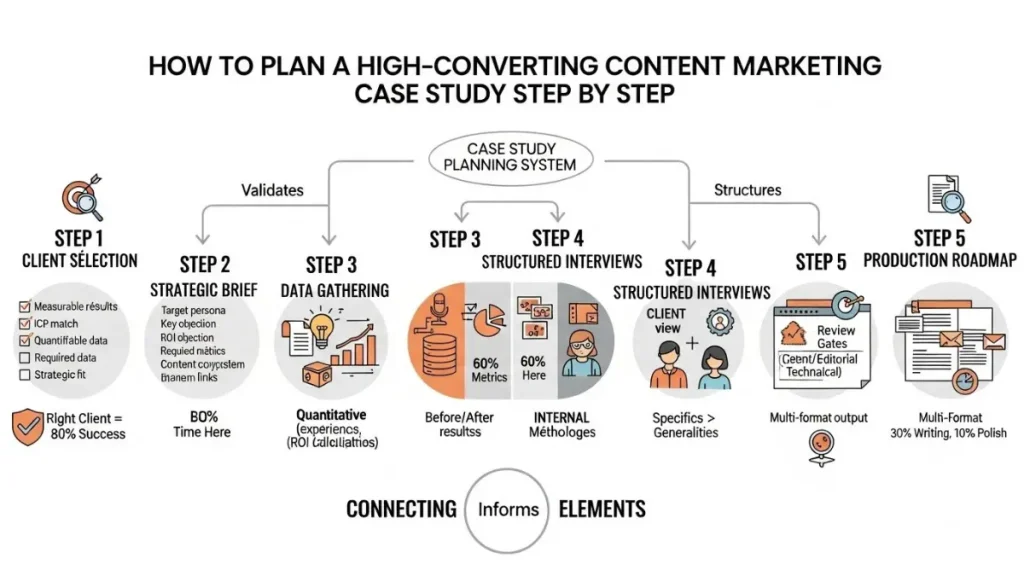
Planning a strong content marketing case study starts long before you open a blank document. You need the right client, a clear problem, measurable outcomes, and a narrative that speaks to your ideal buyers. When this planning process is connected to a broader system, each new story plugs into your [content marketing case study system guide] and reinforces your positioning instead of becoming a one-off asset.
Why does planning matter more than writing?
Most teams treat case study creation as a writing exercise. They pick a successful client, interview them briefly, and draft a story based on memory and incomplete data. The result is a generic narrative that lacks specificity, context, and conversion power.
High-converting case studies are built during the planning phase, not the writing phase. When you identify the right client, define the strategic angle, collect baseline and outcome data before drafting, and align the story with a specific buyer persona and stage of the funnel, the writing becomes straightforward because the strategic foundation is solid.
We recommend investing 60% of your time in planning and data gathering, 30% in writing and editing, and 10% in formatting and publishing. This ratio ensures that every case study you publish has the depth and precision needed to influence purchase decisions rather than just fill a content calendar.
How do you select the right client for a Case study?
Look for measurable transformation, not just satisfaction
Client satisfaction is necessary but insufficient. A happy client who cannot quantify results gives you a testimonial, not a case study. The ideal case study candidate achieved specific, measurable outcomes within a defined timeframe: revenue growth, cost reduction, efficiency gains, customer acquisition, retention improvements, or risk mitigation.
Start by reviewing your client portfolio through a results lens. Which clients have hard data showing before-and-after performance? Which transformations align with the challenges your ideal prospects face? Which industries or use cases do you want to dominate in search and sales conversations?
For example, if you are targeting mid-market B2B SaaS companies struggling with lead quality, prioritize clients in that segment who improved lead-to-opportunity conversion rates by a meaningful percentage. The closer the case study mirrors your prospect’s reality, the more persuasive it becomes.
Prioritize clients who represent your ideal customer profile
Not every successful client makes a strategic case study. A Fortune 500 enterprise client might deliver impressive metrics, but if your core market is small businesses, that case study will create confusion rather than confidence. Prospects need to see themselves in the story, which means industry, company size, team structure, and budget should align with your target audience.
Ask yourself: does this client’s starting point match where our best prospects are today? Can they speak authentically about the challenges our prospects face? Will their results feel achievable rather than aspirational or irrelevant? When the answer is yes to all three, you have a high-priority case study candidate.
What information should you gather before you start writing?
Quantitative Data: the foundation of credibility
Every case study needs at least three categories of quantitative data: baseline metrics (where the client started), outcome metrics (where they ended), and timeline (how long the transformation took). Ideally, you also capture process metrics that show momentum during implementation, such as early wins or interim milestones.
Work with your client to access real numbers from their analytics platforms, CRM systems, financial reports, or operational dashboards. Avoid relying on estimates or anecdotal observations. When you can write “increased qualified leads by 127% in six months” instead of “significantly improved lead generation,” you differentiate your case study from the vague stories your competitors publish.
If absolute numbers are confidential, negotiate for percentage changes, ratios, or indexed comparisons. The goal is specificity, not necessarily raw data disclosure.
Qualitative context: the story behind the Numbers
Numbers prove impact, but context explains why it matters. During the planning phase, gather qualitative insights that answer: What was the client’s situation before engaging with you? What internal or external pressures made change urgent? What alternatives did they consider? What obstacles emerged during implementation? How did the results change their business strategy or operations?
These details transform a metric-driven case study into a narrative that prospects can relate to emotionally and strategically. When you combine quantitative proof with qualitative context, you create a case study that satisfies both analytical decision-makers and intuitive stakeholders, which is critical in complex B2B buying committees and considered B2C purchases.
For more on structuring this narrative effectively, the what makes a great content marketing case study resource explores how to balance data and storytelling for maximum conversion impact.
How do you structure the planning process for maximum efficiency?
Create a Case study brief before the interview
Many teams jump straight into client interviews without a strategic framework, which leads to unfocused conversations and missed opportunities. A case study brief is a one-page document that defines the strategic purpose, target audience, key messages, and required data points before you engage the client.
Your brief should answer: What business challenge does this case study address? Which buyer persona is the primary audience? What objections or questions should this story resolve? What metrics are non-negotiable for credibility? What related content will this case study link to within your content ecosystem?
This brief serves two purposes. First, it ensures your interview questions extract the specific information needed to make the case study strategically valuable rather than just chronologically accurate. Second, it gives your client clarity on why their story matters and what preparation they need to provide, which increases their investment in delivering quality inputs.
Conduct structured interviews with both client and internal teams
The best case studies combine the client’s perspective with your internal team’s strategic insights. Interview the client decision-maker to capture their experience, challenges, and outcomes from their point of view. Then interview your account manager, implementation team, or customer success lead to understand the behind-the-scenes strategy, pivots, and expertise that drove results.
This dual perspective creates richer narratives. The client explains what changed in their business. Your team explains why specific decisions were made and how obstacles were overcome. When you weave these perspectives together, prospects see both the transformation and the strategic competence that made it possible.
During interviews, focus on specifics rather than generalities. Ask “What happened in week three when the integration failed?” instead of “How did implementation go?” Ask “What was the exact lead volume in March versus June?” instead of “Did leads increase?” Specific questions yield specific answers, which translate into compelling, credible case studies.
What strategic angles make Case studies more persuasive?
Align the narrative with a specific Buyer objection
Every case study should neutralize a common objection or doubt that prevents prospects from moving forward. If prospects worry about implementation complexity, your case study should emphasize how quickly and smoothly deployment happened. If they doubt ROI timelines, showcase rapid payback periods with month-by-month breakdowns.
This objection-focused approach requires understanding your sales team’s most frequent sticking points. Review sales call transcripts, lost deal analyses, and qualification conversations to identify patterns. When you build case studies that directly address these concerns with real-world proof, you arm your sales team with assets that shorten deal cycles and improve close rates.
For example, if prospects frequently ask “Will this work for a team our size with limited technical resources?”, create case studies featuring similar clients who succeeded despite those constraints. The narrative becomes a preemptive answer that builds confidence before the objection even surfaces in conversations.
Match the Case study format to the Buyer journey stage
Not all case studies serve the same function. Early-stage prospects need high-level transformation stories that build awareness and interest. Mid-stage prospects need detailed process case studies that prove capability and methodology. Late-stage prospects need ROI-focused case studies that justify investment to internal stakeholders.
Plan your case study with a specific funnel stage in mind. An awareness-stage case study might emphasize the problem and the dramatic before-after contrast with minimal technical detail. A consideration-stage case study dives deep into how you solved the problem, what alternatives were evaluated, and why your approach won. A decision-stage case study focuses on financial outcomes, implementation timelines, and risk mitigation.
When you build case studies across all three stages, you create a content system where each story serves a defined purpose in moving prospects from curiosity to commitment. This strategic segmentation is central to the approach outlined in the [content marketing case study system guide], which shows how to organize case studies for maximum funnel impact.
How do you ensure your Case study plan supports Long-term content goals?
Design for Repurposing from the Start
A well-planned case study is never just a blog post. During planning, identify how this story can be repurposed into multiple formats: a gated PDF for lead generation, slides for sales decks, a video testimonial, a webinar presentation, social media snippets, or email nurture sequences.
This multi-format thinking shapes what data you collect and how you structure the interview. If you know the case study will become a video, capture permission for filming and identify visual proof points during planning. If it will anchor a webinar, plan sections that can be expanded into live discussion topics. When repurposing is part of the plan rather than an afterthought, you extract exponentially more value from each case study investment.
The guide on premium content formats for case studies explores exactly how to transform a single client story into a full asset suite that works across channels, campaigns, and sales stages.
Build Case studies that reinforce topical authority
Each case study should strengthen your authority in a specific topic area or keyword cluster. During planning, identify which pillar content or satellite articles this case study supports. If you are building authority around B2B lead generation, plan case studies that demonstrate lead quality improvement, lead nurturing efficiency, or lead-to-customer conversion optimization.
When you publish the case study, link strategically to related resources: your methodology guides, your measurement frameworks, and other relevant case studies. This internal linking signals to search engines that you have comprehensive coverage of the topic, which improves rankings for competitive keywords and positions you as the definitive resource prospects discover during research.
How do you validate your Case study plan before execution?
Run the plan through your sales and marketing teams
Before committing to interviews and production, validate your case study plan with the teams who will use it. Share your brief with sales to confirm the angle addresses real objections they encounter. Review it with marketing to ensure it fits current campaign priorities and content gaps.
This cross-functional review catches strategic misalignment early. Sales might flag that the industry you chose is no longer a target segment. Marketing might point out that you already have three similar case studies and need coverage in a different use case. These insights save weeks of work on case studies that will not move business metrics.
We recommend a 15-minute validation meeting where you present the case study brief and ask three questions: Does this angle solve a real sales barrier? Does this client profile match our ideal customer? Will this story differentiate us from competitors? If the answer to any question is no, refine the plan before investing in production.
Confirm Data access and client availability Early
Nothing derails case study timelines faster than discovering midway through the process that the client cannot share the metrics you need or that key stakeholders are unavailable for interviews. During planning, confirm three things: the client has access to the quantitative data you need, they have approval from legal or leadership to share results publicly, and decision-makers will commit to interview availability within your production timeline.
Set clear expectations about what you need and when. Provide a list of required metrics, proposed interview dates, and review deadlines. If any element is uncertain, either adjust the case study plan to work within constraints or select a different client whose inputs are fully accessible.
What planning mistakes undermine Case study performance?
Choosing clients based on relationship rather than strategic fit
It is tempting to feature your longest-tenured client or the one who gives the most enthusiastic testimonials. But if that client does not represent your ideal customer profile, solve a priority challenge, or deliver compelling metrics, the case study will not convert prospects.
Plan case studies based on strategic value, not convenience or sentiment. Ask: will this story help us close more deals in our target market? Will it address a specific objection that blocks pipeline progression? Will it strengthen our position in a competitive keyword space? If the strategic answer is weak, find a different client even if the relationship is strong.
Skipping the competitive research step
Before finalizing your case study plan, research what your competitors have published. If three competitors already have detailed case studies on the same challenge with similar clients, your story needs a differentiated angle or stronger results to stand out.
Look for gaps in competitive case study libraries. If competitors focus only on enterprise clients, plan case studies featuring mid-market success. If their case studies emphasize speed, emphasize depth and sustainability. Strategic differentiation during planning ensures your case study captures attention in a crowded market rather than blending into generic proof point collections.
How planning connects to the broader Case study ecosystem
A well-planned case study is never isolated. It should reinforce your pillar content, link to related satellites, and support campaigns across channels. During the planning phase, map how this case study will connect to your content marketing case study system guide, which articles it will reference, and which future case studies it will complement.
This ecosystem thinking transforms individual case studies into a compounding asset. Each new story strengthens your topical authority, improves internal linking architecture, and gives prospects multiple entry points into your expertise. When prospects discover one case study, strategic linking keeps them engaged with additional proof points until they are ready to convert.
Planning with this system mindset also helps you identify content gaps. If you notice that all your case studies focus on acquisition but none address retention, you have a strategic opportunity to fill that gap. If you have strong B2B coverage but weak B2C proof points, your next planning cycle should prioritize consumer-facing stories.
The methodology for building this interconnected case study library is detailed in the [premium content formats for case studies] guide, which shows how to plan not just individual stories but entire proof ecosystems that work together to shorten sales cycles and improve conversion rates across every customer touchpoint.