
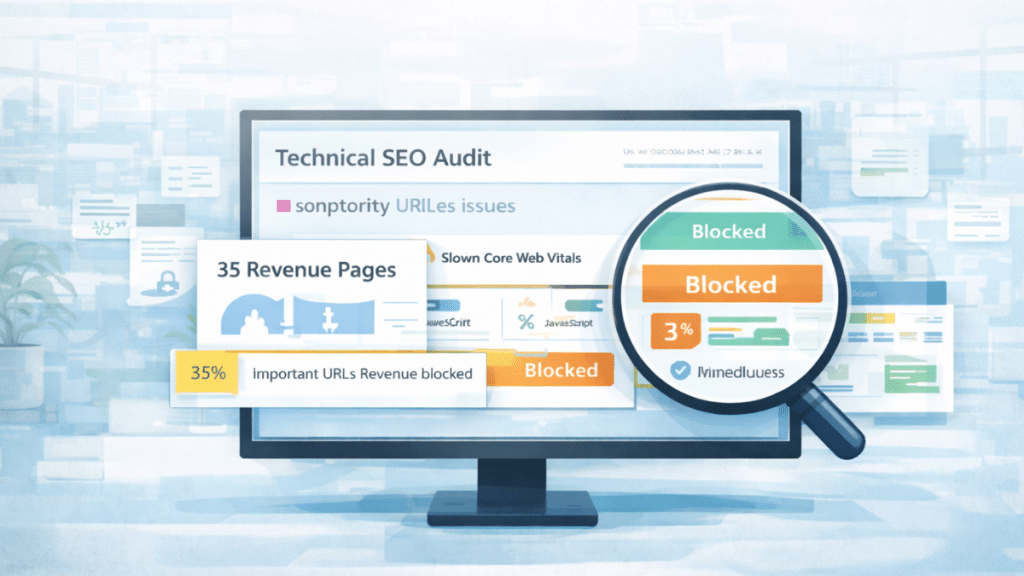
Most technical SEO audits fail because they focus on how many issues exist, not on which ones suppress revenue.
Executives don’t care about error volume. They care about demand capture, pipeline impact, and opportunity cost. When SEO teams prioritize what tools flag instead of what limits business performance, technical SEO becomes operational noise.
To avoid this, technical audits must be reframed through a revenue first lens, as formalized in [How to Prioritize SEO Fixes That Actually Drive Revenue].
Why most technical SEO audits mislead decision-makers
Crawlers are excellent at detecting problems but terrible at ranking their importance.
A site can surface hundreds of warnings without suffering any measurable business loss. Conversely, a single technical failure on a high intent template can suppress thousands in monthly revenue.
The core mistake is assuming that severity equals impact. In reality, impact depends on:
- page intent,
- role in the funnel,
- and competitive pressure.
Without this context, audits create activity, not outcomes.
The three types of technical SEO issues
All technical issues fall into one of three categories:
1. Low-impact noise
Minor HTML warnings, isolated schema errors, or cosmetic inconsistencies. They rarely affect rankings or conversions and should not drive priorities.
2. Latent risk issues
Problems that don’t hurt today but weaken scalability, such as inefficient crawl paths or fragile internal linking. Important but not urgent.
3. Revenue blockers
Issues that prevent commercial pages from being crawled, indexed, ranked, or converted. Examples include:
- indexing exclusions on money pages,
- rendering failures hiding core content,
- severe performance issues on high intent templates.
Only the third category deserves immediate attention. This distinction underpins effective audit reporting in [SEO Audit Report: Create Actionable Insights].
How to isolate revenue-blocking issues step by step
Step 1: Start from money pages
Begin with pages designed to generate revenue or qualified leads: service pages, solution hubs, comparison pages, and pricing-related URLs.
Auditing low-intent content first dilutes focus. A technical issue is only critical if it affects economically meaningful pages. This aligns with performance attribution principles explained in [Data Driven Performance: Linking Organic Traffic to Revenue].
Step 2: Validate indexability and rendering
Before speed or UX, confirm two non negotiables:
- Can search engines crawl the page?
- Can they render and understand the content?
Revenue blockers at this stage include accidental noindex directives, canonical conflicts, JavaScript rendering failures, or blocked resources. If a page cannot be indexed or understood, all other optimizations are irrelevant. This diagnostic layer complements [Technical SEO Audit: Step by Step Guide].
Step 3: Assess performance only where it matters
Core Web Vitals issues only block revenue when they affect:
- templates reused across commercial pages,
- or URLs competing in high pressure SERPs.
A slow blog post is rarely a business problem. A slow service or comparison page is. This distinction is critical and often misunderstood, despite its direct conversion impact shown in [How Technical SEO Improvements in Speed and Core Web Vitals Increase Conversions].
Step 4: Confirm competitive disadvantage
A technical issue becomes urgent when competitors don’t share it.
Ask:
- Are competitors’ equivalent pages indexed faster?
- Do they load more reliably on mobile?
- Are their templates technically cleaner?
If yes, the issue represents active competitive loss. This is why technical audits must be cross-checked with [Competitive SEO Analysis: Find Growth Opportunities].
Step 5: Classify for decision-making
Each issue must end in one bucket:
- Fix now → direct revenue suppression
- Fix later → scalability or resilience
- Ignore → noise
This classification transforms audits into decision tools, not task lists.
Executive takeaway
A technical SEO audit should not answer “what is broken?”
It should answer “what is blocking revenue right now?”
Once revenue blockers are isolated, prioritization not perfection drives results. The full audit-to-impact methodology is detailed in [How to Prioritize SEO Fixes That Actually Drive Revenue].