
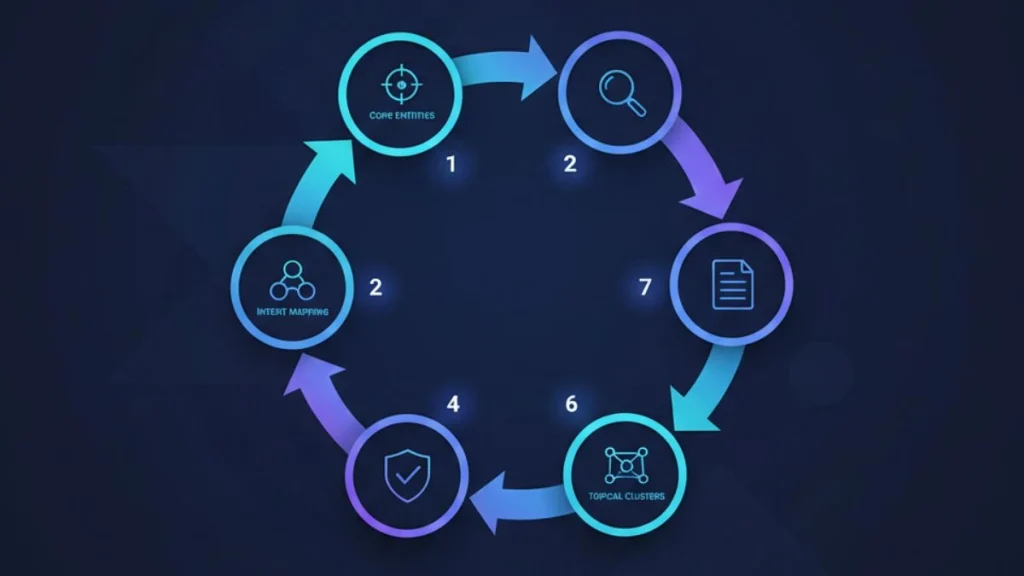
Semantic keyword research identifies conceptual relationships and topical networks rather than isolated search terms. This methodology shifts focus from search volume metrics to entity mapping, intent clustering, and content gap analysis that reveals how Google actually groups related queries. For B2B content strategists, this approach uncovers topic authority opportunities that traditional keyword tools miss entirely, while aligning content architecture with how decision-makers actually search across long, complex buying cycles.
Step 1: Define your core topic entities and business context
Start by mapping the primary business entities your company addresses not marketing keywords, but the actual problems, solutions, and industries you serve. For a B2B marketing automation platform, core entities include “lead nurturing,” “email campaign management,” “sales pipeline acceleration,” and “marketing attribution.” These anchor your topical territory within Google’s Knowledge Graph.
Document the buyer persona context that shapes semantic search behavior . B2B buyers search differently than consumers they use technical terminology, evaluate multiple solutions simultaneously, and search across awareness, consideration, and decision stages over months. A CMO researching “enterprise marketing stack consolidation” expresses different semantic intent than a marketing manager searching “email automation tools comparison,” even though both relate to your core offering.
Build an entity relationship map showing how your core topics connect to adjacent concepts, use cases, and industry-specific applications. A CRM platform’s entity map links “customer data management” to “sales forecasting,” “pipeline visibility,” and “account-based marketing coordination.” This network structure reveals content cluster opportunities that keyword volume data obscures.
Step 2: Analyze competitor topical coverage using entity extraction
Traditional competitor keyword analysis identifies which terms competitors rank for. Semantic research reveals which topic entities they’ve established authority around and which gaps remain exploitable. Use natural language processing tools to extract entities from competitor content, then map their topical coverage against your own.
Identify entity coverage gaps where competitors address surface-level concepts but miss critical supporting entities. If three top-ranking competitors discuss “B2B content marketing” but none adequately cover “content governance frameworks” or “editorial workflow automation,” you’ve found a semantic differentiation opportunity. This gap represents topics Google recognizes as relevant but underserved in current search results.
Analyze entity relationship accuracy in competitor content. Pages that mention entities without demonstrating how they connect claiming “account-based marketing” relates to “content personalization” without explaining the operational relationship signal weak topical understanding. You can outrank these pages by proving accurate entity relationship knowledge rather than matching their keyword coverage.
Step 3: Map search intent clusters instead of individual keywords
Group related queries by the underlying decision framework they represent rather than treating each variation as a separate target. Searches for “marketing automation pricing,” “marketing automation ROI calculator,” and “marketing automation implementation costs” all address the same commercial evaluation intent budget justification. One comprehensive resource addressing the complete decision framework captures rankings across all variations.
Use Google’s “People Also Ask” and “Related Searches” to identify how the algorithm clusters semantically related queries . These features reveal Google’s own understanding of topic relationships and intent groupings. If “People Also Ask” shows questions about integration complexity, data migration challenges, and training requirements alongside your target topic, those entities must appear in your content to signal comprehensive coverage.
Distinguish between informational, navigational, and transactional intent clusters within your topic domain. “How to build a lead scoring model” (informational) and “best lead scoring software” (commercial investigation) address related entities but serve different buyer journey stages. Semantic research maps these intent progressions to create content architectures that guide prospects through decision stages logically .
Step 4: Identify entity co-occurrence patterns in top-ranking content
Extract the most frequently mentioned entities from pages ranking in positions 1-5 for your target topics. This reveals which supporting concepts Google considers mandatory for demonstrating topic expertise. For “B2B SEO strategy” content, consistent entity co-occurrence includes “buyer journey mapping,” “long sales cycle optimization,” and “technical decision-maker targeting.”
Quantify entity density thresholds that separate comprehensive from superficial coverage. If top-ranking pages mention “content distribution channels” an average of 6-8 times across 2,000 words, while your content mentions it once, you’re signaling incomplete topic treatment regardless of overall word count. Entity frequency matters less than entity coverage breadth mentioning 15 related entities once each signals stronger topical authority than repeating three entities throughout.
Map entity relationships shown in top content to identify mandatory conceptual connections. Pages ranking for “marketing attribution” consistently link it to “multi-touch attribution models,” “customer journey analytics,” and “revenue impact measurement.” Your content must demonstrate these same relationship patterns to compete, not because you’re copying competitors but because these connections reflect actual domain knowledge Google validates.
Step 5: Build content clusters around entity relationship networks
Structure your content calendar as entity relationship maps rather than keyword lists . Each pillar page addresses a core entity comprehensively, while satellite articles explore specific entity relationships in actionable detail. A pillar on “B2B content marketing strategy” connects to satellites covering “content audit methodology,” “editorial calendar frameworks,” and “content performance attribution.”
Prioritize clusters where you can demonstrate entity relationship mastery that competitors haven’t established. If existing content treats “sales enablement” and “content marketing” as separate topics, you can capture rankings by proving their operational integration through content that maps entities across both domains. This strategic entity bridging creates differentiation impossible through keyword optimization alone.
Design internal linking that reinforces entity relationships semantically rather than through exact-match anchor text . Link “marketing qualified lead criteria” to “lead scoring frameworks” because these entities connect logically in buyer qualification processes, not because you need keyword-rich anchors. This contextual linking pattern signals natural expertise rather than manipulative optimization.
Step 6: Validate entity coverage against knowledge graph data
Cross-reference your planned entities against Google’s Knowledge Graph to ensure relationship accuracy. If you plan to connect “content syndication” with “domain authority transfer,” verify this relationship reflects technical reality syndication typically uses canonical tags that don’t pass authority. Inaccurate entity relationships damage E-E-A-T signals more than missing entities reduce topical coverage.
Use structured data markup to explicitly declare entity relationships in your content . Schema.org markup for articles, how-to guides, and FAQs helps Google parse which entities you’re addressing and how you’ve connected them. This technical validation reinforces the semantic signals your natural language content creates.
Step 7: Create semantic keyword research documentation for content production
Transform your entity maps into content briefs that guide writers toward semantic comprehensiveness rather than keyword density targets. Instead of “include ‘B2B lead generation’ 8-10 times,” specify “address these 12 related entities with accurate relationship descriptions: lead qualification frameworks, MQL/SQL definitions, lead scoring criteria, nurture campaign architecture.”
Establish entity coverage benchmarks based on competitive analysis. If comprehensive topic treatment in your niche requires addressing 18-22 related entities across 2,500 words, document these thresholds so content creators understand semantic expectations. This shifts quality assessment from subjective editorial judgment to measurable entity analysis.
Build measurement frameworks that track entity coverage evolution over time. As you publish more content within a topic cluster, your demonstrated entity relationship network should expand, signaling growing topical authority to search algorithms. Monitor which entity gaps remain in your content ecosystem and prioritize filling high-value semantic voids before creating redundant content.
From keyword lists to knowledge architecture
Semantic keyword research fundamentally reconceives content planning from search term targeting to knowledge structure building. You’re no longer optimizing individual pages for isolated queries you’re constructing interconnected content architectures that prove domain expertise through comprehensive entity relationship demonstration .
This methodology demands more strategic investment than traditional keyword research but delivers compounding returns as your entity coverage deepens. Each new piece of semantically optimized content strengthens the authority signals of related articles, creating network effects that keyword-optimized pages in isolation cannot achieve.
The practical output isn’t a keyword spreadsheet it’s a living entity relationship map that guides content creation, internal linking strategy, and topical expansion decisions. This strategic artifact becomes your competitive advantage as algorithm sophistication increasingly rewards demonstrated knowledge over mechanical optimization.
Ready to transform your content strategy from keyword targeting to topical authority building? Explore our complete framework for semantic optimization that drives sustainable B2B rankings.