
What is a scalable B2B lead generation system?
A scalable B2B lead generation system is not a collection of channels.
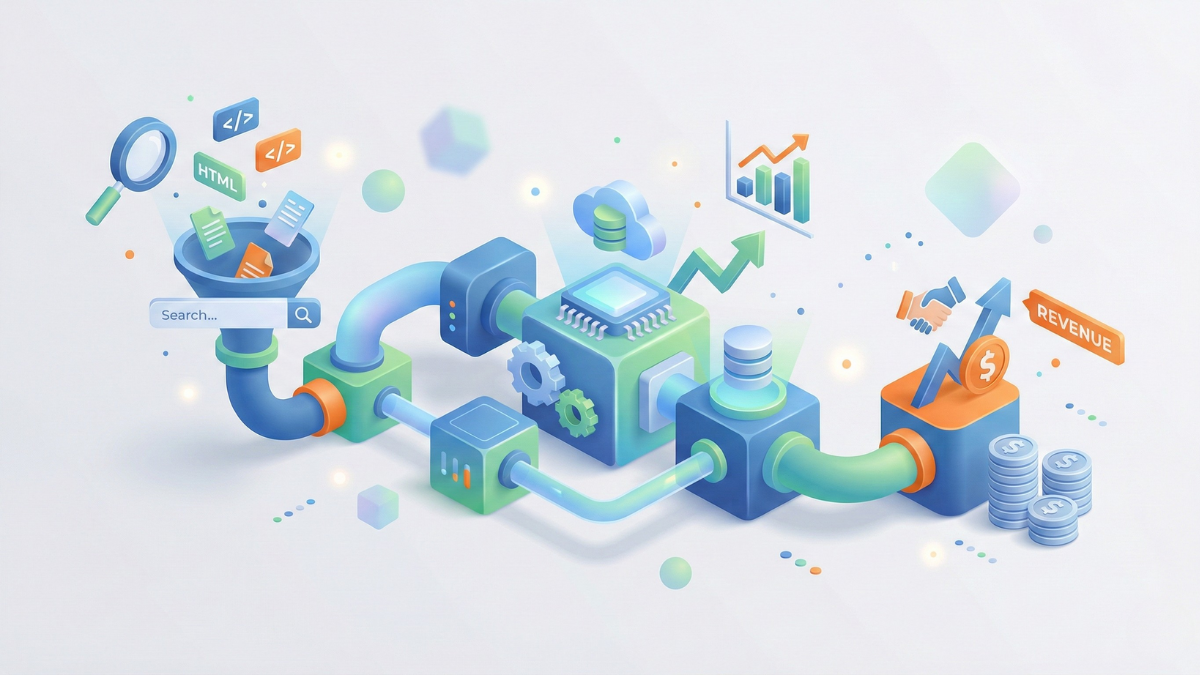
It is a structured operating model that controls how traffic becomes qualified demand, how demand becomes sales ready leads, and how revenue feedback improves the system over time.
Unlike tactic-driven approaches, a scalable B2B lead generation system is designed to grow without collapsing lead quality, sales trust, or conversion efficiency.
This distinction explains why many B2B teams generate activity but struggle to generate predictable revenue.
Why most B2B lead generation strategies fail to scale
Most B2B strategies break under growth because they scale inputs, not structure.
Common failure patterns include:
- Traffic growth without qualification rules
- Lead volume without sales readiness
- Automation layered on unstable funnels
When volume increases, noise multiplies. Metrics look strong, but lead quality degrades often hidden behind vanity KPIs.
The issue is not execution.
It is the absence of a system designed for scale.
The 5 core layers of a scalable B2B lead generation system
Lead definition & qualification rules
Scalability starts with clarity.
If teams cannot agree on what a “qualified lead” is, nothing downstream can scale.
A robust system defines:
- Fit (who this is for)
- Intent (why now)
- Timing (what’s missing)
Clear MQL and SQL boundaries protect sales focus and prevent funnel inflation.
Funnel architecture & intent control
Funnels are not linear paths they are controlled environments.
A scalable funnel:
- Filters early stage curiosity
- Controls progression between stages
- Prevents premature sales handoffs
Intent must be earned, not assumed.
When funnels are designed around intent control, alignment becomes structural not political.
Content & SEO as qualification assets
In scalable systems, content does not exist to attract everyone.
It exists to repel the wrong demand.
High performing systems use:
- SEO pages that frame constraints
- Lead magnets that require commitment
- Content that prepares sales conversations
This turns content into a qualification layer, not a traffic generator.
Scoring, recycling & lead flow governance
Lead flow must be governed, not guessed.
This layer ensures:
- Scoring reflects readiness, not activity
- Unqualified leads are recycled not lost
- Progression rules remain stable under scale
When recycling and scoring are controlled, funnels gain memory instead of chaos.
Sales alignment & revenue feedback loops
Sales alignment is the outcome not the objective.
When systems are clear:
- Sales trusts lead quality
- Feedback becomes actionable
- Funnel decisions are data-driven
Revenue feedback closes the loop, transforming lead generation into a learning system.
How SEO, content, and sales operate as one system
In scalable models, SEO, content, and sales are not separate functions.
They are interdependent layers of the same system.
- SEO filters demand
- Content frames decisions
- Sales converts readiness
When these layers share rules and metrics, performance becomes predictable and optimizable.
How to scale B2B lead generation without losing quality
Safe scaling follows three principles:
- Expand reach after stabilizing qualification
- Replicate what converts don’t experiment at scale
- Increase volume only where sales outcomes confirm quality
Scaling is not acceleration.
It is controlled replication inside a stable system.
From tactics to a revenue system
B2B lead generation does not fail because of tools or channels.
It fails when growth is attempted without structure.
When built as a system, lead generation becomes:
- Predictable
- Scalable
- Revenue-aligned
This is how traffic becomes revenue without breaking trust, quality, or performance.