
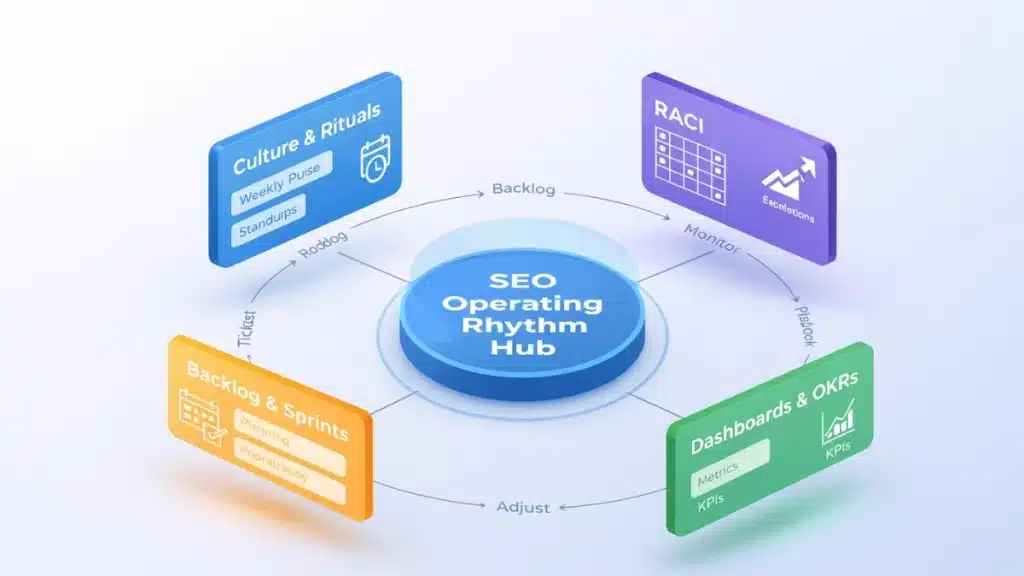
Turning your B2B SEO plan into a daily operating rhythm requires structuring a layered cadence of weekly pulse checks, monthly reviews, and quarterly sprints. Success demands explicit ownership through RACI frameworks, breaking the backlog into executable tickets with team commitment, and embedding SEO criteria into product and marketing workflows through rituals, dashboards, and playbooks.
Why do most B2B SEO plans fail to become an operating rhythm?
The gap between documented strategy and daily execution
Most SEO strategies exist as static documents that never translate into daily action because they lack a connection between high-level objectives and the granular tasks teams execute. Strategy decks outline targets for organic traffic growth, keyword rankings, and conversion rate improvements, but they do not specify who owns each initiative, what the intermediate deliverables look like, or when progress gets reviewed.
When daily operations clash with strategic projects, strategy almost always loses. The execution gap widens when accountability remains vague. If no one owns the outcome of migrating a site section, optimizing page speed, or publishing pillar content, these initiatives drift across quarters without completion.
Warning signs: orphan tasks, empty meetings, slipping deliverables
Orphan tasks accumulate in project management tools with no assignee or due date. Empty meetings recur where attendees report generic updates without surfacing blockers, making decisions, or committing to next actions. Slipping deliverables become normalized: content deadlines move without consequence, technical fixes linger in backlog purgatory, and launch dates slide because no escalation protocol exists to force resolution.
When these warning signs cluster, the team operates in reactive mode.
How do you structure a weekly, monthly, and quarterly rhythm for your SEO team?
Weekly pulse checks: fast detection and short priorities
Weekly pulse checks create the heartbeat of execution by reinforcing accountability, surfacing risks early, and creating space for coordination rather than reporting. These sessions run tightly, focused on what shipped, what is blocked, and what the team commits to in the coming week.
This consistent discipline builds the team culture that separates high-performing SEO operations from teams where strategy documents collect dust. Culture emerges from repeated rituals that demonstrate accountability matters and commitments are honored.
Template pulse check (15 minutes):
- What shipped since last week? (1 deliverable per person, no explanations)
- What blockers prevent progress? (assign owner to each, 24-hour resolution target)
- What do you commit to ship by next week? (public commitment, recorded in project tool)
The format discourages long explanations and encourages fast decisions: if a blocker cannot be resolved in the meeting, the session assigns an owner to investigate and report back asynchronously. The tight feedback loop prevents small problems from compounding into major delays.
Monthly reviews and quarterly sprints: tactical cleanup and strategic progress
Monthly reviews evaluate performance against KPIs, clean up tactical debt, and adjust the plan based on what the data reveals. These sessions analyze organic traffic trends, ranking movements for priority keywords, indexation coverage, technical error rates, and conversion metrics. The team compares actual results to forecasts and diagnoses underperformance.
Template monthly review (60 minutes):
- Review 3 core KPIs: organic traffic by segment, rankings for priority keywords, conversion rate from organic
- Diagnose gaps: where did we miss forecast, and why? (data-driven root cause, not excuses)
- Adjust next 30 days: what tactical shifts do the data demand? (specific actions with owners)
Quarterly sprints frame strategic progress. The team sets objectives and key results aligned with business priorities, allocates resources to initiatives that require sustained effort, and defines the milestones that signal progress. For guidance on building quarterly roadmaps that survive real-world constraints, see: https://decaseo.com/how-do-you-create-a-quarterly-b2b-seo-roadmap-that-survives-real-world-constraints/
The sprint boundary forces prioritization: not every initiative can fit, so the team explicitly chooses what matters most and defers the rest.
What roles and responsibilities prevent gray zones?
Clear ownership and escalation
Explicit ownership eliminates ambiguity through frameworks like RACI (Responsible, Accountable, Consulted, Informed) and escalation protocols that define who resolves blockers. For detailed guidance on RACI assignments, decision rights, and escalation tiers, see: https://decaseo.com/how-do-you-structure-b2b-seo-governance-so-decisions-dont-get-stuck-in-meetings/
Deliverable ownership means one person signs their name to the outcome, tracks progress, coordinates dependencies, escalates blockers, and confirms completion. Escalation protocols define who gets notified when a deliverable is at risk, how quickly they must respond, and what authority they have to unblock the situation. Document the escalation ladder in the team runbook so everyone knows the path and thresholds.
How do you turn your SEO backlog into actionable sprints?
Impact/effort prioritization and breaking work into executable tickets
Impact/effort prioritization sorts the backlog by plotting each initiative on a matrix. For detailed ICE scoring methodology (Impact × Confidence / Effort), see: https://decaseo.com/how-should-b2b-companies-prioritize-seo-initiatives-when-everything-looks-important/
High impact and low effort tasks become quick wins, high impact and high effort tasks become strategic bets, low impact and low effort tasks fill gaps when the team has spare capacity, and low impact and high effort tasks get deprioritized or archived.
Breaking work into executable tickets transforms vague initiatives into concrete tasks with clear acceptance criteria, estimated effort, and assigned owners. Each ticket is small enough to complete within the current sprint, with a definition of done that leaves no ambiguity about whether the work is finished.
Template definition of done (add to every ticket):
- Acceptance criteria met (functional requirements validated)
- Quality gates passed (SEO checklist completed, metadata verified, redirects tested)
- Documentation updated (playbook amended, runbook current, team notified)
- Post-ship monitoring configured (alerts set, tracking validated, baseline captured)
Sprint planning: team commitment and predictable velocity
Sprint planning is the ritual where the team collectively decides what will ship in the next cycle, estimates the effort required for each ticket, and commits to delivering the work within the sprint. The team reviews the prioritized backlog, discusses any unknowns or risks, and selects tickets that fit within their capacity based on historical velocity.
Over time, velocity becomes predictable, allowing the team to forecast how long a large initiative will take. Team commitment during sprint planning creates shared accountability. The sprint boundary enforces discipline: at the end of the cycle, the team reviews what shipped, what did not, and why.
What rituals and tools keep alignment and velocity?
Daily/weekly standups, async updates, centralized channels
Regular standups maintain alignment by creating a predictable forum where the team synchronizes on priorities, surfaces blockers, and coordinates dependencies. Each participant shares what they completed since the last standup, what they are working on now, and what obstacles prevent progress.
Async updates serve distributed teams or organizations where synchronous meetings create coordination overhead. Teams post progress updates in centralized channels using a shared template: completed work, current focus, blockers requiring attention, and requests for input or support.
Performance dashboards and OKRs: continuous measurement and fast adjustments
Performance dashboards expose SEO metrics continuously so the entire team can track progress without generating manual reports. Effective dashboards surface the KPIs that directly connect to business outcomes: organic traffic by segment, rankings for priority keywords, indexation coverage, technical error rates, and conversion events attributed to organic channels.
For methodology on linking organic traffic to revenue and pipeline, see: https://decaseo.com/data-driven-performance-linking-organic-traffic-to-revenue/
OKRs translate strategic objectives into measurable key results that define success for each cycle. Regular check-ins review progress toward key results, diagnose gaps, and trigger adjustments when tactics are not delivering expected outcomes.
How do you embed SEO governance into product and marketing workflows?
Integrating SEO criteria into grooming, QA, and launches
Embedding SEO criteria into product grooming ensures that search considerations shape feature design rather than retrofitting SEO after development completes. During grooming sessions, the SEO lead reviews upcoming tickets to flag potential impacts: will this feature change URL structure, introduce JavaScript rendering issues, alter navigation hierarchy, or affect page load performance?
The team documents SEO requirements directly in the ticket: metadata templates, canonical tag rules, redirect logic, schema markup specifications, and internal linking patterns. QA checklists include SEO validation steps: crawl the staging environment to confirm URLs are indexable, verify that metadata populates correctly, test that redirects return the correct status codes, and validate that structured data passes Google’s testing tools.
For deeper guidance on technical architecture that supports E-E-A-T, see: https://decaseo.com/technical-architecture-as-a-trust-signal-e-e-a-t/
Playbooks and checklists to ensure cross-team consistency
Playbooks document the standard process for recurring SEO activities so teams execute consistently regardless of who performs the work. A content publishing playbook might outline the steps from keyword research through post-publish tracking: research search intent and competition, draft an outline that matches intent, incorporate E-E-A-T signals, optimize on-page elements, implement schema markup, build internal links from related pages, submit the URL for indexing, and monitor rankings and traffic.
For information architecture that supports both traditional and generative search, see: https://decaseo.com/information-architecture-for-generative-search-sge-aeo/
Checklists distill playbooks into executable task lists that prevent steps from being skipped under time pressure. Playbooks and checklists scale expertise across the team, reduce dependency on key individuals, and maintain quality as the organization grows.
Next step
Schedule your first weekly pulse check within the next seven days and treat it as an experiment. Define the format using the template above, document what blocks execution today, and assign one owner to each blocker. Use this first ritual as your baseline for improving the operating rhythm over time.
Connect this to your broader B2B SEO operating system . This connects your operating rhythm to the complete B2B SEO system: roadmap, governance, prioritization, risk, pipeline, budget, and migration.
I’m impressed, I must say. Rarely do I encounter a blog that’s
both equally educative and interesting, and without a doubt, you have hit the nail
on the head. The issue is something too few folks are speaking intelligently about.
Now i’m very happy that I found this in my search for something
regarding this.