
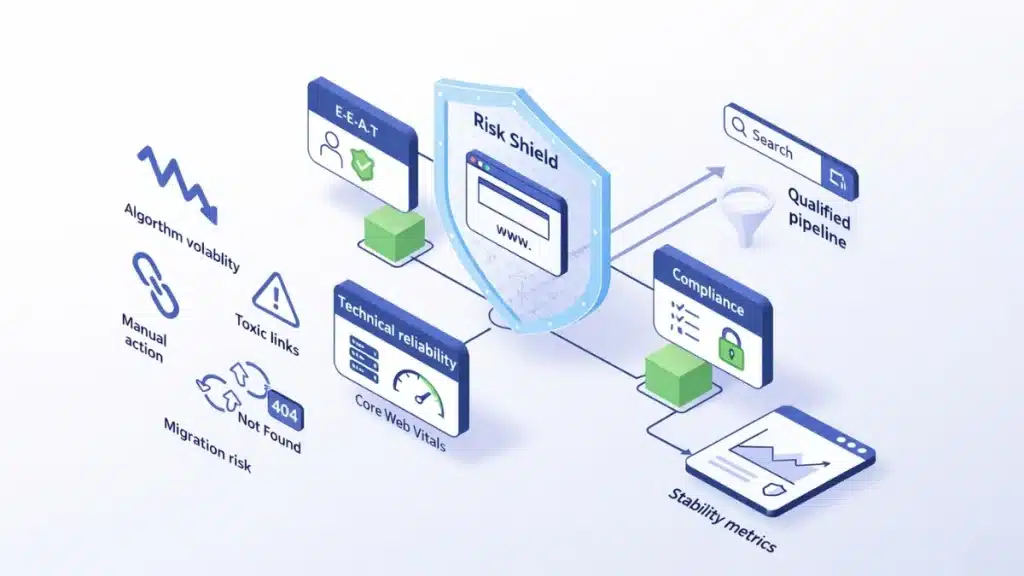
Build E-E-A-T through technical reliability, authoritative content, and external validations to shield against penalties, compliance issues, and algorithmic volatility. This defensive posture turns SEO into a stability engine rather than a gamble. Enterprises face amplified risks from long sales cycles where one penalty disrupts quarters of pipeline, making risk reduction as critical as growth tactics.
What defines institutional risk in B2B SEO
Traffic chasing traps versus stability focus
Institutional risk in B2B SEO covers penalties from black-hat tactics, compliance breaches in regulated sectors, and reputation damage from outdated trust signals. Volume-focused SEO ignores volatility where algorithm shifts wipe gains and leave revenue exposed. Toxic backlinks from unchecked outreach exemplify this danger. When a manual action hits enterprise visibility mid-quarter, pipeline conversations stall immediately because prospects cannot find or validate the company. The gap between penalty detection and recovery can take multiple months, during which business development operates blind.
This risk compounds in B2B because enterprise buying committees research vendors independently before engaging sales. When organic visibility drops, the decision-making unit loses access to educational content that builds confidence across multiple stakeholders. For guidance on aligning content with stakeholder needs throughout the buying journey, see Semantic mapping for the decision-making unit here: https://decaseo.com/semantic-mapping-for-the-decision-making-unit-dmu/
The E-E-A-T defense layer explained
Four dimensions that reduce risk
Experience, Expertise, Authoritativeness, and Trustworthiness form Google’s trust filter for evaluating content quality and site reliability. Prioritize these signals over volume tactics to weather algorithm updates and reassure decision-making unit stakeholders who verify vendor credibility.
Experience demonstrates operational track record through case studies, client tenure data, and industry-specific implementation examples. A cybersecurity vendor showing fifteen years of enterprise deployments signals stability that reduces perceived buyer risk.
Expertise proves technical depth through named authors with visible credentials, published research, and speaking engagements. Assign subject matter experts to content with LinkedIn profiles, certifications, and professional bios that validate claims without requiring prospects to trust marketing copy alone.
Authoritativeness builds through external recognition such as analyst citations, industry award mentions, and peer recommendations. These third-party validations provide social proof that internal claims cannot manufacture, particularly when enterprise buyers conduct due diligence across multiple information sources.
Trustworthiness requires transparency in business practices, visible compliance certifications, clear privacy policies, and secure transaction protocols. For regulated industries like healthcare or financial services, displaying HIPAA compliance badges or SOC 2 certifications directly reduces institutional risk by proving operational maturity.
Audit hidden risks before they compound
Technical gaps create silent vulnerabilities
Start with comprehensive audits to uncover threats before they trigger penalties or compliance flags. Crawl errors, slow Core Web Vitals, or schema inconsistencies signal unreliability to both algorithms and enterprise buyers evaluating vendor stability. A site migration executed without proper 301 redirects creates orphan pages that risk index loss and generate compliance flags when regulated content becomes inaccessible.
Real scenario: migration without risk management
A mid-market SaaS company serving healthcare clients migrated fifty thousand pages to a new platform without comprehensive redirect mapping. Within two weeks, organic traffic dropped sixty percent as Google encountered widespread 404 errors. The compliance team discovered that patient case study pages with testimonials had lost HIPAA-compliant consent documentation during migration, creating legal exposure alongside SEO damage. In this specific case, recovery required six months of manual redirect implementation, content republishing with proper consent trails, and gradual index rehabilitation. The incident cost two quarters of pipeline as prospects could not find educational resources during evaluation cycles.
This scenario demonstrates why risk-managed migrations require pre-launch audits, staged rollouts with monitoring, and rollback procedures that protect both SEO assets and compliance requirements. For deeper implementation of technical trust signals that prevent such failures, see Technical architecture as a trust signal for E-E-A-T here: https://decaseo.com/technical-architecture-as-a-trust-signal-e-e-a-t/
Build technical barriers as your first risk moat
Penalty-proof infrastructure signals
Fortify infrastructure before pursuing growth tactics. Implement structured data that helps algorithms understand content context accurately, reducing misinterpretation risk. Prioritize mobile-first indexing to align with Google’s primary crawl method. Optimize Core Web Vitals to demonstrate operational excellence that enterprise buyers expect from vendors they trust with business-critical solutions.
These penalty-proof signals reduce manual review triggers by showing algorithmic and human reviewers that the site represents a mature operation rather than a spam attempt. When algorithm updates target low-quality sites, technical excellence provides insulation because the foundation proves reliability independent of content tactics.
Establish authority without link chasing
Authorship policies reduce external dependency
Build credibility internally before seeking external validation. Assign named experts to content with detailed author bios, relevant certifications, and publicly verifiable credentials. Display authorship policies that explain editorial standards, fact-checking procedures, and subject matter expert vetting. Trust signals like these validate expertise claims without depending on backlink acquisition, which introduces third-party risk when link sources lose authority or engage in manipulative practices.
Topic cluster depth proves expertise
Develop comprehensive topic clusters covering decision-making unit pain points across the buying journey. A financial services vendor creating twenty interconnected articles on regulatory compliance demonstrates sustained expertise that a single pillar page cannot match. This depth matters most in regulated or high-stakes industries where buyers evaluate vendor knowledge as a proxy for implementation competence. Internal linking within clusters signals topical authority to algorithms while providing prospects with educational paths that build confidence gradually.
Secure digital PR validation for risk diversification
Co-citation strategy buffers volatility
Earn mentions in industry publications, analyst reports, and peer roundups without requiring backlinks. These co-citations reinforce authority by associating your brand with recognized thought leaders and established publications. When algorithm updates devalue certain link types, co-citation signals persist because they reflect genuine industry recognition rather than SEO manipulation.
A cybersecurity vendor mentioned in Gartner research alongside established competitors gains authority through association, even without a direct link. These mentions buffer owned-asset volatility because they exist on third-party platforms immune to your site’s technical issues or algorithm penalties. To execute co-citation strategy through earned media, see Digital PR: establishing the custodian of trust here: https://decaseo.com/digital-pr-establishing-the-custodian-of-trust/
Integrate risk metrics beyond rankings
Revenue attribution proves defensive value
Track beyond rankings to quantify protection. Connect SEO health to CRM outcomes through multi-touch attribution models that reveal how stable organic visibility supports predictable pipeline development. Risk metrics include volatility scores measuring ranking fluctuation across core terms, compliance audit frequencies that catch issues before penalties, and recovery time estimates that inform business continuity planning.
Dashboard framework for C-suite communication
Build executive dashboards showing organic contribution to qualified pipeline, traffic stability indexes across quarters, and compliance status indicators. Stable signals correlate with predictable revenue, proving that defensive SEO investments protect enterprise value rather than simply chasing incremental traffic gains. When presenting to leadership, frame SEO as operational risk management that maintains visibility during market uncertainty, competitive pressure, or platform changes.
Integrate these metrics with governance frameworks that ensure prioritization decisions account for risk exposure. For guidance on connecting SEO activity to pipeline outcomes, see Data-driven performance: linking organic traffic to revenue here: https://decaseo.com/data-driven-performance-linking-organic-traffic-to-revenue/
This measurement approach ties risk reduction directly to business stability, making defensive tactics defensible in budget conversations where growth metrics typically dominate.
Implementation within your operating system
Risk management integrates with your broader B2B SEO operating system by adding defensive checkpoints to quarterly roadmaps and governance decisions. For guidance on building roadmaps that incorporate risk assessments, see: https://decaseo.com/how-do-you-create-a-quarterly-b2b-seo-roadmap-that-survives-real-world-constraints/
Before launching initiatives, evaluate risk exposure through compliance reviews, technical audits, and reputational impact assessments. Establish decision rights that require legal or compliance sign-off for content touching regulated topics. See SEO governance decision rights (Satellite 2).
When prioritizing initiatives, weight risk reduction alongside growth potential to ensure defensive stability wins receive appropriate resources. See SEO prioritization framework (Satellite 3).
For the complete operating system framework that ties risk management to execution, see: https://decaseo.com/how-do-you-build-a-b2b-seo-operating-system-that-your-organization-actually-executes/
Next step
Run a risk audit on your top ten revenue-generating pages to identify quick stability wins. Check for missing E-E-A-T signals, technical vulnerabilities, and compliance gaps. Prioritize fixes that reduce exposure before pursuing new growth initiatives that could amplify existing risks.