
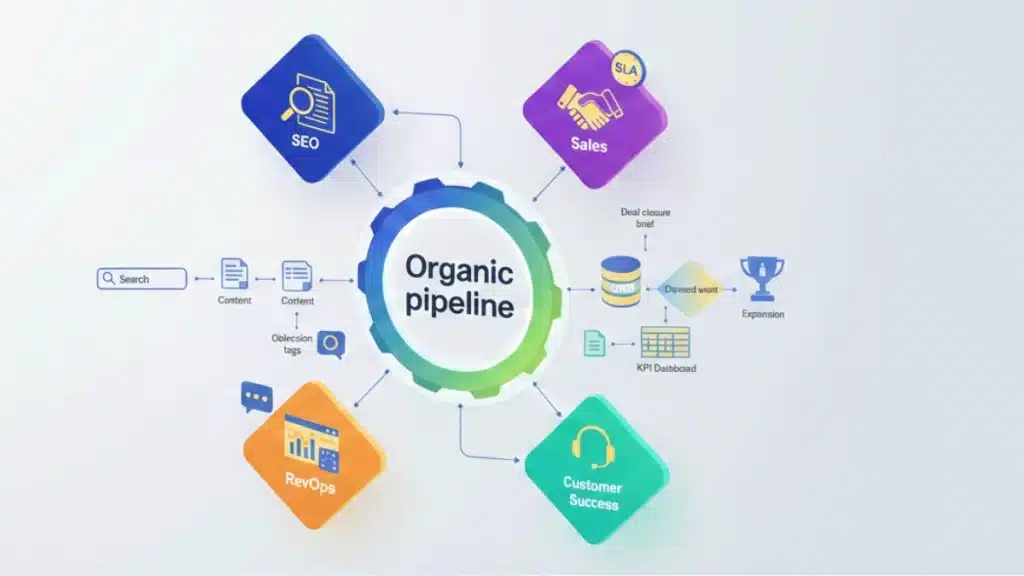
B2B SEO only aligns with sales and customer success when everyone optimizes for the same thing: qualified pipeline and account outcomes, not sessions. The goal of this operating model is to make organic the most reliable upstream signal and the most reusable source of assets across the entire revenue engine. Image by Siham and Gemini.
Reframe SEO as a pipeline engine, not a traffic channel
Define shared KPIs across SEO, Sales, CS and RevOps: contribution to qualified pipeline, opportunity rate by source, win rate, cycle length, expansion and renewal on organic-sourced accounts. Map your core SEO clusters to stages of the sales pipeline and the account lifecycle including education, problem framing, solution fit, risk mitigation, rollout, and expansion. Each content theme should have a clear job to be done for Sales and CS.
Document this mapping in your B2B SEO operating system alongside governance, roadmap and prioritization. For the complete framework that ties cross-functional alignment to execution, see: https://decaseo.com/how-do-you-build-a-b2b-seo-operating-system-that-your-organization-actually-executes/
This approach builds on quarterly planning described in Quarterly roadmap (Satellite 1) here: https://decaseo.com/how-do-you-create-a-quarterly-b2b-seo-roadmap-that-survives-real-world-constraints/
Make organic context visible inside the CRM
Most handoffs fail because marketing intent stays locked in analytics tools instead of following the account into the CRM. The fix is to standardize how organic context is captured and surfaced to SDRs, AEs and CSMs.
Create a mandatory organic context section in the CRM for any lead or contact whose first-touch or last-touch is SEO. Capture landing page, query theme, cluster, asset type, and key signals such as scroll depth or repeated visits. Link each SEO cluster and key page to a sales motion in the CRM, for example implementation risk, vendor comparison, or ROI justification. This connection allows reps to immediately know which playbook and talk track to use.
Use the decision-making unit work done in your persona and DMU mapping to structure CRM fields for role, business driver and risk sensitivity. For detailed needs analysis by profile, see Semantic mapping for the decision-making unit here: https://decaseo.com/semantic-mapping-for-the-decision-making-unit-dmu/
Align on what a good organic lead looks like
If SEO optimizes for volume while Sales optimizes for fit, friction is guaranteed. Alignment starts with a hard definition of qualified organic pipeline that all teams adopt.
Co-define with Sales and CS a shared ICP and qualification grid covering firmographics, pains, maturity, deal size, and risk profile. Tag those attributes on organic leads in the CRM. Review monthly which SEO-originated leads converted to opportunities and closed-won. Deprecate content or keywords that systematically attract poor-fit accounts, building on the traffic to revenue logic described in Data-driven performance: linking organic traffic to revenue here: https://decaseo.com/data-driven-performance-linking-organic-traffic-to-revenue/
Feed these learnings back into SEO prioritization framework (Satellite 3) to focus SEO efforts on themes that actually generate pipeline.
Build a clean handoff and feedback loop between SEO, Sales and CS
Once organic context is visible, the next failure point is handoff: who does what, when, and with which assets. You need explicit workflows, SLAs and playbooks that connect SEO with sales execution and customer activation.
Standardize the SEO to Sales handoff with SLAs
Organic leads should not be just another form fill. They carry rich intent that demands tailored follow-up. SLAs ensure that Marketing’s work is actually converted into conversations and pipeline.
Define a specific SLA for organic MQLs, for example first touch under 24 hours with a message referencing the exact content and pain addressed. Configure routing rules to assign organic leads to the right SDR or AE based on segment, cluster and expected motion such as new business, expansion, or strategic. Document these SLAs and escalation paths in SEO governance decision rights (Satellite 2) so they are visible and enforceable during pipeline committee reviews.
Nail the Sales to Customer success handoff
For B2B mid-market and enterprise, the real value of organic often plays out during onboarding, adoption and expansion, not just at the first deal. A structured Sales to CS handoff prevents expectation gaps and allows CS to reuse SEO assets to drive activation.
Use a standard deal closure brief template capturing business context, stakeholders, goals, risks, pricing and all content that influenced the deal including articles, comparison pages, and implementation guides. Make this brief a blocking step in the CRM workflow before a deal can be marked closed-won, with automatic task creation for the CSM and implementation lead.
Encourage CS to reuse the same assets consumed during the sales cycle as an onboarding path, linking to your SXO approach described in Search experience optimization: bridging the gap between search and retention here: https://decaseo.com/search-experience-optimization-sxo-bridging-the-gap-between-search-and-retention/
This reduces time-to-value and reinforces message consistency.
Turn objections and win/loss reasons into SEO briefs
Sales and CS sit on the highest-value dataset for SEO: real objections, frictions and jobs to be done expressed in buyer language. Without a system, this gold stays buried in call recordings and notes.
Standardize a small taxonomy of objections and reasons including pricing, integration, security, change management, adoption, and timing. Require SDRs, AEs and CSMs to tag them in the CRM and call intelligence tools. Export monthly an objections and win/loss report by segment and deal stage. Translate top patterns into prioritized briefs for SEO, UX and product marketing, connected to your ICE prioritization mechanics in SEO prioritization framework (Satellite 3).
Create objection hub SEO pages and dedicated resources covering pricing, security, implementation, and migration alternatives so buyers can self-resolve their doubts well before they arrive on a call.
Operationalize enablement, rituals and reporting around organic pipeline
Alignment doesn’t hold without rituals, tools and shared dashboards. This block aims to transform your strategy into a daily operating rhythm around organic, in line with the overall vision of your B2B SEO operating system: https://decaseo.com/how-do-you-build-a-b2b-seo-operating-system-that-your-organization-actually-executes/
Use SEO content as a structured enablement layer
Your best SEO assets should double as sales and CS enablement tools, not live only in the blog directory. That requires explicit mapping between content and plays.
Build a content for revenue catalog where every high-intent SEO asset is tagged by stage from awareness to renewal, persona, objection covered and recommended use such as pre-call, follow-up, QBR, or onboarding. Create a simple objection-to-asset matrix for SDRs, AEs and CSMs so each common objection has one to three recommended pages or resources to send.
Make these mappings easily accessible inside your CRM or sales engagement tool and connect key items back to your core cluster on performance: https://decaseo.com/data-driven-performance-linking-organic-traffic-to-revenue/
This reinforces the business case.
Establish recurring cross-team rituals
Week over week, alignment is maintained less by one-off workshops than by short, focused rituals with clear outcomes. These rituals should complement, not duplicate, the cadence defined in your quarterly roadmaps.
Run a monthly organic pipeline review bringing together SEO, Demand Gen, Sales leaders, CS leaders and RevOps to inspect lead mix, opportunity creation, win rates, and expansion on organic-sourced accounts. Use this meeting to validate or adjust quarterly priorities, escalate governance blockers through SEO governance decision rights (Satellite 2), and prioritize high-impact content topics for the next sprint through SEO prioritization framework (Satellite 3).
Complement this with bi-weekly pods or squad syncs pairing AE, CSM and marketer focused on a specific segment or region to surface field signals quickly and test new SEO and SXO assets.
Build an organic pipeline dashboard that RevOps owns
Without transparent reporting that everyone trusts, SEO will remain perceived as a nice to have rather than a pipeline engine. RevOps is the natural owner of a cross-functional view linking organic interactions to revenue outcomes.
Configure a shared dashboard showing at minimum: sessions and engaged sessions by SEO cluster, MQLs and SQLs from organic, opportunity creation rate, win rate, sales cycle, ACV and expansion or renewal on organic-sourced accounts. Add a content to revenue view that surfaces which specific URLs and queries are associated with the highest-value opportunities and retained revenue, aligned with the methodology described in: https://decaseo.com/data-driven-performance-linking-organic-traffic-to-revenue/
Use this dashboard as a central artifact in your B2B SEO operating system to demonstrate the clear link between SEO, pipeline and customer success, and to inform your budget and capacity decisions.
Next step
Establish your first monthly organic pipeline review within 30 days and use it to co-build the shared KPI dashboard with RevOps. Start with three core metrics: qualified pipeline from organic, win rate comparison by source, and expansion rate on organic-sourced accounts.