
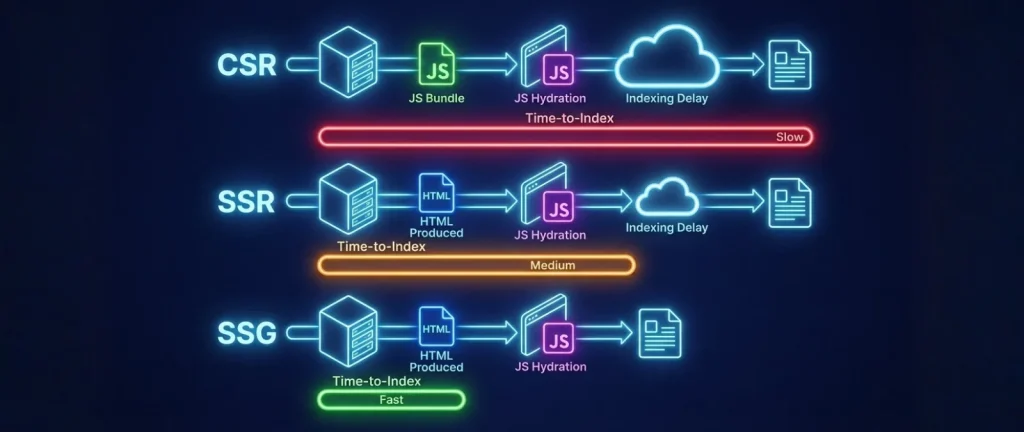
In B2B SEO, the “best” rendering strategy is the one that consistently delivers indexable HTML for your revenue-critical pages while staying maintainable for your product team.
In 2026, SSR/SSG tend to win for SEO pages because HTML is available immediately, crawling is more efficient, and time-to-index is typically faster than CSR-heavy setups that can hit rendering queue delays.
Definitions (only what you need)
- CSR (Client-Side Rendering): The browser builds most of the content via JavaScript after initial load.
- SSR (Server-Side Rendering): The server returns HTML already rendered for the route.
- SSG (Static Site Generation): HTML is generated ahead of time (build-time) and served fast and consistently.
The decision framework (by page type)
Use this rule: SEO landing pages should not depend on JS to “exist.”
- Money pages (solutions, industries, product, pricing, comparisons): Prefer SSR or SSG so content is indexable immediately and stable under load.
- Content hubs and editorial articles: Prefer SSG when possible (best consistency), or SSR if content is frequently personalized or assembled dynamically.
- Authenticated apps / dashboards: CSR is often fine because those pages typically shouldn’t be indexed anyway.
- Faceted listings / internal search: SSR can help, but you must control crawl waste; rendering won’t save you if you let infinite URL combinations explode.
Where teams get burned (indexing failure modes)
- “It renders in my browser” ≠ “it’s indexable”: if critical content arrives late or inconsistently, indexing becomes slower or partial.
- Mixed rendering across templates creates inconsistent HTML footprints, which complicates debugging crawl/index drops after releases.
- Performance variance (TTFB spikes, edge/origin inconsistency) can negate rendering wins by making even SSR pages unstable.
Operational checklist (ship safely)
- Ensure every SEO-critical URL returns meaningful HTML on first response (don’t require user interaction or delayed JS hydration for main content).
- Validate canonical, hreflang (if used), and internal links are present in the initial HTML for SSR/SSG templates.
- Monitor time-to-index after releases; if it worsens, review rendering strategy changes and server stability before changing content.
- Treat rendering changes like migrations: baseline templates, deploy with gates, and verify post-release crawling behavior.
What I’d deploy for a B2B SEO system (default architecture)
A practical default is: SSG for editorial + SSR for commercial templates, with CSR reserved for logged-in product surfaces.
This balances indexability, performance consistency, and engineering maintainability while reducing the risk of JavaScript rendering delays for SEO-critical pages.