
Core Web Vitals have become one of the clearest ways Google evaluates whether a page delivers a fast, stable, and responsive experience for real users across devices. When you treat Core Web Vitals as part of a broader technical SEO strategy that also covers overall site speed and mobile experience, they turn into a direct growth lever instead of just another compliance checklist.
What are Core Web Vitals in 2025?
Core Web Vitals are a set of user‑centric performance metrics that measure how quickly a page loads, how responsive it feels, and how visually stable it remains while users interact with it. [Google’s official documentation explains that these metrics are designed to capture real user experience rather than just technical page speed scores.]
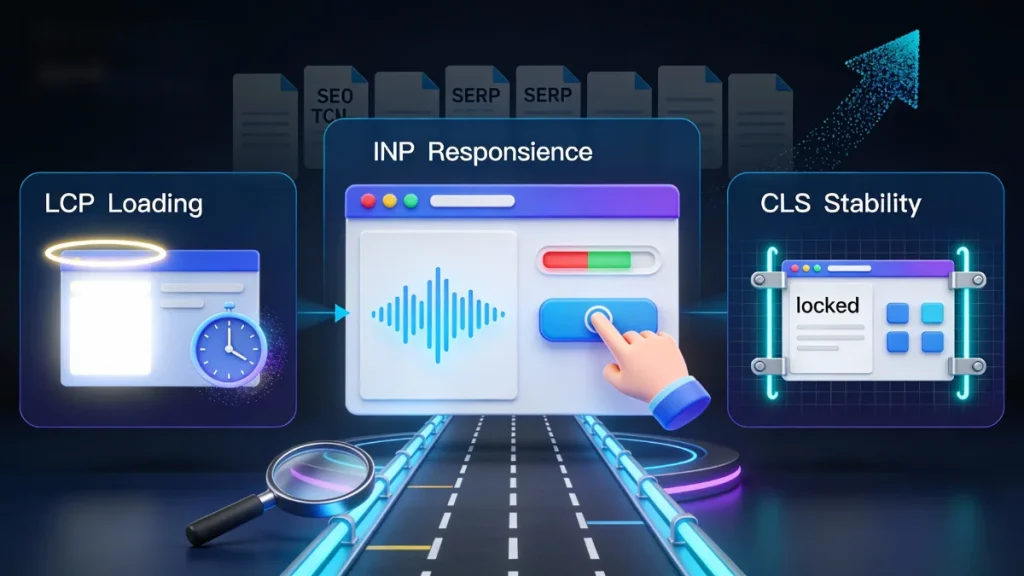
As of 2025, the three Core Web Vitals that matter for SEO are Largest Contentful Paint (LCP), Interaction to Next Paint (INP), and Cumulative Layout Shift (CLS), each with recommended thresholds that separate “good” pages from those that need improvement.
What are the current thresholds for LCP, INP, and CLS?
Largest Contentful Paint (LCP) measures how long it takes for the main content of a page to appear, with a “good” experience generally achieved when LCP occurs within about 2.5 seconds from when the page first starts loading.
Interaction to Next Paint (INP) has replaced First Input Delay as the responsiveness metric, and pages that respond to most user interactions within roughly 200 milliseconds are typically considered performant, while CLS values at or below 0.1 indicate that layout shifts are not likely to distract or frustrate users.
How do Core Web Vitals influence Google rankings?
Core Web Vitals are part of Google’s broader page experience signals, meaning they do not override relevance but act as a tiebreaker and competitive advantage between pages that answer the same query.
Sites that consistently meet or exceed the recommended thresholds for LCP, INP, and CLS tend to see better visibility in competitive SERPs, especially on mobile, because Google can trust that users will have a smoother, more satisfying experience.
Why are Core Web Vitals critical for mobile SEO?
On mobile devices, network conditions, CPU constraints, and interface limitations amplify any performance issue, making Core Web Vitals even more critical for retaining users.
Because Google primarily indexes and evaluates the mobile version of most sites, poor Core Web Vitals on smartphones can drag down rankings and organic traffic even if the desktop experience appears acceptable.
How do Core Web Vitals affect user behavior and conversions?
When a page loads quickly, responds immediately, and remains visually stable, users are more likely to stay, scroll, and complete high‑value actions such as form submissions or purchases.
Multiple industry studies show that even modest slowdowns in load time or responsiveness correlate with higher bounce rates and lower conversion rates, which means fixing Core Web Vitals often delivers a measurable uplift in revenue, not just better technical scores.
How can you measure Core Web Vitals reliably?
You can measure Core Web Vitals using both lab tools and field data, with lab tools like Lighthouse and PageSpeed Insights helping you debug issues and field data from the Chrome User Experience Report and Search Console showing how real users experience your pages.
Combining synthetic tests with real‑user monitoring gives you a more complete picture, allowing you to prioritize fixes on the templates and page types that have the highest traffic and business impact.
What are the most common issues that hurt Core Web Vitals?
For LCP, common problems include unoptimized hero images, render‑blocking CSS and JavaScript, and slow server responses, all of which delay the visible content from appearing.
For INP and CLS, heavy client‑side JavaScript, poorly managed third‑party scripts, late‑loading fonts, and dynamically injected elements without reserved space are frequent culprits that cause sluggish interactions and jarring layout shifts.
Why should B2B and B2C brands prioritize Core Web Vitals now?
In both B2B and B2C, buyers and consumers expect pages to feel instant and stable, and they quickly abandon sites that do not meet that expectation.
For brands investing heavily in acquisition, failing Core Web Vitals means paying to drive traffic to experiences that leak users before they ever convert, which weakens ROI across SEO, paid media, and email campaigns.
To deepen your understanding of how Core Web Vitals fit into a complete Technical SEO strategy for speed, mobile experience, and performance, refer to the main pillar article.