
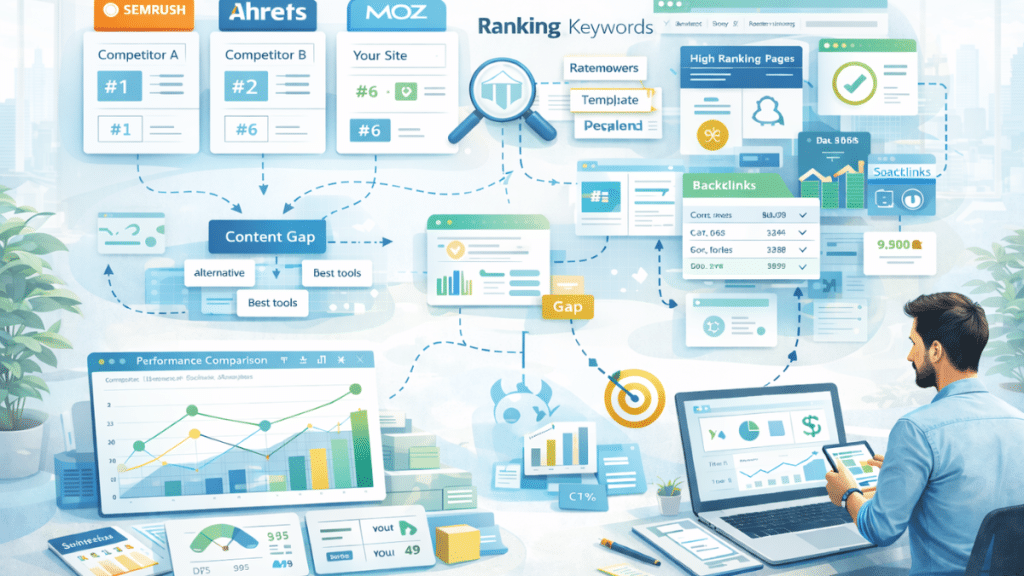
What is a competitive SEO analysis?
A competitive SEO analysis is the process of evaluating your competitors’ search performance to understand their strengths, weaknesses, and the strategies that drive their visibility. This analysis reveals opportunities you can leverage to outperform them. It aligns with the broader methodology presented in our SEO audit and competitive analysis hub, supporting a complete, data-driven approach to growth.
Why does competitive SEO analysis matter?
Competitive SEO analysis matters because the search landscape is relative. Your performance depends not only on your own actions but also on what competitors are doing. When you understand how others achieve rankings—content strategy, backlink profile, technical strengths—you uncover opportunities they missed. Experience shows that companies conducting structured competitor analysis often capture market share faster and more reliably.
How to identify your real SEO competitors?
Your real SEO competitors are not always your direct business rivals—they are the sites ranking for the keywords you want to own.
Steps to identify them:
- Enter your core keywords into Semrush, Ahrefs, or Moz
- Analyze “SERP Competitors” or “Organic Competitors”
- Prioritize websites with overlapping keywords
- Exclude irrelevant massive domains (Wikipedia, Pinterest), unless they control key positions
- Map 5–10 realistic competitors for deep analysis
This ensures your strategy is based on accurate SERP dynamics rather than assumptions.
How to analyze competitor keyword strategy?
Keyword analysis reveals competitors’ content priorities and growth ambitions.
Focus on:
- High-ranking keywords with stable positions
- Keywords where they recently gained visibility
- Long-tail or intent-rich queries they dominate
- Pages generating the most traffic
- Keyword cannibalization patterns
- Featured snippet ownership
Tools such as Ahrefs’ Top Pages or Semrush’s Organic Research provide reliable insights.
This helps you identify opportunities where your content can outperform theirs.
How to study competitor content quality and structure?
Content is often the primary driver of rankings. Compare their structure with yours to understand what Google favors.
Evaluate:
- Content depth (word count, structure, subtopics)
- Use of FAQ blocks, lists, or tables
- Level of expertise demonstrated
- SERP intent alignment
- Freshness and update frequency
- Rich media: images, charts, videos
- Internal linking cohesiveness
- Schema markup implementation
Experience shows that well-structured, frequently updated content outperforms older formats—even on high-authority websites.
How to assess competitor backlink profiles?
Backlinks reveal how competitors build authority. Examine:
- Referring domains
- DR/DA levels
- Link types (editorial, resource lists, guest posts)
- Anchor text distribution
- Toxic link patterns
- Link velocity trends
Questions to ask:
- Which pages attract the most links?
- What content formats generate natural backlinks?
- Do they use case studies or data-driven reports?
- Are there high-authority domains linking to them but not to you?
This analysis fuels link-gap strategies that complement insights from the Backlink Audit satellite.
How to evaluate competitor technical strengths?
Technical performance often impacts rankings more than expected.
Audit competitor technical indicators:
- Core Web Vitals (PageSpeed Insights comparisons)
- Mobile-friendliness
- URL structure and site depth
- Rendering behavior (JS-heavy vs. static)
- Internal link distribution
- Search Console performance proxies (via SERP behavior)
A technically superior competitor may outrank you even with weaker content. This step is crucial for identifying performance gaps.
How to detect competitor content gaps?
A content gap analysis uncovers topics competitors cover that you do not—but should.
Look for:
- Subtopics missing from your own cluster
- Comparison keywords (“vs.”, “best tools”, “alternatives”)
- High-intent searches (pricing, templates, audit checklists)
- Long-tail questions in People Also Ask
- Industry events or trends they cover faster than you
These gaps are high-priority opportunities, especially when aligned with your topic clusters.
How to use competitor insights to build a growth strategy?
Turn competitive findings into a roadmap:
Strategic priorities:
- Create or improve pages where competitors dominate SERPs
- Refresh outdated content to match competitor depth
- Strengthen internal linking around low-performing clusters
- Acquire backlinks from domains linking to multiple competitors
- Create unique assets (data reports, templates) competitors lack
- Target featured snippet opportunities they haven’t secured
This approach pairs well with high-level strategic planning seen in the Stratégie Digitale pôle.
How to avoid copying competitors blindly?
Competitive analysis should inspire—not dictate—strategy.
Avoid:
- Blindly mirroring content structure
- Targeting competitor keywords without intent validation
- Chasing volume without considering difficulty
- Over-optimizing anchor text to match competitors
- Replicating flawed backlink strategies
Your differentiation, not imitation, drives long-term authority.
A competitive SEO analysis helps you identify opportunities competitors miss—and weaknesses you can exploit. When integrated with technical, content, and backlink audits, it creates a complete picture of your growth potential.