
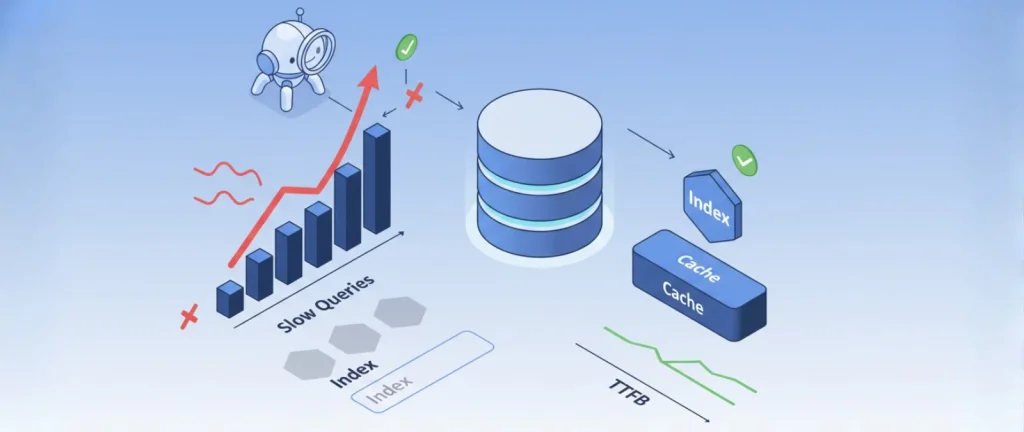
A CDN/edge layer is not “just faster static files” it’s an infrastructure control plane that can stabilize delivery, reduce TTFB variance, and protect crawling/indexing reliability across regions.
In 2026, the SEO win comes less from shaving milliseconds in the lab and more from making performance consistent for users and Googlebot under real traffic conditions.
When a CDN is an SEO lever (and when it isn’t)
A CDN becomes an SEO lever when your audience (and Googlebot) hits your site from multiple geographies and your origin response is variable, because the edge reduces round trips and absorbs spikes.
If your bottleneck is purely server-side compute or database queries on dynamic pages, a CDN alone won’t fix it you need caching strategy + origin optimization.
What edge computing changes for SEO (practical view)
Edge can improve SEO by stabilizing TTFB, reducing errors, and improving crawl efficiency at scale when the setup caches assets (and sometimes selected HTML) and enforces SEO-safe redirects/headers at the edge.
Done right, it reduces performance volatility across regions, which helps Core Web Vitals stability and keeps crawling predictable.
The 80/20 setup (what to configure first)
- Caching policy: Cache static assets aggressively; for HTML, cache only what is safe (public pages, correct vary rules, no personalization leaks).
- Origin protection: Use the CDN to reduce origin hits during peaks (rate limiting/bot management if relevant) so TTFB spikes don’t appear under load.
- Header hygiene: Ensure consistent cache-control, content-type, and response behavior across edge and origin to avoid “sometimes fast, sometimes slow” delivery.
- Redirect discipline: Keep redirects deterministic (no chains, no geo surprises) because redirect complexity wastes crawl budget.
SEO failure modes to avoid (the stuff that breaks indexing)
The biggest risks come from caching the wrong thing (serving mismatched HTML), inconsistent headers between edge and origin, or accidental redirect/canonical behavior changes.
Treat edge rules like code: version them, test them on a staging-like environment, and validate critical templates before rollout.
Quick audit: “Do we have an edge problem or an origin problem?”
If TTFB is bad mostly in distant regions, edge/CDN is often the fastest first fix.
If TTFB is bad everywhere and worsens on DB-heavy templates, the bottleneck is usually origin compute/database, and you should prioritize backend + query/caching work first.