
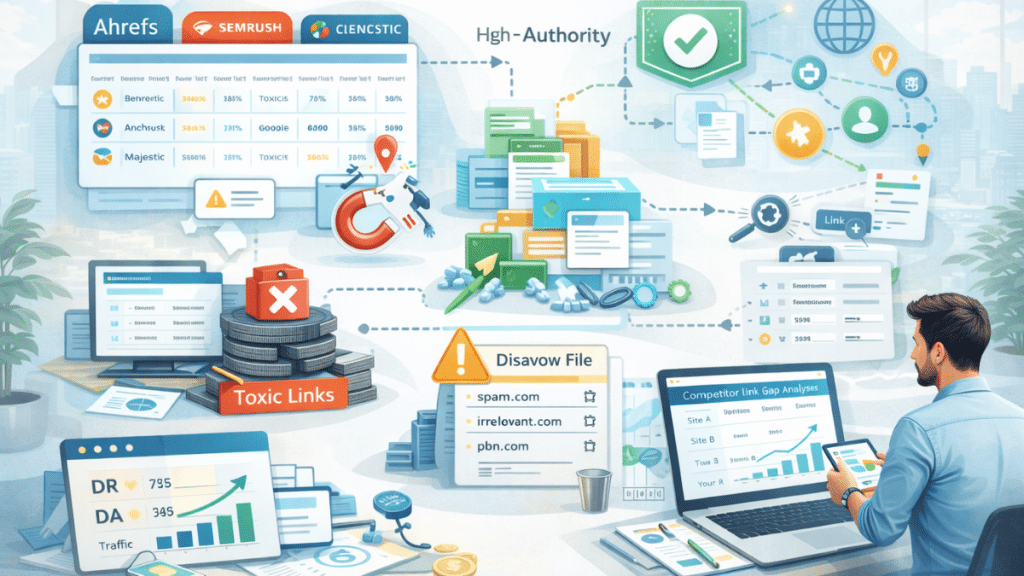
What is a backlink audit?
A backlink audit is the process of evaluating the quality, relevance, and trustworthiness of all external sites linking to your domain. Its goal is to detect toxic links, measure authority signals, and uncover new link-building opportunities. This assessment is a core part of the broader methodology detailed in our SEO audit and competitive analysis hub, ensuring your off-page profile supports sustainable long-term growth.
Why does a backlink audit matter for SEO?
A backlink audit matters because backlinks remain one of the strongest ranking signals in search. Good links improve authority and trust; toxic or irrelevant links damage credibility, impact rankings, or trigger algorithmic suppression. Experience shows that companies performing regular backlink audits reduce volatility after algorithm updates and maintain stronger visibility in competitive SERPs.
How to extract your full backlink profile?
Start by exporting your backlink data from Ahrefs, Semrush, Majestic, or Google Search Console. Consolidate all sources into a single spreadsheet to avoid blind spots. Include URLs, anchor texts, domain ratings, link types, first-seen dates, and toxicity scores.
Recommended data points to collect:
- Referring domains
- Domain Authority (DA/DR)
- Anchor text distribution
- Follow vs nofollow ratios
- Link velocity (acquisition speed)
- Linking page context
- Toxicity or spam scores
A complete baseline ensures that the audit is grounded in real, actionable data.
How to identify toxic or harmful links?
Toxic links originate from spammy, irrelevant, or manipulative sources. These links can negatively impact your authority or trigger penalties.
Indicators of potentially harmful links:
- Links from irrelevant or unrelated niches
- Links from deindexed or penalized domains
- Excessive exact-match anchor text
- Links from low-quality directories
- Sitewide links from suspicious networks
- Hidden links or automated blog networks (PBNs)
- Sudden spikes in backlink velocity
Tools such as Semrush’s Toxic Score or Ahrefs’ Spam indicators help flag risk levels.
We recommend manual review before making disavow decisions.
How to evaluate backlink relevance and authority?
Relevance and authority matter more than raw volume. Prioritize backlinks from websites aligned with your industry, content, and target audience.
Assess relevance by asking:
- Does the linking site cover a related topic?
- Is the linking page contextually aligned with your content?
- Does the anchor text reflect the target page accurately?
Assess authority using:
- DR/DA (Ahrefs/Moz)
- Organic traffic estimates
- Page-level authority metrics
- Editorial quality
High-authority, contextually aligned links carry the most weight and support stable ranking growth.
How to analyze anchor text distribution?
Anchor text provides search engines with context about your page. An unbalanced anchor profile—especially with over-optimized exact-match phrases—can appear manipulative.
Healthy anchor text distribution should include:
- Branded anchors (majority)
- Partial-match anchors
- Generic anchors (“learn more”, “website”)
- Exact-match anchors (used sparingly)
Experience shows that businesses with natural anchor profiles are less exposed to volatility during major search updates.
How to audit lost and broken backlinks?
Lost backlinks represent missed opportunities. Identify pages that previously linked to you and check whether the links were removed due to content changes, HTTP errors, redesigns, or outdated references.
Steps to restore value:
- Identify 404 pages with external links
- Set proper 301 redirects
- Re-reach out to webmasters when links were removed
- Recover broken backlinks through updated content
Restoring lost links often improves authority faster than acquiring new ones.
How to identify backlink gaps and competitor opportunities?
A backlink audit isn’t only about identifying risks—it is also about uncovering growth opportunities.
Use Ahrefs’ or Semrush’s “Link Gap” features to compare your backlink profile with top-ranking competitors.
Look for:
- Domains linking to multiple competitors but not to you
- High-authority sites in your niche
- Resource pages or industry directories
- Publications that frequently cover your competitors
This helps build a targeted link acquisition strategy that complements insights from our Competitive SEO Analysis satellite.
How to build a safe disavow file?
If harmful links pose a risk, prepare a disavow file. However, disavowing should be a last resort, not a default action.
We recommend:
- Only disavow clearly harmful patterns
- Keep documentation for each link removed
- Upload the file via Google Search Console
- Review every 3–6 months
A thoughtful approach avoids unintended loss of authority.
How to turn audit insights into a link building strategy?
Transform audit findings into clear actions that strengthen authority:
Strategies include:
- Refresh high-value content to earn links naturally
- Pitch insights, data, and guides to relevant publications
- Build hub pages that attract passive links
- Strengthen internal linking to reinforce authoritative pages
- Develop partnerships or co-marketing opportunities
Link-building grounded in data—and aligned with your topic clusters—produces more consistent long-term value.
A backlink audit helps protect your site from harmful links and unlocks new authority opportunities. When aligned with technical and content audits, it forms a comprehensive visibility strategy.