
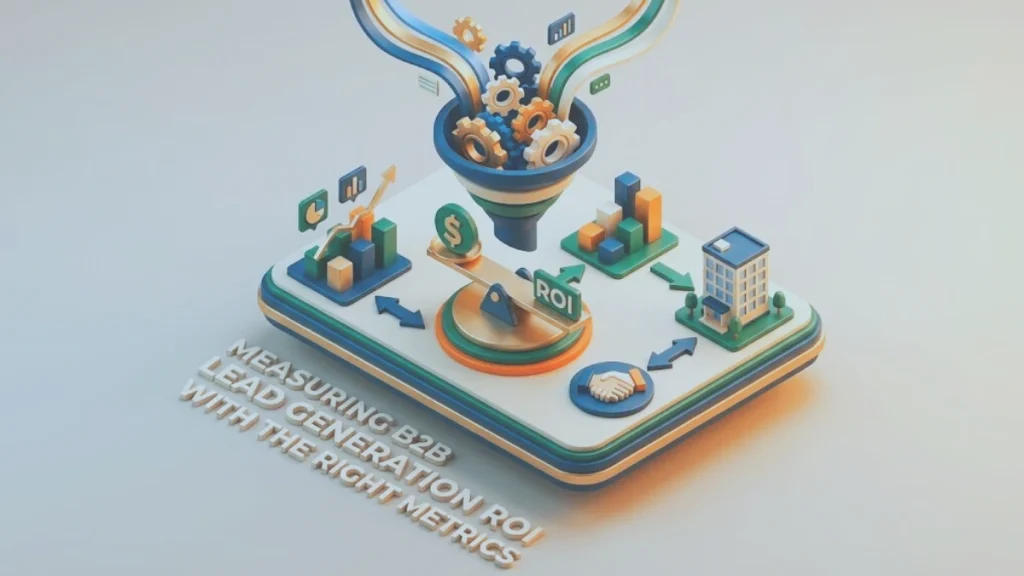
Measuring B2B lead generation ROI requires tracking the metrics that reflect true revenue impact, not vanity results. ROI improves when companies measure performance across the entire funnel from initial engagement to closed revenue using data that reflects buyer intent, pipeline velocity, and acquisition efficiency.
Why measuring ROI is essential for scaling B2B lead generation
Companies that do not measure ROI accurately cannot optimize budget allocation, forecast pipeline, or identify the channels that produce the best customers. ROI becomes the truth behind acquisition performance.
Direct answer:
Measuring ROI is essential because it reveals which channels generate revenue, which waste budget, and where to invest for predictable growth.
Without clear metrics, teams rely on assumptions instead of evidence. This leads to inconsistent acquisition, low conversion rates, and misaligned expectations.
Our [B2B lead generation strategies framework] positions ROI measurement as a core lever in scaling acquisition across channels.
What are the most important metrics for B2B lead generation?
Modern B2B acquisition requires more than tracking leads or clicks. You need metrics that reflect commercial outcomes.
Direct answer:
The most important B2B lead generation metrics are those tied to revenue, intent, efficiency, and progression through the funnel.
Key ROI metrics include:
1. Cost Per Lead (CPL)
Baseline indicator of acquisition efficiency.
But CPL alone is not enough cheap leads often convert poorly.
2. Cost per SQL / Cost per Opportunity
More reliable for B2B
because they reflect true sales readiness.
3. Lead to SQL Conversion Rate
Measures qualification quality and the real effectiveness of your channels.
4. SQL to Opportunity Rate
Reveals whether leads truly match ICP and pain intensity.
5. Pipeline contribution per channel
Shows which channels generate serious opportunities.
6. Customer Acquisition Cost (CAC)
Critical for understanding ROI in later stages.
7. Customer Lifetime Value (CLV / LTV)
Helps benchmark long term profitability.
How to track ROI across the entire funnel
ROI improves when data is measured across multiple intent milestones, not just first touch or last touch.
Direct answer:
Track ROI across the entire funnel using intent based milestones that reflect real buyer progression.
Funnel based ROI measurement:
• TOFU metrics: engagement, content depth, visit quality
• MOFU metrics: downloads, repeat visits, webinar sign ups
• BOFU metrics: demo requests, pricing interactions, sales engagement
• Sales metrics: SQL acceptance, win rates, deal size
• Revenue metrics: CLV, CAC, payback period
This structure aligns with the funnel optimization principles discussed in optimizing conversion funnels for B2B growth.
What attribution models work best for B2B?
Attribution determines how you credit each touchpoint. Multi touch attribution provides a more realistic view of buyer behavior.
Direct answer:
Use multi touch attribution to understand which channels contribute meaningfully to revenue across the journey.
Best attribution models in B2B:
• Position Based (best for long cycles)
• Linear Multi Touch (balanced insight)
• Time Decay (weights later-stage intent)
• W Shaped (captures key milestones)
Avoid relying solely on first touch or last touch they distort decision making and underrepresent high value touchpoints like webinars or BOFU content.
How to calculate true B2B lead generation ROI
ROI must reflect total investment, total pipeline generated, and actual closed revenue.
Direct answer:
Calculate ROI by comparing total revenue generated against total acquisition costs across channels and campaigns.
Formula:
ROI = (Revenue – Cost) / Cost
However, a more strategic version includes:
Pipeline ROI (opportunity-level)
Channel ROI (channel-level)
Lifecycle ROI (full-funnel view)
Teams that incorporate all three gain a complete understanding of acquisition profitability.
Which tools help measure B2B ROI more accurately?
ROI tracking depends on reliable data infrastructure.
Direct answer:
Use integrated analytics, CRM, and attribution tools to track true ROI across the funnel.
Top Tool Categories:
• CRM: HubSpot, Salesforce
• Attribution: Hyros, Dreamdata
• Analytics: GA4, Matomo
• Automation + scoring: Marketo, HubSpot
• Revenue intelligence: Gong, Clari
Tools matter but tracking rigor matters more.
How to improve ROI through continuous optimization
ROI is not a static metric. It evolves based on optimization cycles.
Direct answer:
Improve ROI through iterative experimentation, better targeting, and tighter qualification processes.
Top ROI levers include:
• reducing unqualified lead volume
• improving scoring accuracy
• optimizing landing pages
• investing in high performing channels
• eliminating underperforming campaigns
• refining persona alignment
High ROI systems operate on continuous iteration and feedback loops.
The next logical step in mastering B2B acquisition
Once ROI measurement is solid, the next step is to revisit foundational strategy. Continue with our guide on what is B2B lead generation, which provides the fundamentals behind building a predictable acquisition engine.