
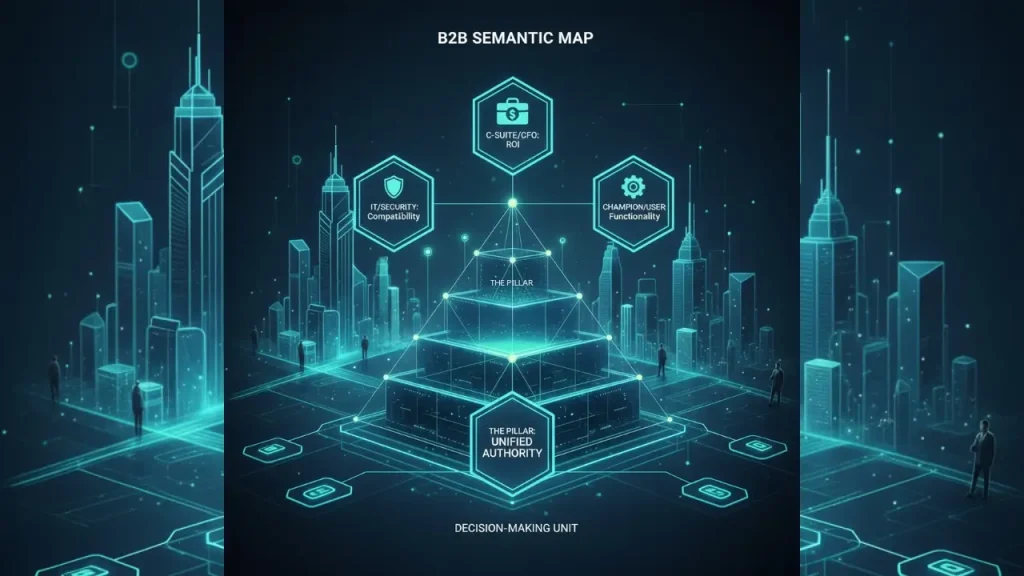
A robust B2B SEO strategy must transcend individual keyword targeting to address the collective intelligence of the Decision-Making Unit (DMU). In the institutional buying journey, content must serve as a bridge between diverse stakeholders, each carrying unique technical requirements and financial constraints. This module outlines the methodology for mapping semantic intent across the entire organizational hierarchy to ensure uncontested thematic authority.
What is the role of the Decision-Making Unit (DMU) in B2B SEO?
The DMU is a group of stakeholders typically ranging from 5 to 11 individuals responsible for evaluating and approving enterprise-level investments. In SEO terms, this means a single “purchase” is preceded by multiple search journeys from different personas. If your content only speaks to the end-user (the “Champion”) but ignores the IT Director or the CFO, the search engine will perceive a lack of depth, and the conversion path will be blocked by internal friction.
How does the DMU influence the “Information Gap” in search?
Each member of the DMU searches to fill a specific “Information Gap.” The Champion seeks functional efficiency, the IT Gatekeeper seeks security and compatibility, and the Executive Sponsor seeks ROI and strategic alignment. A successful semantic map covers all these gaps, ensuring your domain is recognized as the Single Source of Truth for every stakeholder involved in the transaction.
How to construct a semantic map for multiple B2B personas?
Constructing a semantic map requires segmenting your keyword research based on the specific pain points and search behaviors of each stakeholder. This ensures that explored in: B2B vs B2C: Algorithmic Dichotomy and Intent Analysis, is addressed through targeted, high-value content.
What are the primary search intent categories for the DMU?
| Persona | Primary Focus | Search Intent Example | Content Asset Type |
| The Champion | Functionality & Ease of Use | “How to automate [Process] with [Tool]” | Technical Tutorials / Pillar Pages |
| IT/Security | Compatibility & Risk | “[Tool] API documentation security” | White Papers / Security Specs |
| Procurement | Cost & Compliance | “[Tool] pricing models comparison” | Pricing Guides / TCO Tables |
| Executive/CFO | ROI & Business Impact | “Business case for [Technology] in 2026” | Executive Summaries / ROI Calculators |
Why is “Search Intent Sequencing” vital for B2B conversion?
Search Intent Sequencing is the strategic arrangement of content to guide different stakeholders through their respective journeys simultaneously. Because B2B cycles are long and non-linear, your internal linking must allow a technical researcher to easily pass authoritative “proof” to their financial superiors.
How do Topic Clusters facilitate stakeholder alignment?
By using the [Topic Cluster model]{Satellite 5}, you create a web of authority where a technical “how-to” satellite article links back to a high-level strategic pillar. This architecture allows search engines to see the connectivity between technical expertise and business value, boosting the overall E-E-A-T of the entire cluster.
How does semantic mapping impact technical performance?
A well-mapped semantic strategy informs the site’s Information Architecture (IA). When search engines crawl a logically organized site where content is segmented by stakeholder intent, they can more efficiently distribute Crawl Budget to high-value pages. This technical efficiency is a prerequisite for the Technical Foundation as a Trust Signal that we will examine in the next module.
Sources and References (Strategic Verification)
To validate the complexity of the DMU and the necessity of multi-persona mapping, the following institutional sources were utilized:
- Gartner (2024): New B2B Buying Journey and the role of the DMU.
- Verification Query: https://www.google.com/search?q=gartner+B2B+buying+journey+complex+2023+report
- Forrester Research: B2B Content Strategy and Persona Mapping for 2025.
- Google Think B2B: Identifying the “Shadow” Decision-Makers in Search.
- Verification Query: https://www.google.com/search?q=google+think+b2b+search+intent+personas