
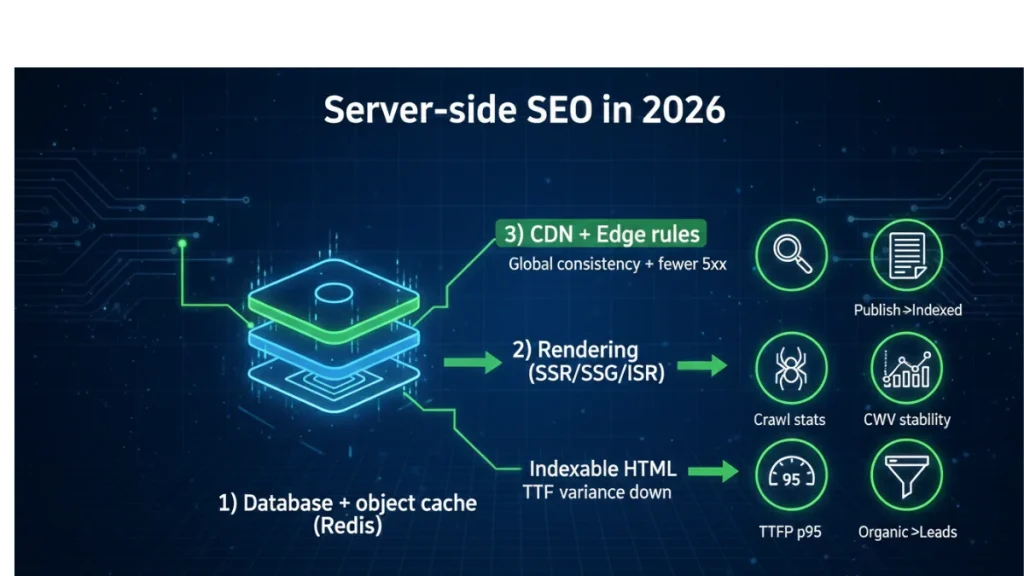
Server configuration impacts SEO rankings in 2026 because it controls how fast Googlebot can fetch your URLs, how reliably pages render (for users and crawlers), and how stable your Core Web Vitals remain under load. In practice, server-side performance is the difference between a site that gets crawled deeply and indexed fast, and a site that “bleeds” crawl budget through latency, errors, and inconsistent delivery.
If Cluster 1 was about front-end outcomes (LCP/INP/CLS), Cluster 2 is about the infrastructure that makes those outcomes repeatable at scale. Your fastest design can still rank poorly if the origin server is unstable, the database is overloaded, or rendering requires expensive work on every request.
The 2026 ranking reality: Google rewards stability, not just peak speed
Google doesn’t need your homepage to load in 0.8 seconds once. It needs your site to respond predictably across:
- Peak traffic bursts (campaigns, PR spikes, seasonal demand).
- Crawling bursts (Googlebot fetching hundreds/thousands of URLs).
- Multiple geographies (users + crawler locations).
- Mobile-first constraints (higher latency, lower CPU).
When server response time fluctuates, Googlebot becomes conservative. Crawl rate drops, deep URLs get discovered later, and new pages take longer to index. This is why reducing TTFB and error variance matters more than chasing an “A” Lighthouse score on a single test run. [[What is server response time (TTFB) and why it matters for SEO rankings?]]
The real server-side bottlenecks behind poor rankings
Most ranking losses blamed on “content” are actually infrastructure friction. The common pattern looks like this:
- Slow database paths → spikes in TTFB and timeouts on long-tail templates. [[How database optimization prevents SEO performance bottlenecks]]
- Misconfigured server behavior → redirect chains, weak caching, inconsistent headers, more wasted crawling. [[How to optimize server configuration for faster crawling and indexing]]
- No edge layer → international latency inflates response time and makes Core Web Vitals inconsistent by region. [[CDN and edge computing: How distributed infrastructure boosts SEO performance]]
The result is an “expensive-to-crawl” website. And when crawling is expensive, indexing becomes selective.
The problem: why “good content” underperforms on unstable infrastructure
In B2B, rankings are rarely lost because one page is “not optimized.” They’re lost because the site becomes inconsistent at scale. The same URL can be fast at 10am, slow at 2pm, and time out during a crawl burst. From Google’s perspective, that’s not a content issue—it’s a reliability issue.
Three mechanisms explain most server-side ranking underperformance in 2026:
- Crawl budget dilution: When each URL takes longer to fetch or fails intermittently (timeouts/5xx), Googlebot crawls fewer pages per session and revisits important pages less frequently. That slows discovery of deep pages and delays index refresh, even if the content is excellent. [[How to optimize server configuration for faster crawling and indexing]]
- Rendering friction: If your rendering model depends on heavy server computation (slow SSR, expensive API calls, unoptimized middleware), the time “to useful HTML” increases. That shows up as higher TTFB or unstable LCP/INP, especially on mobile. [[Client-side vs server-side rendering: Which SEO strategy wins in 2026?]]
- Regional inconsistency: A single origin without edge distribution creates a “distance tax.” Users (and crawlers) far from the origin experience higher latency, inflating TTFB and making Core Web Vitals inconsistent by geography. [[CDN and edge computing: How distributed infrastructure boosts SEO performance]]
The solution model: turn server-side performance into an indexing advantage
A practical server-side SEO strategy in 2026 is not “make it faster.” It’s a layered reliability model.
Layer 1 — Control TTFB variance (not only median)
Aim for predictable response behavior under load by removing the biggest variance drivers:
- Query spikes from database-heavy templates and cache misses. [[How database optimization prevents SEO performance bottlenecks]]
- Connection overhead (no keep-alive reuse) and inefficient compression or headers. [[How to optimize server configuration for faster crawling and indexing]]
Layer 2 — Make rendering crawl-friendly by design
Pick the rendering approach that makes your critical pages immediately indexable, then reduce server work per request:
- Use SSR/SSG/ISR for content and landing pages where SEO matters. [[Client-side vs server-side rendering: Which SEO strategy wins in 2026?]]
- Reserve CSR for authenticated app experiences where indexing is not the goal. [[Client-side vs server-side rendering: Which SEO strategy wins in 2026?]]
Layer 3 — Add an edge reliability layer
Use CDN + edge to stabilize performance across countries and protect the origin during spikes:
- Cache static assets aggressively and HTML selectively. [[CDN and edge computing: How distributed infrastructure boosts SEO performance]]
- Enforce canonical redirects and consistent headers at the edge to reduce crawl waste. [[CDN and edge computing: How distributed infrastructure boosts SEO performance]]
The playbook: what to audit, fix, and monitor (server-side SEO in 2026)
This is the operational sequence used to turn server-side performance into a repeatable ranking advantage, without “random optimizations.”
1) Audit what Googlebot actually experiences
Most teams test one page in one location. That’s not how crawling works.
- Segment performance by template: homepage, content page, category/facet page, product page, search results page.
- Segment by geography/device: mobile + international latency often exposes bottlenecks that desktop tests hide.
- Track failures, not only speed: timeouts and 5xx during crawl bursts are crawl killers, even if averages look acceptable.
Internal references:
- [[Technical SEO Audit: Step-by-Step Guide]]
- [[What is server response time (TTFB) and why it matters for SEO rankings?]]
- Google crawling & indexing documentation
2) Fix the highest-leverage bottleneck first (database → server → edge)
A reliable order prevents regressions.
A. Database hotspots (stability layer)
- Add indexes based on real query filters/sorts.
- Reduce query count (remove N+1 patterns).
- Implement object caching for repeated blocks (menus, taxonomies, related content).
Reference: [[How database optimization prevents SEO performance bottlenecks]]
B. Server configuration (crawl efficiency layer)
- Keep-alive tuned for connection reuse.
- Brotli for text assets; consistent cache headers.
- Single-hop redirects (301) and clean canonical behavior.
Reference: [[How to optimize server configuration for faster crawling and indexing]]
C. CDN + edge (global consistency layer)
- Cache static assets aggressively; cache HTML selectively.
- Edge rules: canonical host, trailing slash normalization, header consistency.
- Rate-limit abusive bots without blocking legitimate crawlers.
Reference: [[CDN and edge computing: How distributed infrastructure boosts SEO performance]]
3) Choose a rendering strategy that supports indexing speed
Rendering isn’t a front-end preference; it’s an indexing decision.
- Use SSR/SSG/ISR for pages that must rank (content, landing pages, catalogs).
- Keep CSR for authenticated app experiences where SEO is irrelevant.
Reference: [[Client-side vs server-side rendering: Which SEO strategy wins in 2026?]]
KPIs that prove the infrastructure is helping rankings
Track these as a system (not one metric in isolation):
- Publish → indexed time for new pages.
- Crawl stats trend: crawl requests/day, average response time, error rate.
- TTFB distribution (median + p95/p99) to measure variance collapse.
- CWV stability by country/device (reduced volatility matters).
- Business impact: organic → leads → revenue attribution. [[How to Measure B2B Lead Generation ROI with the Right Metrics]]
Where most teams get it wrong (and how to avoid it)
- Optimizing Lighthouse scores while ignoring crawl failures and p95 response time.
- Caching HTML too aggressively (risk of wrong indexing if content is personalized).
- Fixing edge/CDN before fixing database hotspots (you “hide” the issue, then it returns).
- Picking CSR for SEO-critical pages and assuming Google will “figure it out.”
CTA (neutre, éducatif)
Explore the supporting implementation guides to execute each layer safely: [[What is server response time (TTFB) and why it matters for SEO rankings?]] and [[How to optimize server configuration for faster crawling and indexing]].